Contents
- 1 Where They Agree — and Where They Don’t
- 2 Why Two Tools Agree on One Site and Diverge on Another
- 3 How Each Metric Is Actually Calculated
- 4 The Key Differences, Side by Side
- 5 The Organic Traffic Factor — Why It Changes Everything
- 6 When the Scores Diverge — What It Signals
- 7 Which One Should You Actually Use?
- 8 A Note on Both Being Third-Party Metrics
- 9 Semrush Plans That Include Authority Score
- 9.1 SEO Classic Plans
- 9.2 Semrush SEO Free Trial ( Pro & Guru )
- 9.3 Semrush One Plans
- 9.4 Semrush One Free Trial
- 9.5 Semrush One Free Trial
- 9.6 Semrush Pro & Guru Free Trial
- 9.7 Frequently Asked Questions
- 9.8 What is the difference between Semrush Authority Score and Moz Domain Authority?
- 9.9 Can a site have a high Moz DA but a low Semrush Authority Score?
- 9.10 Which is more accurate — Semrush Authority Score or Moz Domain Authority?
- 9.11 Does Moz DA factor in organic traffic?
- 9.12 Why do Semrush and Moz show different scores for the same website?
- 9.13 Should I use Semrush or Moz for link prospecting?
- 9.14 Is Moz Domain Authority still relevant?
- 10 The Bottom Line
- 11 All Semrush Toolkits — Quick Overview
Same domain. Two tools. Two completely different numbers.
If you’ve ever run the same website through Semrush and Moz and wondered why the scores don’t match, you’re asking exactly the right question. Most people assume these metrics measure the same thing under different branding. They’re not. The methodologies diverge in ways that actually matter for how you use them.
Quick Answer: Semrush Authority Score and Moz Domain Authority both measure domain-level SEO strength on a 0–100 scale, but they calculate it differently. Semrush factors in organic traffic and spam signals alongside backlinks, while Moz DA is primarily link-based. This means the same site can score notably higher on one platform than the other — and knowing why helps you choose the right metric for the right job.
After running both tools across client projects over the years, I’ve found they’re not interchangeable. They answer slightly different questions. And using the wrong one for the wrong task can send your link-building strategy in the wrong direction.
Where They Agree — and Where They Don’t
Both metrics share the same basic premise: a domain’s SEO strength can be estimated using third-party data and expressed as a number between 0 and 100. Both are comparative tools — not absolute scores. Neither is used directly by Google. Both work best when benchmarked against competitors rather than chased as targets.
That’s roughly where the similarities end.
The moment you look at the same domain in both tools, real differences can appear — but not always. Take two live examples, both checked on May 24, 2026.
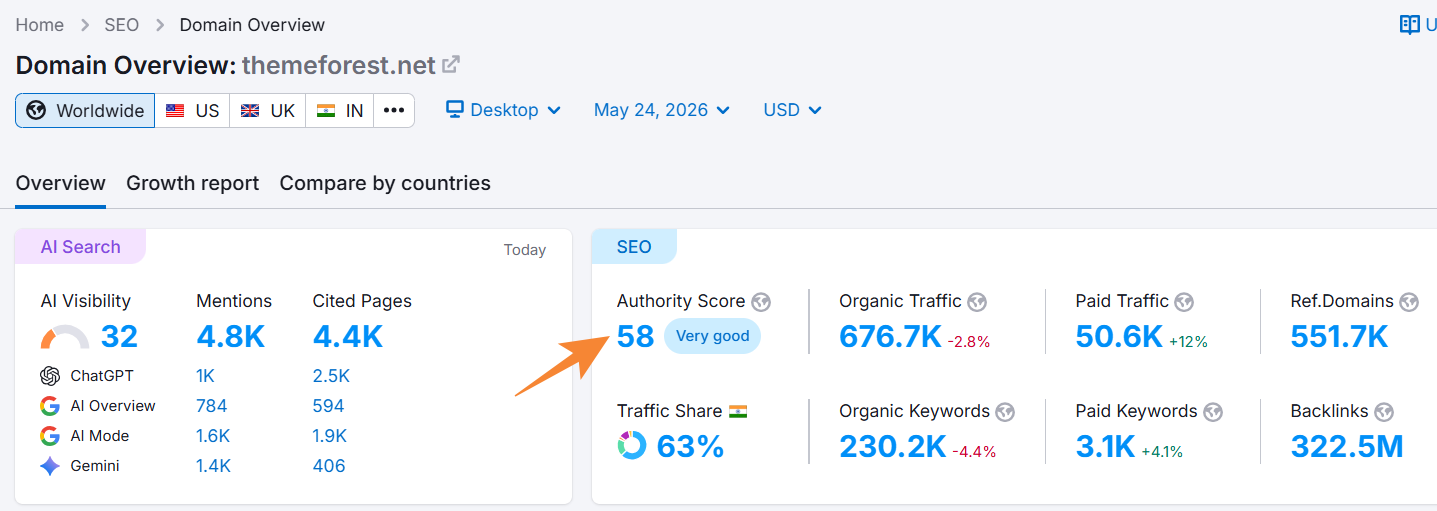
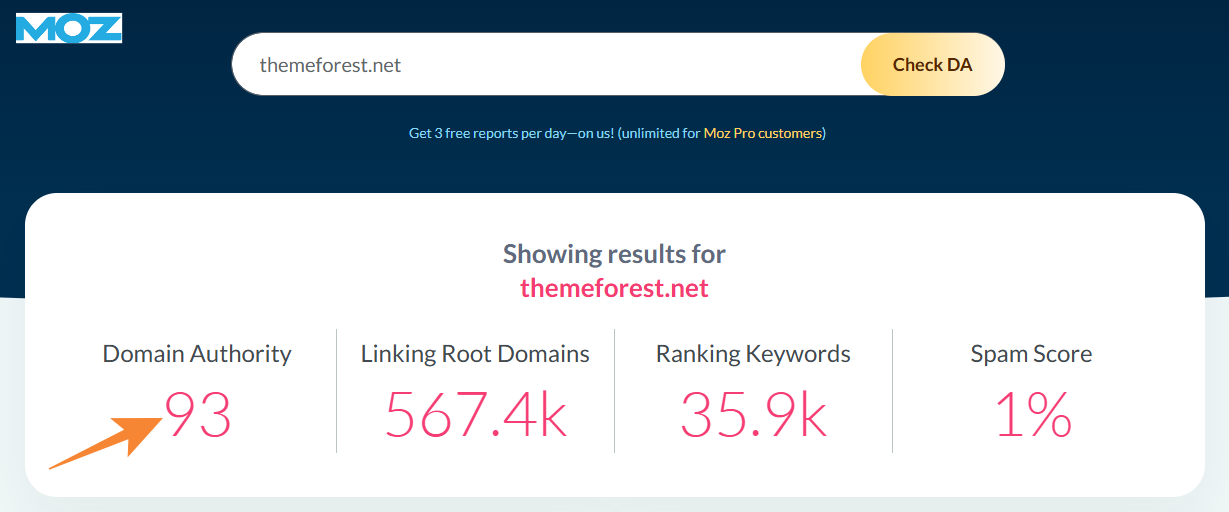
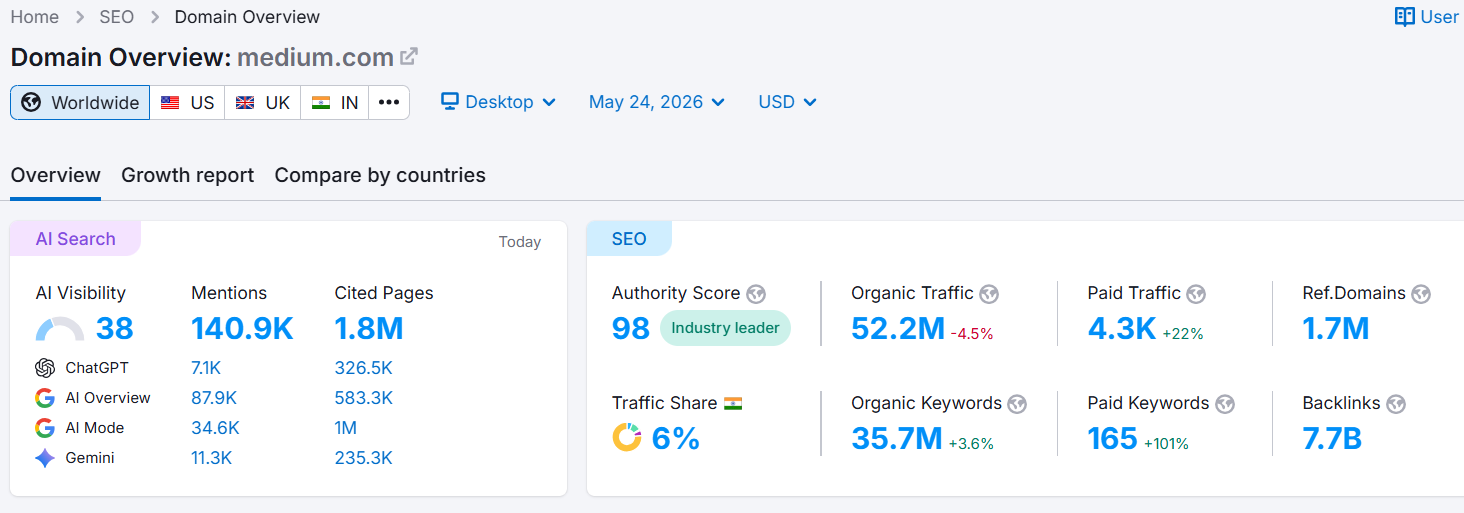
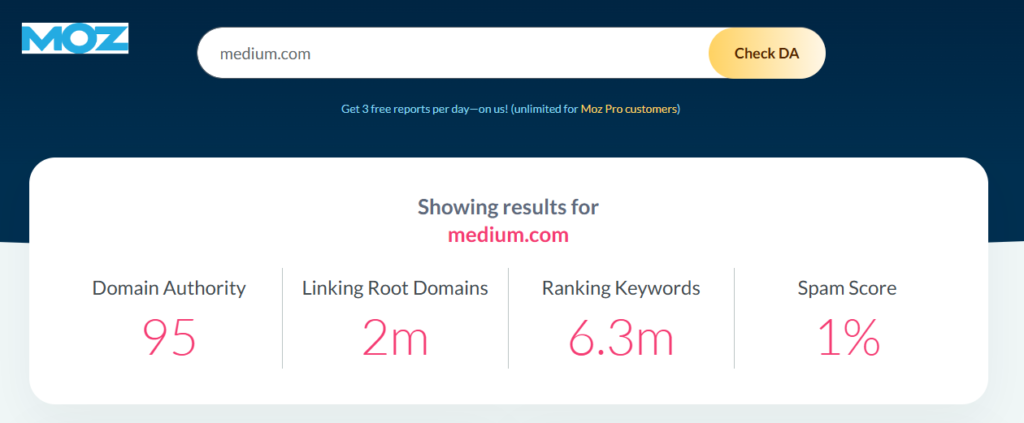
medium.com scores 95 in Moz DA and 98 in Semrush Authority Score. The tools are essentially in agreement. themeforest.net scores 93 in Moz DA and 58 in Semrush Authority Score — a 35-point gap on the same domain, on the same day.
Same scale. Same date. Completely different conclusions for one of them. The reason isn’t a data error. It comes down to what each tool is actually measuring — which is where things get interesting.
Semrush Authority Score themeforest.net
Moz Domain Authority themeforest.net
SEMrush Authority Score medium.com
Moz Domain Authority medium.com
Why Two Tools Agree on One Site and Diverge on Another
The medium.com and themeforest.net comparison isn’t just an interesting data point — it illustrates the core logic gap between these two metrics.
medium.com has 52.2 million monthly organic visits and 1.7 million referring domains. The link profile and organic performance are proportional — a site that has earned massive links and also ranks for millions of keywords. Semrush sees no imbalance to flag. Moz sees a powerful link profile. Both tools arrive at roughly the same conclusion from different angles.
themeforest.net tells a different story. It has 322.5 million backlinks and 567K linking root domains — numbers that justify Moz’s DA of 93. But its monthly organic traffic sits at 676K. For a site with that volume of inbound links, that organic traffic figure is disproportionately low. Semrush’s algorithm is specifically designed to catch this pattern — a large backlink footprint that doesn’t translate into search performance is one of the core signals its spam and natural profile factors evaluate. The result: Authority Score of 58, not 93.
This is the most practically important thing to understand about both metrics. When a site’s links and organic performance are aligned, both tools will broadly agree. When they diverge — particularly when Moz scores significantly higher than Semrush — it almost always points to a link profile that looks stronger on paper than it performs in practice.
Concluding observation
The rule of thumb worth remembering: when Moz DA and Semrush Authority Score broadly agree on a domain, you have high confidence in the reading. When Moz scores 20–30+ points higher than Semrush on the same domain, treat that gap as a signal — not a discrepancy. One tool is telling you about link volume. The other is telling you whether those links actually translate into real search presence.
How Each Metric Is Actually Calculated
This is the part most comparison articles gloss over. Let’s be specific.
Semrush Authority Score — Three Inputs, Eight Factors
Semrush Authority Score is built on three main pillars:
Link Power — quality and quantity of backlinks. Calculated from the number of follow referring domains and the authority of those referring domains. More weight goes to domains with their own strong Authority Scores linking to you.
Organic Traffic — estimated monthly organic search visits. This is a direct input into the score calculation, not just a supporting signal. A site with many backlinks but near-zero organic traffic will score significantly lower than its link profile alone would suggest.
Natural Profile (Spam Factors) — six specific spam indicators evaluated together:
- No organic rankings in Google’s top 100
- Unnaturally high percentage of dofollow domains (90%+ is a red flag)
- An imbalance between link volume and actual organic traffic
- Too many referring domains from the same IP address
- Too many referring domains from the same IP network
- Presence of another domain with an identical backlink profile (PBN signal)
Total: eight weighted factors. Semrush updates these scores for all domains every two weeks.
Moz Domain Authority — Machine Learning on Link Data
Moz DA is calculated using a machine learning algorithm that evaluates multiple factors, with backlink data as the primary input. The key inputs include:
- Number of linking root domains
- Quality and diversity of those linking domains
- Data from Moz’s Link Explorer web index
Moz’s algorithm assesses the likelihood of a domain appearing in Google search results based on these signals. It’s designed as a comparative metric — reflecting link profile strength relative to other domains in their index.
Critically, Moz DA does not factor in organic traffic as a direct input. It’s link-centric by design. A domain with an artificially inflated link profile will score higher in Moz DA than it will in Semrush Authority Score, because Semrush’s spam factors would catch signals that Moz’s model might weigh differently.
Also worth noting: Moz scores on a logarithmic scale, which means it becomes progressively harder to grow the score at higher ranges. Growing from 20 to 30 is significantly easier than growing from 70 to 80.
The Key Differences, Side by Side
| Factor | Semrush Authority Score | Moz Domain Authority |
|---|---|---|
| Scale | 0–100 | 1–100 |
| Backlink signals | Yes — quality + quantity | Yes — primary input |
| Organic traffic | Yes — direct input | No |
| Spam / manipulation detection | Yes — 6 explicit spam factors | Limited |
| Update frequency | Every 2 weeks | Varies (crawl-based) |
| Score type | Compound metric | ML-based link prediction |
| Logarithmic scaling | No | Yes |
| Free checker | Yes (Website Authority Checker) | Yes (Link Explorer — limited) |
The Organic Traffic Factor — Why It Changes Everything
This is the most practically important difference and the one that most articles skip.
Semrush Authority Score penalizes domains that have strong backlink profiles but poor organic search performance. The reasoning is straightforward: if a site has thousands of referring domains but ranks for nothing and drives no organic traffic, something is wrong. Either the content is terrible, the site has technical problems that prevent ranking, or the links were built artificially.
Moz DA doesn’t apply this logic. A domain with bought links from high-DA sites will appear stronger in Moz than it actually is in practice. Semrush’s algorithm is specifically designed to catch this pattern.
In my testing across client projects, I’ve found that whenever a prospective link site scores noticeably higher in Moz DA than in Semrush Authority Score — particularly when the gap is 15+ points — it almost always indicates a weak or manipulated link profile. The Semrush score is doing exactly what it’s designed to do: flagging that the link power doesn’t translate into real-world search performance.
This makes Semrush Authority Score generally more conservative — and more honest — about the true link value of a domain.
When the Scores Diverge — What It Signals
You’ll frequently encounter situations where the two metrics give meaningfully different readings for the same domain. Here’s what those gaps usually indicate:
Moz DA is higher than Semrush AS by 15+ points — The site likely has a large volume of backlinks that don’t translate to organic traffic. Could indicate link buying, PBN involvement, or a site that once had good links but has since lost rankings. Be cautious about pursuing links from here.
Semrush AS is higher than Moz DA by 10+ points — The site probably has strong organic performance with a leaner but high-quality link profile. Semrush is giving credit for the organic traffic signal. This site is likely a genuinely strong link prospect even if Moz’s score seems moderate.
Scores roughly aligned — The site’s link profile and organic performance are proportional. Both tools essentially agree. This is the most reliable indicator that the site is legitimate and the authoritative reading is trustworthy.
Which One Should You Actually Use?
Honestly, the answer isn’t “pick one.” They serve different purposes effectively.
Use Semrush Authority Score when:
- Vetting link-building prospects — the spam factor layer gives you a more complete picture of whether a link from this site will actually help
- Auditing your own site’s health — the organic traffic component means the score reflects real-world performance, not just link accumulation
- Comparing competitor domains in your niche — especially if you want to see who’s building legitimate authority versus inflated link profiles
- Tracking your own progress over time — rising AS with rising organic traffic confirms your strategy is working at a fundamental level
Use Moz Domain Authority when:
- Working with clients or stakeholders who are already familiar with DA as a standard — it’s more widely recognized outside SEO circles
- Doing quick competitive benchmarking in industries where you don’t have Semrush access
- Evaluating page-level authority (Moz Page Authority is a genuinely useful page-level metric that Semrush doesn’t have a direct equivalent for)
For most day-to-day SEO workflows, Semrush Authority Score gives you more signal because it’s factoring in more dimensions. Moz DA is still useful — particularly for quick checks and client reporting — but it’s the more conservative, link-only view of authority.
If you want to use Semrush for your authority analysis, you can access a 7-day free trial to run Authority Score checks across your domain and competitors.
A Note on Both Being Third-Party Metrics
Neither Semrush Authority Score nor Moz Domain Authority is used by Google. Neither directly determines rankings. Both are proxy signals built from third-party data — Semrush pulling from its own backlink index and Domain Analytics, Moz pulling from Link Explorer.
This doesn’t make them useless. It means you should treat them as directional indicators, not absolute scores. A site with Semrush AS 55 and Moz DA 52 is almost certainly stronger than a site with AS 22 and DA 20. But a site with AS 55 doesn’t automatically outrank a site with AS 40 for every keyword — on-page relevance, content quality, and countless other factors still determine actual rankings.
Use these scores the way they’re designed: as relative benchmarks within a competitive context, not as standalone measures of ranking ability. If you’re looking at a potential link prospect for a broader perspective, the Semrush vs Moz Pro comparison covers the full platform differences beyond just authority metrics.
Semrush Plans That Include Authority Score
Authority Score is available across Semrush’s current plan lineup.
SEO Classic Plans
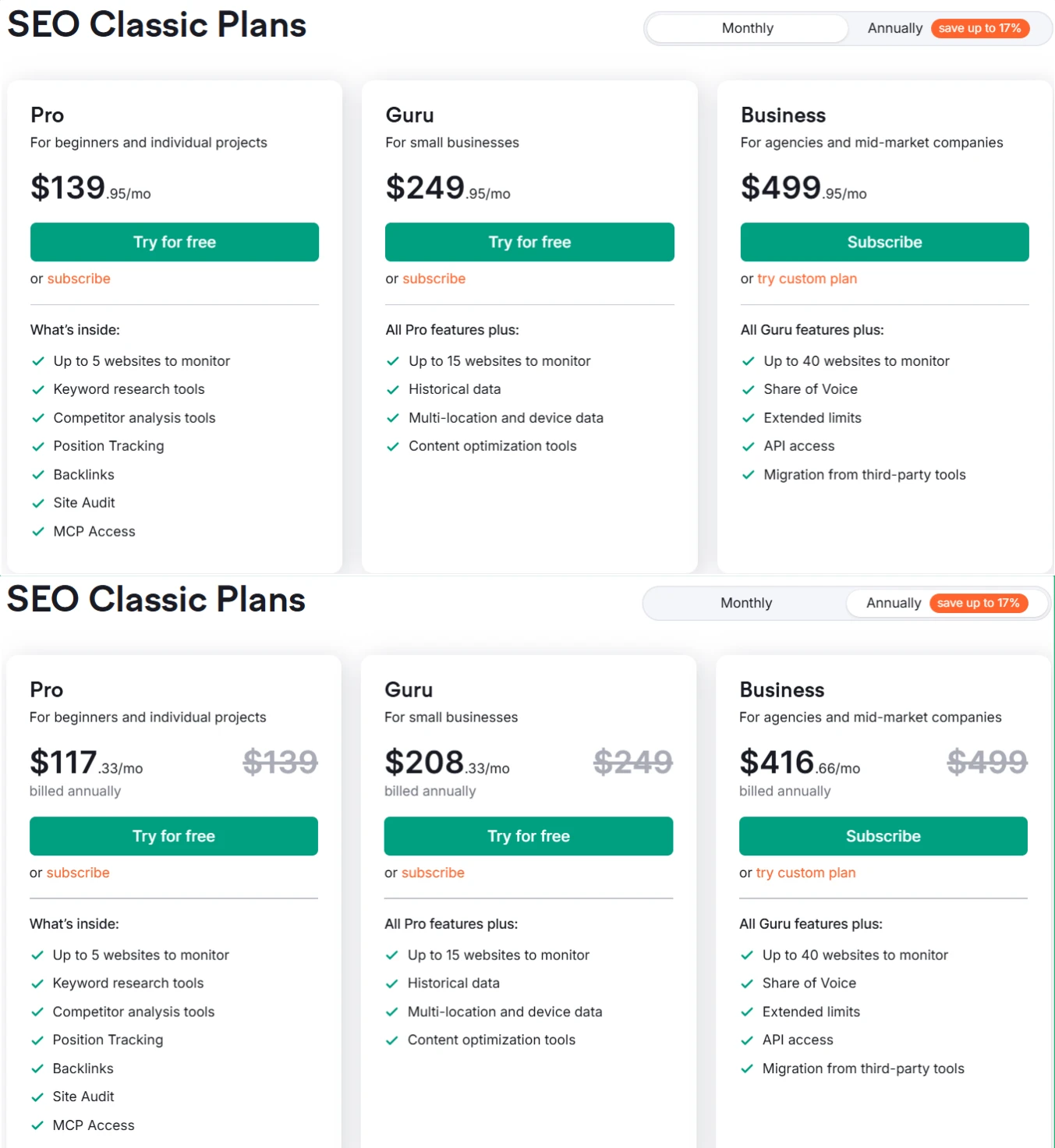
Pro — $139.95/mo (monthly) or $117.33/mo billed annually. Covers 5 websites, 500 daily keywords, backlink access with Authority Score data, Site Audit up to 100,000 pages/month, and MCP access. No historical data.
Guru — $249.95/mo (monthly) or $208.33/mo billed annually. Adds 15 websites, 1,500 daily keywords, historical data, content optimization tools, multi-location and device tracking, JavaScript rendering in Site Audit, and keyword cannibalization analysis. Results per report increase from 10,000 to 30,000.
Business — $499.95/mo (monthly) or $416.66/mo billed annually. Up to 40 websites, 5,000 daily keywords, Share of Voice, API access, migration from third-party tools, and 1,000,000 pages/month crawl capacity.
Pro and Guru both include a 7-day free trial. For a detailed breakdown of what separates these two tiers, the Semrush Pro vs Guru guide covers the specific feature differences worth knowing before you decide.
Semrush SEO Free Trial ( Pro & Guru )
Get full Pro access for 7 days — keyword research, site audit, backlink analysis & competitor research. No charge until after the trial ends.
Start Your Semrush 7-Day Free Trial→Semrush One Plans
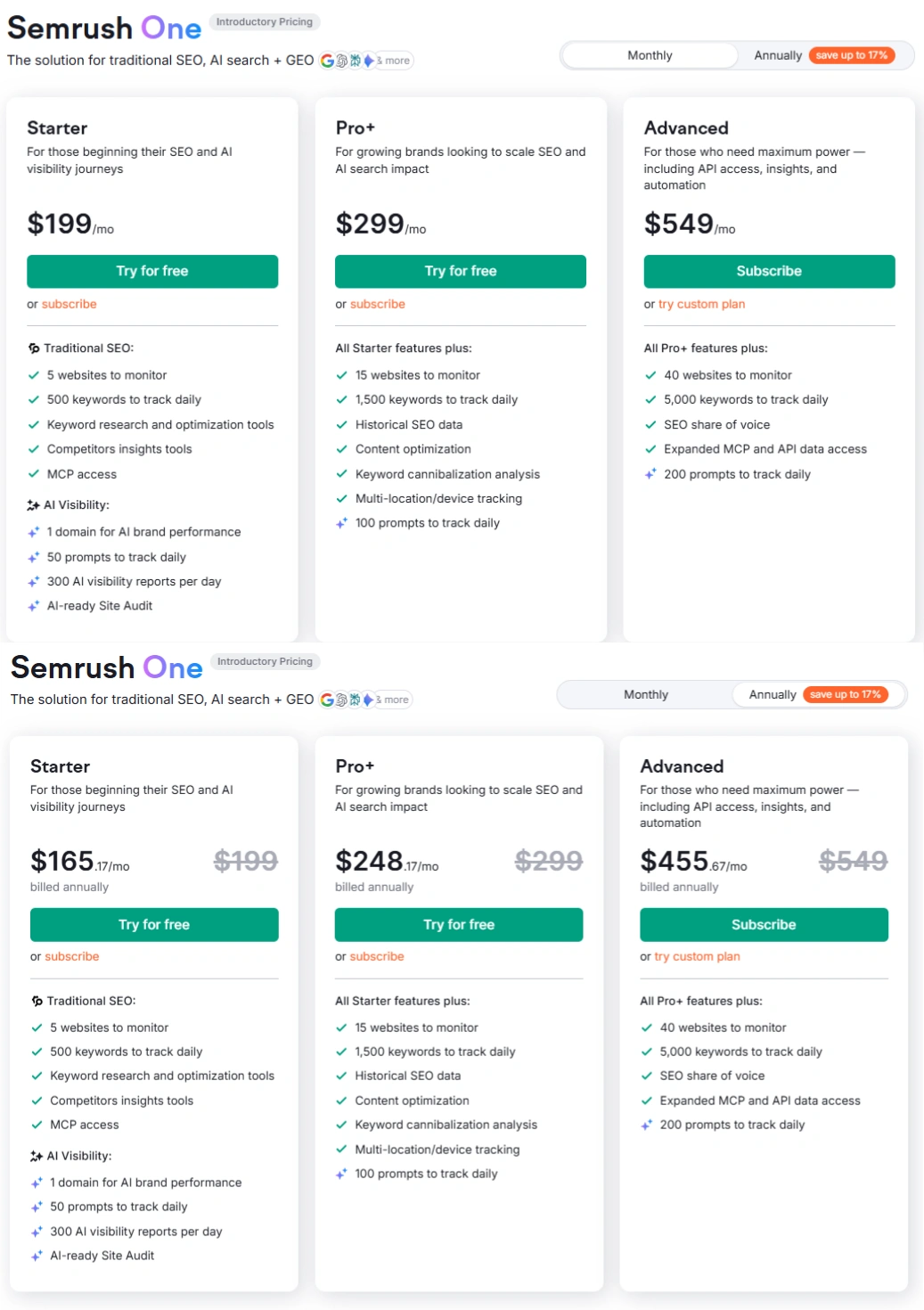
Starter — $199/mo (monthly) or $165.17/mo billed annually. 5 websites, 500 daily keywords, plus AI visibility tracking for 1 domain, 50 daily AI prompts to track, 300 AI visibility reports per day.
Pro+ — $299/mo (monthly) or $248.17/mo billed annually. 15 websites, 1,500 daily keywords, historical data, content optimization, keyword cannibalization analysis, multi-location/device tracking, 100 daily AI prompts.
Advanced — $549/mo (monthly) or $455.67/mo billed annually. 40 websites, 5,000 daily keywords, SEO share of voice, expanded MCP and API access, 200 daily AI prompts to track.
Semrush One Free Trial
Everything you need to win AI visibility and drive SEO Success. Get full Semrush One access for 7 days — explore the Starter, Pro+, or Advanced plans. Track your website’s SEO performance, monitor AI visibility and brand share of voice, run deep site audits, and get AI-driven marketing insights. No charge until after your 7-day trial ends.
Start Your Semrush One 7-Day Free Trial →Add-ons across all plans:
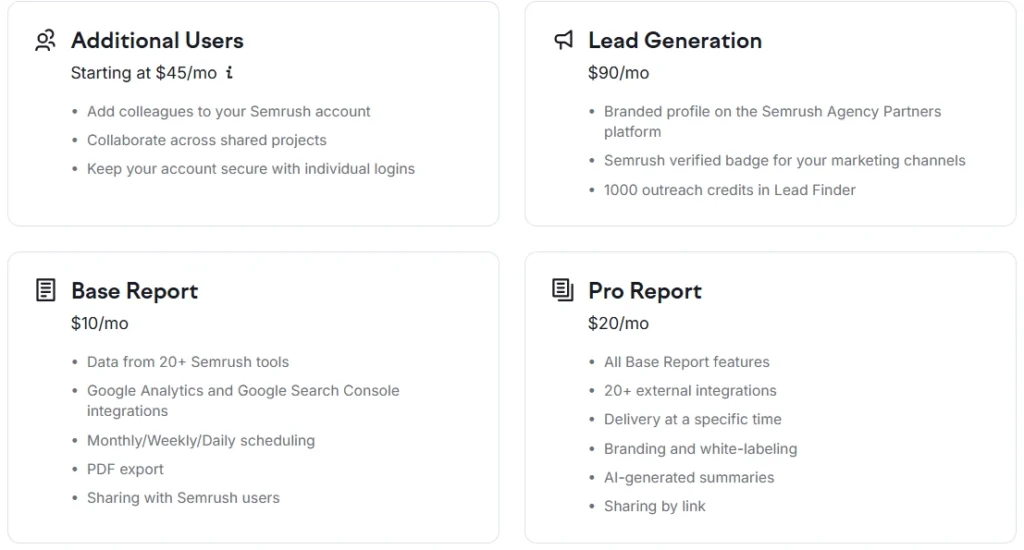
- Additional Users: from $45/user/mo
- Lead Generation: $90/mo
- Base Report: $10/mo
- Pro Report: $20/mo
Semrush One Free Trial
Dominate the future of AI search. Unlock advanced brand share of voice, monitor generative AI visibility, automate insights, and scale marketing impact across all digital channels.
Semrush Pro & Guru Free Trial
Master your organic rankings. Run comprehensive site audits, track keyword positions, analyze backlink profiles, and spy on competitor SEO strategies completely risk-free for 7 days.
Frequently Asked Questions
What is the difference between Semrush Authority Score and Moz Domain Authority?
Both metrics score domain-level SEO strength from 0 to 100, but the calculation differs meaningfully. Semrush Authority Score incorporates organic traffic and six spam detection factors alongside backlink signals, making it a compound metric. Moz Domain Authority is primarily link-based, calculated using a machine learning model trained on backlink data from their Link Explorer index. The result is that the same domain often scores differently on each platform — and understanding why the gap exists tells you something useful about the domain’s actual SEO health.
Can a site have a high Moz DA but a low Semrush Authority Score?
Yes, and this is one of the most practically useful patterns to recognize. When Moz DA is significantly higher than Semrush Authority Score for the same domain, it typically indicates that the site has accumulated backlinks that don’t translate into organic search performance. This is a common footprint of bought links, PBN networks, or sites that once ranked but have since lost traction. Semrush’s spam factors are specifically designed to catch this imbalance. If you’re evaluating a link prospect and see this gap, investigate further before pursuing.
Which is more accurate — Semrush Authority Score or Moz Domain Authority?
Neither is objectively “more accurate” because both are proxies built from third-party data, not Google’s actual signals. That said, Semrush Authority Score factors in more dimensions — organic traffic and spam patterns — which makes it harder to manipulate and more reflective of real-world site health. For link prospecting and competitive analysis, most experienced SEOs find Semrush’s metrics give them a more complete picture. For understanding how well you’ve built a good SEMrush authority score, it helps to look at both together. See what a good Semrush authority score looks like in your niche for fuller context.
Does Moz DA factor in organic traffic?
No. Moz Domain Authority is calculated using backlink data from their Link Explorer index — specifically, the number and quality of linking root domains. Organic traffic is not a direct input into the DA calculation. This is the most significant methodological difference between DA and Semrush Authority Score.
Why do Semrush and Moz show different scores for the same website?
Because they use different data sources and different methodologies. Semrush pulls from its own backlink database and Domain Analytics for organic traffic estimates. Moz pulls from Link Explorer. The two databases don’t index backlinks identically — they have different crawl frequencies, different index sizes, and different ways of weighting link quality. On top of that, Semrush factors in organic traffic and spam signals that Moz doesn’t. Even if both databases agreed perfectly on backlinks, the scores would still differ because Semrush is calculating something more complex.
Should I use Semrush or Moz for link prospecting?
For link prospecting specifically, Semrush Authority Score is the stronger tool. The spam factor layer and organic traffic input mean you get a more complete picture of whether a site is genuinely authoritative or just link-rich on paper. A prospect that scores 45 in Semrush AS with a matching organic traffic level is a meaningfully stronger link opportunity than a site with Moz DA 60 but Semrush AS 30. If you want to run that analysis yourself, the 7-day free trial gives you full access to Backlink Analytics and the Link Building Tool.
Is Moz Domain Authority still relevant?
Yes, but its relevance depends on context. Within SEO teams and tools, DA remains widely recognized and is embedded in many third-party platforms and dashboards. For client reporting or quick competitive benchmarks, it’s still useful. However, for deep link analysis, prospect evaluation, or understanding the real health of a site’s authority, Semrush Authority Score provides more signal. Think of DA as a widely-understood shorthand and Semrush AS as the more diagnostic metric.
The Bottom Line
Semrush Authority Score and Moz Domain Authority are both measuring something real — but they’re not measuring the same thing, and they’re not interchangeable.
Moz DA gives you a link-based view of a domain’s strength. Clean, straightforward, widely recognized. Useful for quick benchmarking and stakeholder reporting.
Semrush Authority Score gives you a more complete view — one that accounts for whether those links actually translate into organic performance, and whether the link profile shows signs of manipulation. It’s the more diagnostic metric for anyone doing serious link building or competitive analysis.
The practical takeaway: when the two scores agree, you have high confidence in the reading. When they diverge significantly, that divergence itself is the signal — and it’s usually pointing at something worth investigating before you build a strategy around it.
All Semrush Toolkits — Quick Overview
Semrush is not just one tool. It’s a complete platform of 8 specialized toolkits — each built for a specific marketing goal. Pick the one that fits your workflow, or go all-in with Semrush One.