Contents
- 1 What Semrush Authority Score Actually Measures
- 2 The Score Range — What Each Level Signals
- 3 So What’s Actually a “Good” Score?
- 4 Where to Check Authority Score Inside Semrush
- 5 Three Ways Authority Score Becomes Practically Useful
- 6 What Actually Moves the Number
- 7 Semrush Plans That Give You Full Authority Score Access
- 8 Frequently Asked Questions
- 8.1 What is a good SEMrush authority score for a new website?
- 8.2 Does a higher Authority Score always mean better rankings?
- 8.3 How often does Semrush update Authority Scores?
- 8.4 What is the difference between Semrush Authority Score and Moz Domain Authority?
- 8.5 Can I check a competitor’s Authority Score without a paid plan?
- 8.6 Is a score of 30 good or bad?
- 8.7 What’s the fastest way to improve Authority Score?
- 8.8 The Bottom Line
- 9 Everything You Need About Semrush Free Trial
Most people who check their Semrush Authority Score for the first time have the same reaction — they see a number, have no idea if it’s good or bad, and either panic or feel falsely confident.
A 28 could be strong. A 60 could be worrying. Context is everything.
Quick Answer: There’s no single “good” Authority Score that applies universally. A score between 30–50 is healthy for most small-to-mid websites. Established sites in competitive industries typically sit between 60–80+. What actually matters is how your score compares to the specific sites competing for your keywords — not some imaginary benchmark.
That said, there’s a lot more to understanding this metric than a single number. After using Semrush across dozens of client projects over the years, I’ve come to see Authority Score as one of the most misread signals in SEO — not because it’s complicated, but because people focus on the wrong things.
What Semrush Authority Score Actually Measures
Authority Score is Semrush’s compound metric that grades the overall SEO strength and quality of a domain (or webpage) on a scale of 0 to 100.
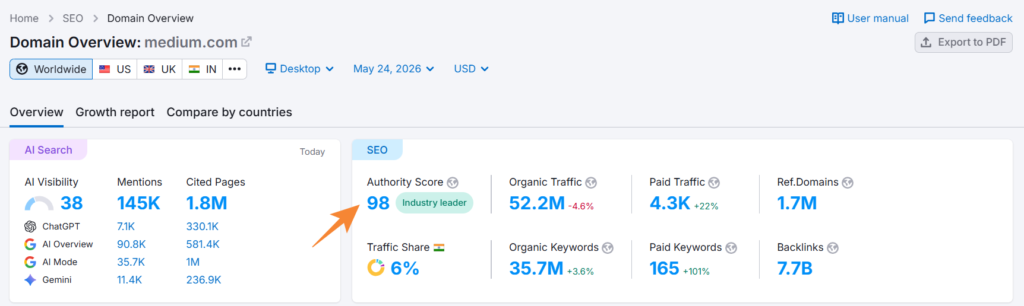
The number doesn’t come from a single data point. It’s calculated from eight weighted factors grouped into three main categories:
Link Power — quality and quantity of backlinks pointing to your site. This is driven by the number of follow referring domains and the authority of those referring domains.
Organic Traffic — the estimated monthly organic search traffic your site receives. A site with strong backlinks but zero organic traffic raises a red flag in the algorithm.
Natural Profile (Spam Factors) — this is the part most people don’t know about. Six separate spam indicators are evaluated here, including:
- No organic rankings on SERPs (site has zero top-100 positions)
- Unnaturally high percentage of dofollow domains (above 90% is suspicious)
- An imbalance between link volume and organic traffic
- Too many referring domains from the same IP address
- Too many referring domains from the same IP network
- Presence of another domain with an identical backlink profile
That last spam factor is particularly interesting. If Semrush finds a domain with 95%+ competition level similarity to yours in terms of backlink structure, it flags it as a potential PBN signal. I’ve seen this drag scores down on client sites that had otherwise solid link profiles — because a cluster of links came from a low-quality link network they weren’t even aware of.
Semrush updates Authority Scores across all domains once every two weeks, pulling link data and organic traffic from its own databases.
The Score Range — What Each Level Signals
Rather than guessing what your number means in isolation, Semrush applies labels to different score bands. Here’s what those labels actually indicate in practice:
| Score Label | What It Means |
|---|---|
| Low authority | Few backlinks, unlikely to pass meaningful link value |
| Low authority but niche relevant | Few backlinks, but from topically relevant domains — small benefit possible |
| Average | Decent link profile and traffic, but not standout in the niche |
| Average but niche relevant | Not high-authority overall, but niche-relevant links — worth pursuing |
| Good | Well-rounded backlink profile with solid organic traffic |
| Good and niche relevant | Good profile AND topically relevant — a strong link prospect |
| Very good | Strong brand signals and a great backlink profile |
| Very good and niche relevant | Excellent linking candidate — highly relevant and authoritative |
| Excellent | Great backlink profile with lots of organic traffic |
| Superb | Excellent profile and organic traffic — among the best |
| Industry leader | Top-tier — a link from here would highly benefit your profile |
| Heavy signs of spam | Backlink profile may be fabricated — avoid |
| Some signs of spam | Potential manipulation — proceed with caution |
| Light signs of spam | Some suspicious signals — worth investigating |
| Lacks organic traffic | Strong link profile but low traffic — possibly technical issues or poor content |
| Poor traffic-to-backlink ratio | Many backlinks, low traffic — possible manipulation attempt |
| High traffic-to-backlink ratio | High traffic with few backlinks — a link here may still benefit you if relevant |
One thing worth noting: a “Lacks organic traffic” label on an otherwise well-linked site is a big red flag. In my experience, this usually means one of two things — either the site has serious technical problems that prevent ranking, or the backlinks were built artificially and Google doesn’t trust the content. Either way, you probably don’t want a link from there.
So What’s Actually a “Good” Score?
Here’s the thing most articles get wrong — they give you a universal number and call it a day.
The real answer is: your Authority Score is only meaningful relative to your competitors.
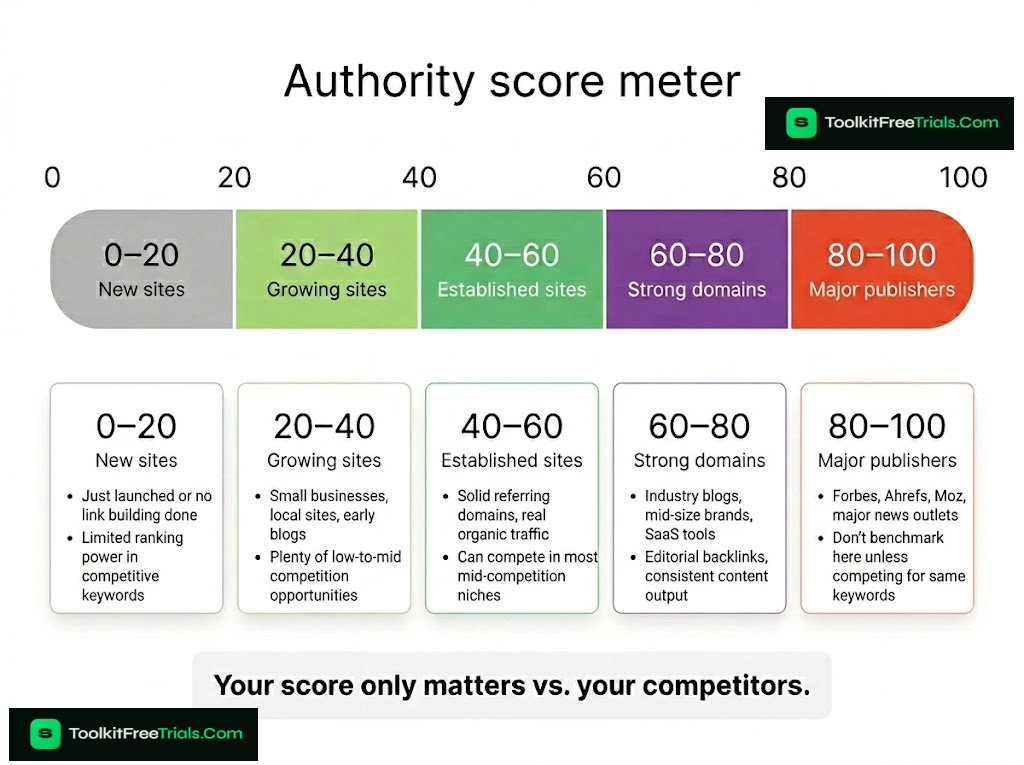
A score of 20 for a brand-new local business blog competing against other small local sites? Totally fine. A score of 20 for a SaaS company trying to rank against HubSpot and Moz? You’ve got significant ground to cover.
Here’s a rough practical guide based on patterns I’ve observed across projects:
Scores 1–20 — New or low-activity sites. Very few backlinks. Typical for newly launched domains or sites that have never invested in link building. Not alarming on its own, but expect limited ranking power in competitive keywords.
Scores 20–40 — Growing sites with a developing backlink profile. This range is where most small businesses, local sites, and early-stage content sites sit. Plenty of keyword opportunities at lower competition levels.
Scores 40–60 — Mid-range authority. Established sites with a decent number of quality referring domains. Can compete meaningfully in most mid-competition niches.
Scores 60–80 — Strong domain authority. Usually, well-established sites have consistent content output, editorial backlinks, and good organic traffic. This range covers most reputable industry blogs and mid-size brands.
Scores 80+ — Major publications, large media sites, well-known software platforms. Think Ahrefs, Forbes, and major news outlets. Don’t benchmark against these unless you’re actually competing for the same keywords.
The right approach: take your top 5 ranking competitors for your target keywords, run their domains through Semrush’s Backlink Analytics tool, and look at where their Authority Scores cluster. That cluster is your real target range.
Where to Check Authority Score Inside Semrush
Authority Score isn’t buried in one obscure corner — it surfaces across multiple tools, which makes it genuinely useful for day-to-day SEO work. You’ll find it in:
- SEO Dashboard
- Domain Overview
- Keyword Overview
- Compare Domains
- Backlinks Tool
- Backlink Gap
- Backlink Audit
- Link Building Tool
- Website Authority Checker (free tool — no account needed)
That free Website Authority Checker is worth bookmarking. You get a limited number of free lookups per day without needing a Semrush account, which makes it useful for quick prospect vetting before you commit to a full outreach sequence.
Three Ways Authority Score Becomes Practically Useful
Understanding your score is step one. Using it is where the real value shows up.
Vetting Link Building Prospects
Not all backlinks move the needle equally. When you’re identifying outreach targets — whether through guest posting, digital PR, or link reclamation — Authority Score gives you a fast filter.
In practice, I’d suggest a minimum threshold of AS 30+ for link prospects, adjusting upward if you’re in a competitive niche. But more important than the raw score is the label. A site marked “Low authority but niche relevant” can still be worth pursuing if the topical alignment is tight. A site with AS 60 but marked “Heavy signs of spam”? Skip it entirely.
Semrush’s Link Building Tool shows Authority Scores next to every prospect automatically, which saves a significant amount of manual lookup time.
Competitive Intelligence
When a competitor is outranking you consistently, their Authority Score gives you a structural starting point for understanding why. Are they winning on link volume? Organic traffic? Or are they just in a less-contested space?
Use Semrush’s Compare Domains feature to stack your domain against 3–4 competitors simultaneously. Look at the Authority Score trend (not just the current number) — a competitor whose score has been climbing for 6 months is investing in link building actively. One with a flat or declining score might be a realistic target to overtake.
Tracking Your Own Progress
A rising Authority Score is one of the clearest signals that your SEO activities are accumulating. It’s not a vanity metric if you’re tracking it alongside organic traffic and referring domain growth.
If your score is stagnating despite consistent content output, that usually points to a link acquisition problem — the content exists but isn’t earning external links. If it’s declining, check for lost backlinks or a spike in low-quality links pointing at your domain.
What Actually Moves the Number
This is where a lot of people waste time. Adding pages, updating meta descriptions, or submitting to random directories won’t move your Authority Score. The levers that genuinely matter:
Building backlinks from relevant, reputable sites. The quality of referring domains matters more than quantity. One editorial link from a well-ranked industry publication will move your score more than fifty links from low-authority directories.
Growing organic traffic. Because organic traffic is a direct input into the Authority Score calculation, content that actually ranks and draws traffic reinforces your score. It creates a positive feedback loop — better links → higher rankings → more traffic → higher Authority Score.
Keeping your link profile clean. Toxic or suspicious backlinks drag the Natural Profile component of your score down. Regular backlink audits through Semrush’s Backlink Audit tool help catch unnatural patterns before they become a problem.
Internal linking. It doesn’t directly affect Authority Score the way external links do, but it helps distribute whatever link authority you do have across your site more evenly.
What won’t help: buying bulk links, using PBNs (Semrush’s spam detection explicitly checks for this), or any tactic that creates an imbalance between your link volume and organic traffic. The algorithm is specifically designed to catch those patterns.
Semrush Plans That Give You Full Authority Score Access
Authority Score data is available across Semrush’s plan lineup, but the depth of access — particularly for backlink analysis and competitive comparison — varies by tier.
SEO Classic Plans
The traditional SEO-focused plans remain the most popular entry point.
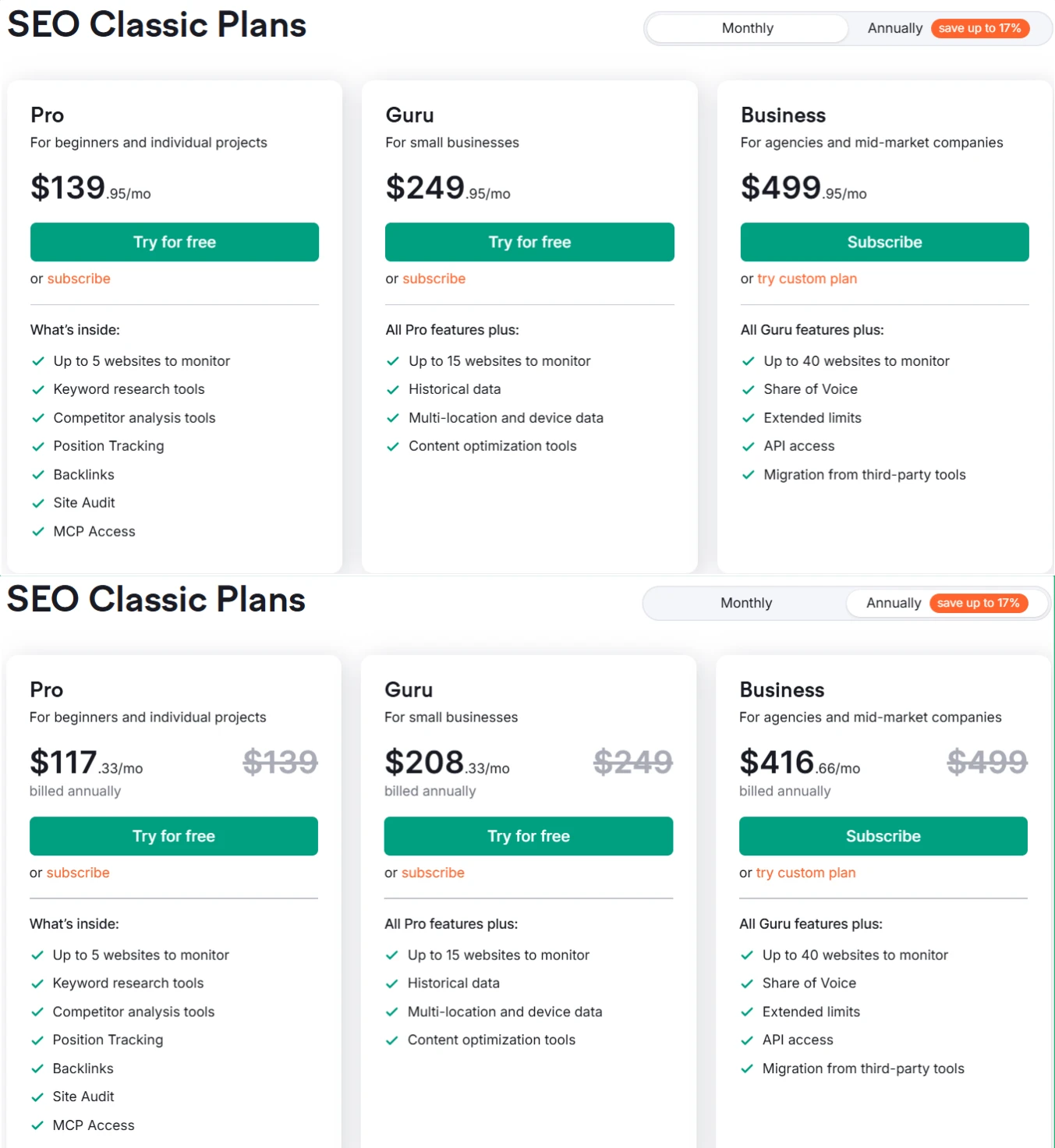
Pro — $139.95/mo (monthly) or $117.33/mo billed annually. Covers up to 5 websites, 500 keywords to track daily, backlink access, Site Audit (100,000 pages/month), and MCP access. No historical data, no JavaScript rendering in Site Audit.
Guru — $249.95/mo (monthly) or $208.33/mo billed annually. Adds up to 15 websites, 1,500 daily keywords, historical data, content optimization tools, multi-location and device tracking, JavaScript rendering, and keyword cannibalization analysis. Results per report jump from 10,000 (Pro) to 30,000.
Business — $499.95/mo (monthly) or $416.66/mo billed annually. Up to 40 websites, 5,000 daily keywords, Share of Voice, API access, migration from third-party tools, and 1,000,000 pages/month site crawl. For agencies running competitive authority analysis at scale, this is the relevant tier.
Both Pro and Guru include a 7-day free trial — enough time to run a full backlink audit and benchmark your authority against your top competitors.
Semrush SEO Free Trial ( Pro & Guru )
Get full Pro access for 7 days — keyword research, site audit, backlink analysis & competitor research. No charge until after the trial ends.
Start Your Semrush 7-Day Free Trial→If you’re trying to decide between Pro and Guru specifically, the comparison of Semrush Pro vs Guru breaks down exactly which features justify the price difference.
Semrush One Plans
Semrush One is the newer unified offering combining traditional SEO with AI visibility tracking and GEO (Generative Engine Optimization).
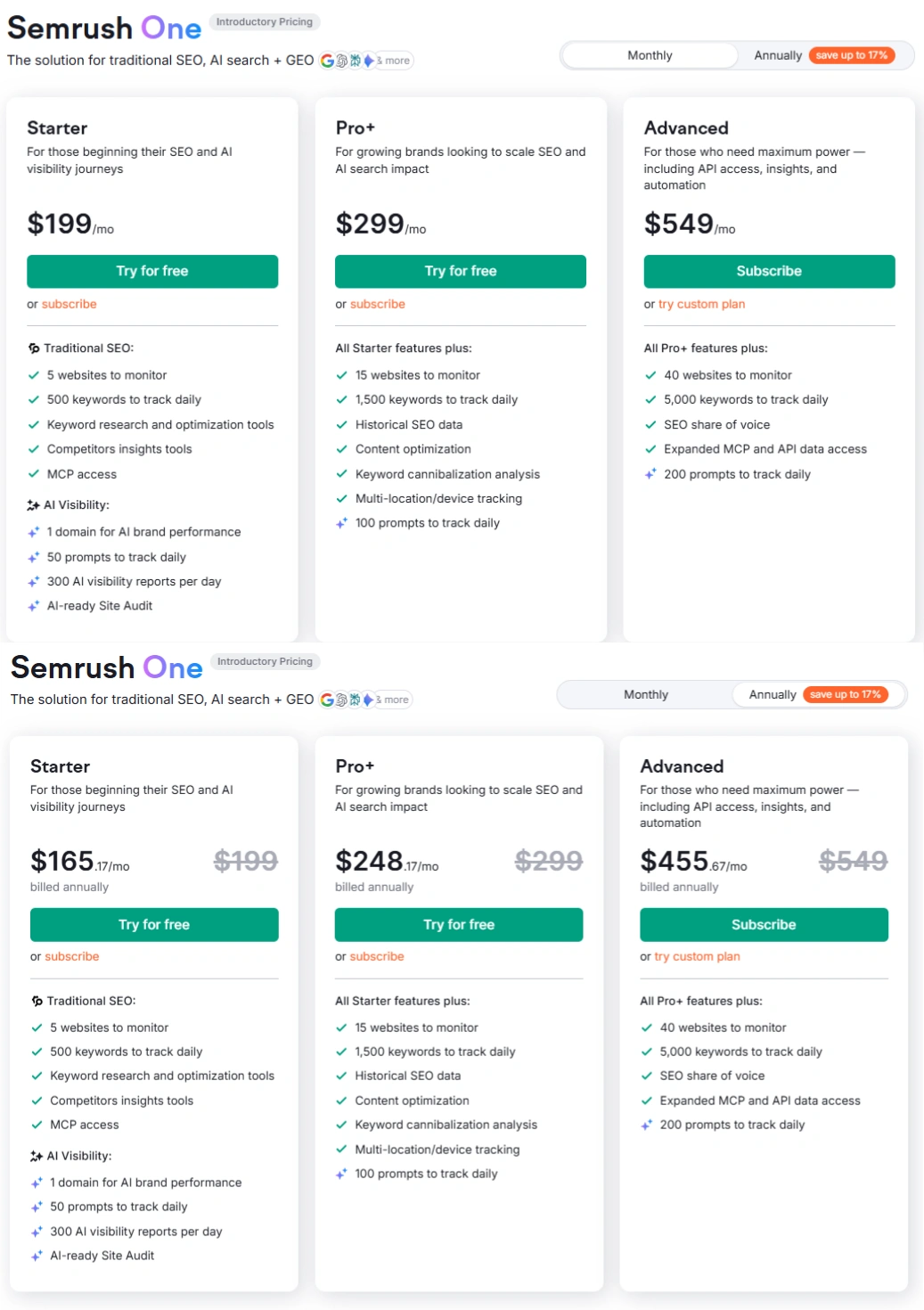
Starter — $199/mo (monthly) or $165.17/mo billed annually. 5 websites, 500 daily keywords, AI visibility for 1 domain, 50 daily AI prompts to track, 300 AI visibility reports per day, MCP access.
Pro+ — $299/mo (monthly) or $248.17/mo billed annually. 15 websites, 1,500 daily keywords, historical SEO data, content optimization, keyword cannibalization analysis, multi-location/device tracking, 100 daily AI prompts to track.
Advanced — $549/mo (monthly) or $455.67/mo billed annually. 40 websites, 5,000 daily keywords, SEO share of voice, expanded MCP and API access, 200 daily AI prompts to track.
The Semrush One plans make the most sense if you’re already concerned about AI search visibility alongside traditional authority building — increasingly relevant as more searches happen through AI-generated answers.
Semrush One Free Trial
Everything you need to win AI visibility and drive SEO Success. Get full Semrush One access for 7 days — explore the Starter, Pro+, or Advanced plans. Track your website’s SEO performance, monitor AI visibility and brand share of voice, run deep site audits, and get AI-driven marketing insights. No charge until after your 7-day trial ends.
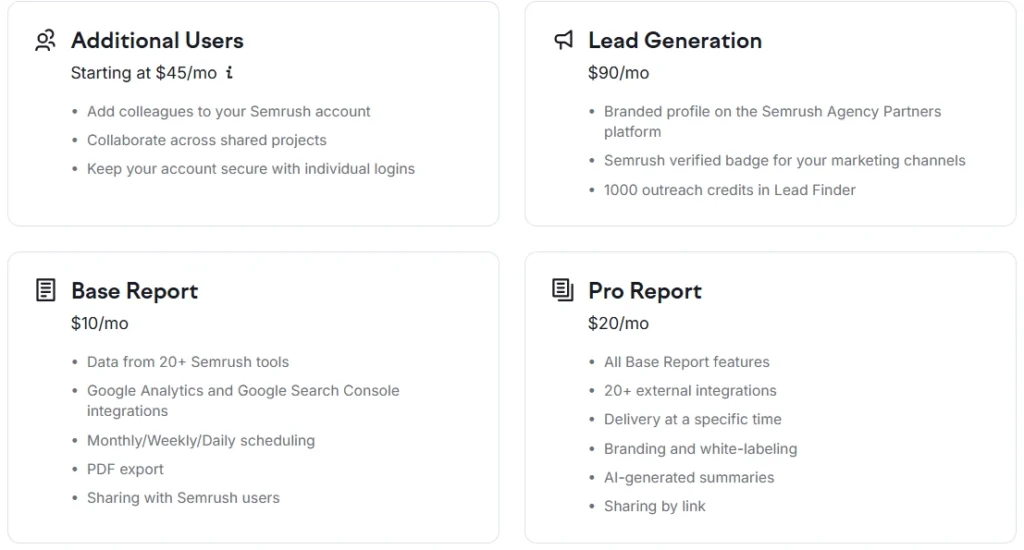
Start Your Semrush One 7-Day Free Trial →Add-ons available across plans:
- Additional Users: from $45/user/mo
- Lead Generation: $90/mo
- Base Report: $10/mo
- Pro Report: $20/mo
Semrush One Free Trial
Dominate the future of AI search. Unlock advanced brand share of voice, monitor generative AI visibility, automate insights, and scale marketing impact across all digital channels.
Semrush Pro & Guru Free Trial
Master your organic rankings. Run comprehensive site audits, track keyword positions, analyze backlink profiles, and spy on competitor SEO strategies completely risk-free for 7 days.
Frequently Asked Questions
For a brand-new site, any score above 0 is a start — but realistically, expect to sit between 1–10 for the first few months. A score of 15–25 within the first year is reasonable if you’re actively building backlinks and publishing content that earns links. What matters more than the raw number is the trajectory: a new site climbing from 5 to 22 in six months is in a healthy place, even if 22 sounds low on an absolute scale.
Does a higher Authority Score always mean better rankings?
Not automatically. Authority Score is a proxy signal, not a direct ranking factor. Google doesn’t use Semrush’s metric in its algorithm. A site with Authority Score 55 can outrank a site with AS 70 if its on-page optimization is tighter, its content better answers user intent, or its topical relevance is stronger for that specific query. Think of Authority Score as a measure of structural SEO strength, not a ranking guarantee.
How often does Semrush update Authority Scores?
Semrush refreshes Authority Scores for all domains once every two weeks. So if you’ve recently earned a cluster of strong backlinks, expect to see the impact reflected within roughly 14 days. It’s worth noting that a single new link won’t visibly move the score — meaningful changes require consistent link acquisition over time.
What is the difference between Semrush Authority Score and Moz Domain Authority?
Both aim to measure domain-level SEO strength on a 0–100 scale, but they use different methodologies. Semrush Authority Score factors in organic traffic and spam signals alongside link power — meaning a domain with many backlinks but no organic traffic gets penalized. Moz Domain Authority is primarily link-based. In practice, a site can score quite differently on each metric depending on its traffic-to-link ratio. If you’re looking for a deeper breakdown, the Semrush vs Moz Pro comparison covers the platform differences more broadly.
Can I check a competitor’s Authority Score without a paid plan?
Yes. Semrush’s free Website Authority Checker tool lets you look up any domain’s Authority Score without logging in, though you get a limited number of free checks per day. For deeper analysis — looking at referring domains, backlink history, or comparing multiple competitors simultaneously — you’ll need a paid plan or at least the 7-day free trial. You can also use Semrush for free in limited ways with a basic account to get a feel for the data before committing.
Is a score of 30 good or bad?
It depends entirely on your niche. A score of 30 for a local service business competing against other local sites is perfectly competitive. A score of 30 for a SaaS startup trying to rank in “project management software” — where Asana, Monday.com, and Notion are sitting at 80+ — represents a substantial gap to close. Run your actual competitors through Backlink Analytics and see where they cluster. That’s your real benchmark.
What’s the fastest way to improve Authority Score?
The most impactful lever is earning backlinks from genuinely authoritative, topically relevant domains. Guest posting on respected industry publications, building data-driven content that earns editorial citations, and digital PR campaigns that get you coverage in major outlets — these move the needle faster than volume-based link building. Cleaning up a toxic link profile through Semrush’s Backlink Audit tool also helps by removing the spam penalty drag on your Natural Profile score.
The Bottom Line
Authority Score is genuinely useful — but only when you stop treating it like an absolute grade and start using it as a relative benchmark.
A score in the 30s that’s growing consistently beats a stagnant score in the 60s. A site labeled “Good and niche relevant” at AS 40 is a stronger link prospect than a technically higher-scored site labeled “Lacks organic traffic.” The nuance is in the labels, the trend, and the competitive context — not the raw number.
If you haven’t already benchmarked your score against your actual ranking competitors, that’s the first practical step. Pull up Semrush’s Backlink Analytics tool, add your top 3–5 competitors, and look at where their scores cluster. Then you’ll know exactly what you’re working toward.
The 7-day free trial gives you full access to run that analysis — Domain Overview, Backlink Analytics, and Backlink Audit are all included. It’s enough time to get a clear picture of where you stand and what it would actually take to close the gap.
Everything You Need About Semrush Free Trial
Activate your Semrush free trial directly, read our step-by-step guide on how to get it, or learn how to cancel before getting charged — all in one place.
Start Semrush Free Trial
Get full Pro access for 7 days — keyword research, site audit, backlink analysis & competitor research. No charge until after the trial ends.
Start Free Trial →How to Get Free Trial
Step-by-step guide to activate your Semrush free trial — what you unlock, how to use it right, and how to get maximum value in 7 days.
Read Full Guide →How to Cancel Trial
Don’t get charged by mistake. Step-by-step guide to cancel your Semrush trial before the billing date — timing tips included.
Read Cancel Guide →