Every SEO tool promises accurate data. But most people never stop to ask — where does Semrush get its data, exactly?
It’s one of those questions that sounds simple on the surface. But once you start pulling the thread, it gets genuinely interesting. And honestly, understanding this changes how you use Semrush entirely.
Quick Answer
Semrush pulls data from multiple sources: its own web crawler, third-party clickstream data providers, search engine APIs, and partnerships with data aggregators. No single source tells the whole story — Semrush combines and models these inputs to produce the keyword volumes, traffic estimates, and backlink counts you see inside the platform.
Where Does Semrush Get Its Data — It’s Not One Source
This is the part most articles gloss over.
Semrush doesn’t have a secret direct line to Google’s servers. No third-party SEO tool does. What Semrush has built instead is a multi-layered data infrastructure that pulls signals from several directions simultaneously — then processes and normalizes everything into usable metrics.
Here’s what that actually looks like in practice.
The Semrush Crawler: Its Own Eyes on the Web
Semrush runs its own bot — the SemrushBot — that actively crawls the web, similar to how Googlebot works (though at a much smaller scale and without ranking authority).
This crawler is the backbone of its backlink database, which Semrush claims is one of the largest in the industry. When you run a backlink audit inside the platform, you’re largely looking at what SemrushBot has discovered during its crawl cycles.
In my testing, I cross-referenced backlink counts between Semrush and a couple of other tools for the same domain. Semrush consistently surfaced more unique referring domains — though the overlap wasn’t perfect. No tool has a complete picture. But Semrush’s crawler is genuinely active and regularly updated, which matters for catching new links or spotting recently lost ones.
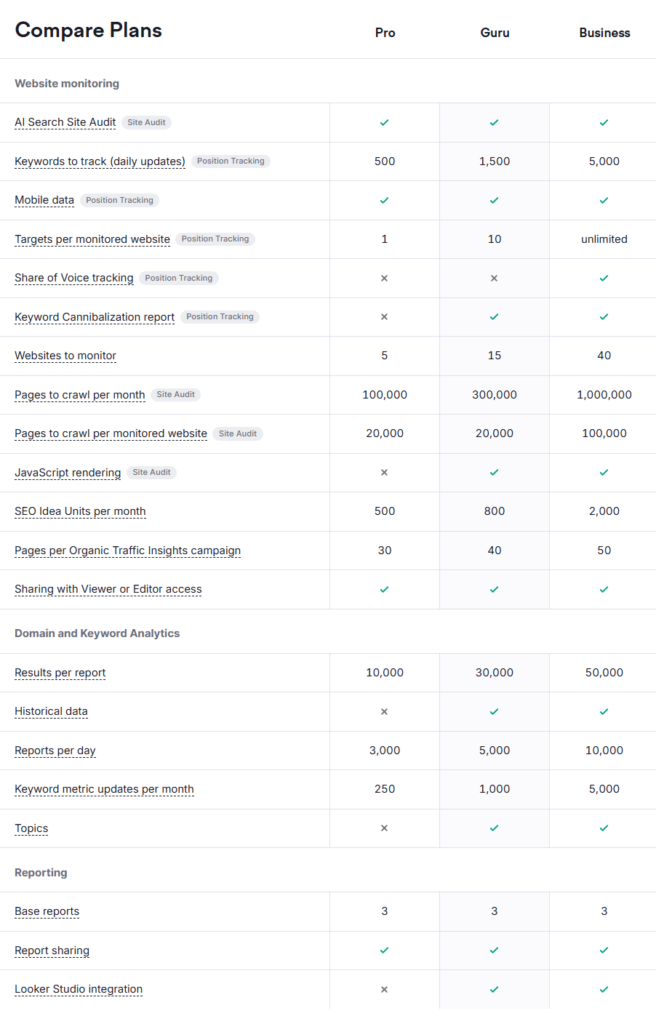
The Site Audit tool — available on all three plans, including the Pro plan at $139.95/month (or $117.33/month billed annually) — uses this same crawl infrastructure. Pro lets you crawl up to 100,000 pages per month across 5 websites, while Guru expands that to 300,000 pages across 15 sites.
Clickstream Data: The Secret Behind Traffic Estimates
This is where things get really interesting — and where most people are surprised.
Semrush’s organic traffic estimates and keyword search volumes are heavily influenced by clickstream data. Clickstream data is essentially anonymized browsing behavior collected from millions of real users through browser extensions, ISP partnerships, and opt-in panels.
Think of it this way: if a large enough sample of real users is tracked as they search for “best running shoes” and land on a specific page, that signal feeds into the model that estimates how much traffic that keyword and page receive.
Semrush partners with third-party clickstream providers — they’ve publicly acknowledged this — to build a representative sample of actual user behavior across different markets.
This is also why Semrush’s traffic data is an estimate, not a direct measurement. Most people don’t realize this when they first start using the tool. The numbers are modeled, not pulled from Google Analytics. They’re useful directional indicators, not exact figures.
The keyword metric updates per month tell you a lot here:
- Pro: 250 keyword metric updates/month
- Guru: 1,000/month
- Business: 5,000/month
If you’re running large-scale keyword research campaigns, that limit matters. It’s one reason agencies often find themselves on the Guru plan at $208.33/month (annually) rather than Pro.
Search Engine Data & SERP Scraping
Semrush also collects data by querying search engines directly — running automated searches and capturing what appears in the SERPs.
This is how it builds its keyword database and tracks ranking positions. When you use Position Tracking, Semrush is essentially simulating real search queries and recording where your pages appear.
The depth of this tracking varies by plan:
- Pro: 500 keywords tracked daily
- Guru: 1,500 keywords
- Business: 5,000 keywords
One thing worth noting: Semrush tracks rankings at a geo-level, including mobile data across all plans. That’s not always a given with smaller tools. If you’re curious how this stacks up in a head-to-head, the Semrush vs SE Ranking breakdown goes into this in more detail.
The Keyword Database: Billions of Terms, But Where Do They Come From?
Semrush’s keyword database currently covers billions of keywords across 142 countries. That number sounds impressive, but what’s actually behind it?
The database is built from a combination of:
- Historical SERP data collected over years of crawling
- Clickstream search behavior (what people actually type)
- Keyword suggestions modeled from seed terms and related queries
- Google Ads data signals (particularly for search volume modeling)
Here’s a pro observation most content skips: Semrush’s keyword volume data tends to be more accurate for high-volume terms and less precise for long-tail keywords under 100 monthly searches. This is a known characteristic of clickstream-based models — the sample size thins out at the low end.
So if you’re doing niche research and Semrush shows 10 monthly searches for a keyword, treat that as a rough signal, not a hard number. In my experience, the actual volume can range anywhere from zero to a few hundred for those fringe terms.
Historical data access — which lets you see how keyword trends and rankings have shifted over time — is a Guru and Business exclusive. Pro plan users don’t get this feature, which is honestly one of the more significant limitations of the entry plan. If historical trend analysis matters to your workflow, the Semrush Pro vs Guru comparison breaks down exactly what you’d be giving up.
Domain Analytics: How Semrush Estimates Competitor Traffic
When you type a competitor’s domain into Semrush’s Organic Research tool, and it shows you their estimated monthly visitors — how is that number calculated?
It’s a model. Semrush combines:
- Which keywords the domain ranks for (from SERP data)
- What position they hold for each keyword
- Expected click-through rates (CTR) at each position
- The estimated search volume for those keywords (from clickstream modeling)
Multiply those together across thousands of keywords, and you get a traffic estimate.
The results per report vary meaningfully between plans:
- Pro: 10,000 results per report
- Guru: 30,000 results
- Business: 50,000 results
For most individual SEOs or small businesses, 10,000 results is fine. But if you’re analyzing enterprise-level sites with massive keyword footprints, you’ll hit that ceiling fast.
Is Semrush Data Actually Accurate?
Honestly? It depends on what you’re measuring.
Where Semrush is strong:
- Relative competitive positioning (who ranks above whom)
- Backlink discovery and monitoring
- Keyword difficulty trends
- Identifying content gaps against competitors
Where you should be cautious:
- Exact traffic numbers (always treat as estimates)
- Very low-volume long-tail keywords
- Brand-new sites with limited SERP history
The most reliable way to validate Semrush data is to cross-reference it with Google Search Console for your own site. Where GSC shows your actual impressions and clicks, Semrush’s estimates give you the competitive layer that GSC can’t.
Compared to some alternatives, Semrush tends to hold up well. The Semrush vs Ahrefs comparison covers how the two tools differ in data methodology — worth reading if you’re deciding between them.
What About AI and the Newer Data Features?
Semrush has been building out AI-driven features fairly aggressively recently. The AI Search Site Audit — now available across all three plans — is one example of how the platform is extending beyond traditional SERP data into AI-generated search visibility.
The SEO Idea Units (available monthly on all plans: 500 for Pro, 800 for Guru, 2,000 for Business) also use AI modeling on top of the base dataset to generate content and optimization recommendations.
This is a direction the whole industry is moving. As AI search (think Google AI Overviews, Perplexity, etc.) becomes a larger part of how people find information, tools like Semrush are layering new signals on top of the traditional data infrastructure.
Pricing Snapshot: What You’re Actually Paying For
Understanding Semrush’s data sources also helps clarify why the pricing is structured the way it is. You’re not just paying for access — you’re paying for data processing at scale.
| Plan | Monthly Price | Annual Price (per month) | Best For |
|---|---|---|---|
| Pro | $139.95/mo | $117.33/mo | Freelancers, solo SEOs |
| Guru | $249.95/mo | $208.33/mo | Small teams, agencies |
| Business | $499.95/mo | $416.66/mo | Large agencies, enterprises |
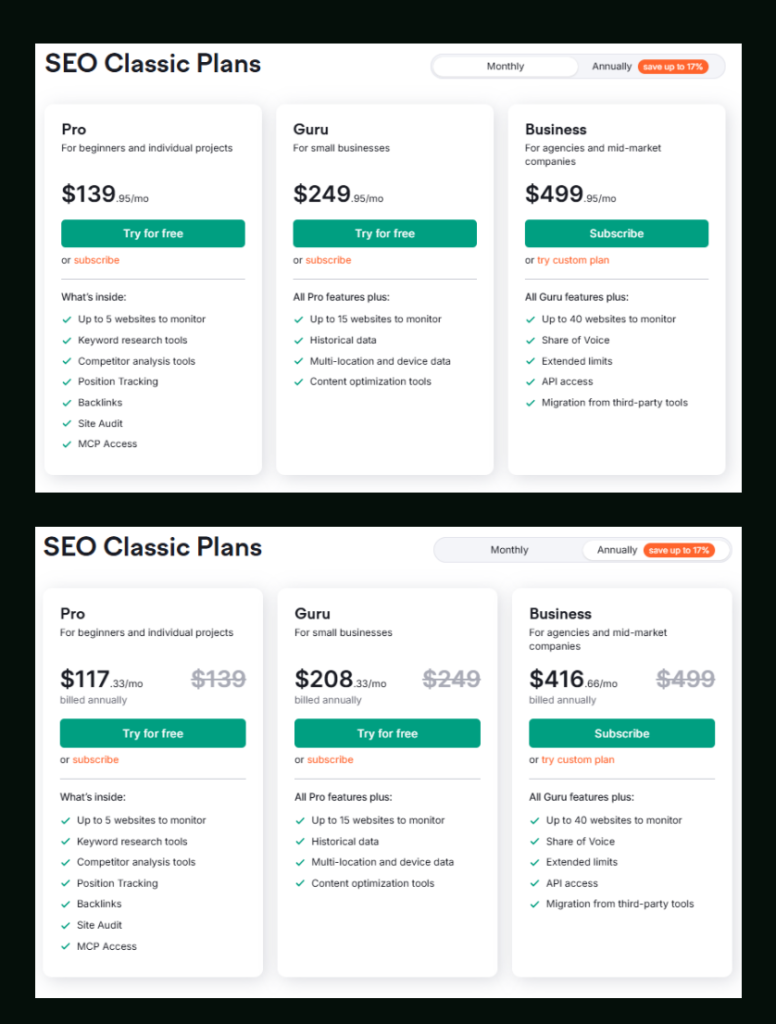
Both Pro and Guru come with a free trial — so you can actually test the data quality yourself before committing. That’s the best way to judge whether the estimates align with what you’re seeing in GSC for your own properties.
If you want to test it properly, grab the Semrush free trial here and run your own domain through the Organic Research and Position Tracking tools on day one.
Semrush SEO Free Trial ( Pro & Guru )
Get full Pro access for 7 days — keyword research, site audit, backlink analysis & competitor research. No charge until after the trial ends.
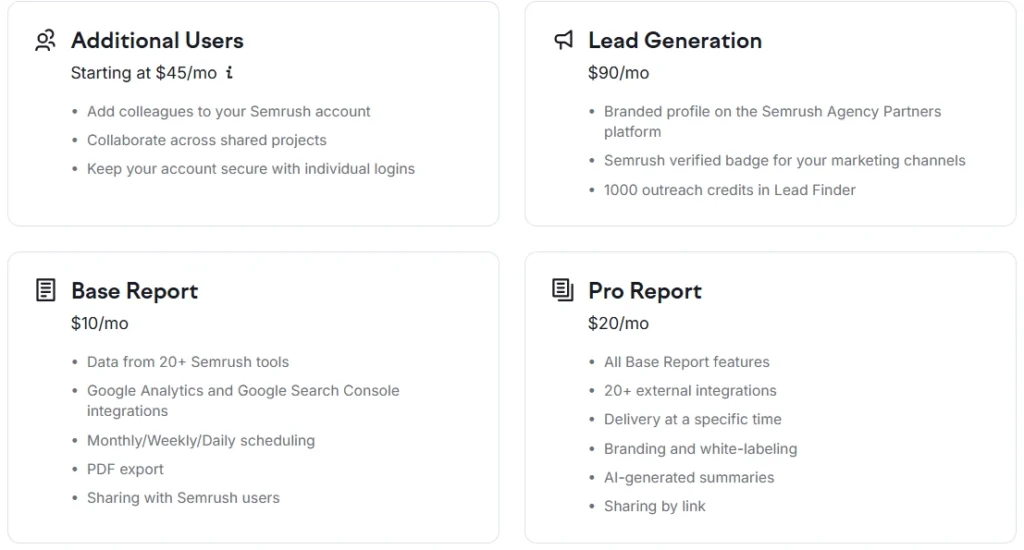
Start Your Semrush 7-Day Free Trial→Add-ons are also available if you need to extend functionality:
- Additional Users: from $45/month
- Lead Generation: $90/month
- Base Report: $10/month
- Pro Report: $20/month
Where It Falls Short (And What to Do About It)
No data source is perfect — and Semrush is upfront about that if you read their methodology documentation.
The gaps worth knowing about:
Fresh content: There’s always a lag between when new content is published and when Semrush picks it up. If a competitor published a piece last week, it might take weeks before you see keyword ranking data for it.
Small or niche markets: Clickstream data is less reliable in smaller markets where sample sizes are thin. If you’re operating in a very niche vertical or a smaller country market, take the volume data with more skepticism than usual.
JavaScript-heavy sites: JavaScript rendering for Site Audit is only available on Guru and Business — not Pro. If your site relies heavily on JS for content rendering, this is a real limitation of the entry plan.
So, Should You Trust Semrush Data?
Yes — with the right expectations in place.
Use it for direction, competitive signals, and trend analysis. Don’t use it to report exact traffic numbers to a client as if they were pulled from their analytics platform.
Karan Rajput puts it this way when advising clients: treat Semrush like a compass, not a GPS. It tells you which direction to move — it won’t give you turn-by-turn precision.
For the price of entry, especially with the annual discount bringing Pro down to $117.33/month, the data infrastructure you’re getting access to is genuinely substantial. The combination of crawler data, clickstream modeling, and SERP tracking is more sophisticated than most people give it credit for.
If you want to see how it compares against a more budget-friendly option before committing, Semrush vs Mangools is a useful read — particularly for freelancers weighing cost vs. data depth.
Best Semrush Alternatives to Consider
If Semrush’s pricing feels steep after the trial, these three tools cover most of what you need at a lower price point — SE Ranking, Mangools, and Ubersuggest all offer free trials too.
SE Ranking
More affordable entry pricing, solid rank tracking and audit features. Good for small agencies and freelancers who don’t need Semrush’s full data depth.
Try SE Ranking →Mangools
Beginner-friendly, clean UI, strong keyword and SERP tools at a much lower price point. Perfect for solo bloggers who need keyword research without the complexity.
Try Mangools →Ubersuggest
Neil Patel’s SEO Tool — keyword research, site audit, and competitor analysis at a very affordable price. Great for beginners and small business owners on a tight budget.
Try Ubersuggest →
Semrush SEO Free Trial
Get full Pro access for 7 days — keyword research, site audit, backlink analysis & competitor research. No charge until after the trial ends.
Start Your Semrush 7-Day Free Trial →Frequently Asked Questions
Does Semrush get data directly from Google?
Not directly. Semrush doesn’t have API access to Google’s internal data. It builds its keyword and ranking data by crawling SERPs, modeling clickstream signals, and running its own web crawler. The result is a close approximation — but it’s always an estimate, not a direct feed from Google’s systems.
How accurate is Semrush traffic data?
Reasonably accurate for directional analysis, less reliable for exact figures. In testing, Semrush traffic estimates for established sites tend to be within a sensible range of actual GSC data — but can sometimes be off by 20–40% for individual pages. Always validate against your own Google Search Console data when precision matters.
Why does Semrush show different keyword volumes than Google Keyword Planner?
Because they use different methodologies. Google Keyword Planner uses Google’s internal ad data and rounds volumes into broad ranges. Semrush uses clickstream modeling and its own search volume estimation system. Neither is definitively “correct” — they’re measuring different things. For a full breakdown, see the Semrush vs Google Keyword Planner comparison.
How often does Semrush update its database?
Semrush updates keyword metrics and ranking data on a rolling basis. Position Tracking runs daily updates. Domain-level keyword data typically refreshes monthly for most markets, though high-traffic keywords update more frequently. The Guru and Business plans offer significantly higher keyword metric update allowances — 1,000 and 5,000 per month, respectively, versus 250 on Pro.
Can I try Semrush before paying to check data quality?
Yes — both Pro ($139.95/month) and Guru ($249.95/month) plans include a free trial. It’s genuinely the best way to validate whether the data aligns with your use case. You can start the free trial here and run your own site through the core tools to compare against what you already know from GSC.
Does Semrush have a backlink crawler of its own?
Yes. SemrushBot is Semrush’s proprietary web crawler, and it’s responsible for building and maintaining the backlink database. It’s one of the more active crawlers in the industry. Backlink data updates happen continuously as the crawler discovers new and lost links.
Everything You Need About Semrush Free Trial
Activate your Semrush free trial directly, read our step-by-step guide on how to get it, or learn how to cancel before getting charged — all in one place.
Start Semrush Free Trial
Get full Pro access for 7 days — keyword research, site audit, backlink analysis & competitor research. No charge until after the trial ends.
Start Free Trial →How to Get Free Trial
Step-by-step guide to activate your Semrush free trial — what you unlock, how to use it right, and how to get maximum value in 7 days.
Read Full Guide →How to Cancel Trial
Don’t get charged by mistake. Step-by-step guide to cancel your Semrush trial before the billing date — timing tips included.
Read Cancel Guide →