Most people frame this comparison wrong.
They line up the feature lists, count the checkmarks, and declare a winner — without ever asking the more important question: who actually needs what?
I’ve used both tools across different types of projects. Semrush on agency-level campaigns where competitive data had to be precise. Mangools, when I was building out niche sites and needed fast, clean keyword data without navigating a dashboard that felt like a cockpit. They’re not direct competitors in the way most reviews suggest — they solve different problems, for different users, at very different price points.
Here’s what I actually found.
Semrush vs Mangools: Quick Answer
Semrush is a full-scale SEO and marketing platform with deep competitive intelligence, content tools, and advertising data — starting at $139.95/mo (or $117.33/mo billed annually). Mangools is a focused, beginner-friendly SEO suite built around keyword research and rank tracking, starting at just $30.50/mo (or $18.85/mo annually). If budget and simplicity matter, Mangools wins. If you need power across multiple SEO dimensions, Semrush is in a league of its own.
The Tools at a Glance — Before the Deep Dive
Let me be direct: Mangools and Semrush are not evenly matched on features. Semrush has a significantly larger toolset. But feature count doesn’t equal value — and for a lot of users, Mangools does 80% of what they actually need at 15% of the cost.
Semrush covers keyword research, competitor analysis, site audits, backlink analytics, content marketing tools, position tracking, advertising intelligence, social media management, and local SEO. It’s genuinely one of the most comprehensive platforms in the industry.
Mangools focuses on five core tools: KWFinder (keyword research), SERPChecker (SERP analysis), SERPWatcher (rank tracking), LinkMiner (backlink analysis), and SiteProfiler (domain analysis). Now it also bundles AI Search Watcher PRO across all plans — which is actually a notable addition for 2026.
Pricing — The Number That Changes Everything
This is where the comparison gets real.
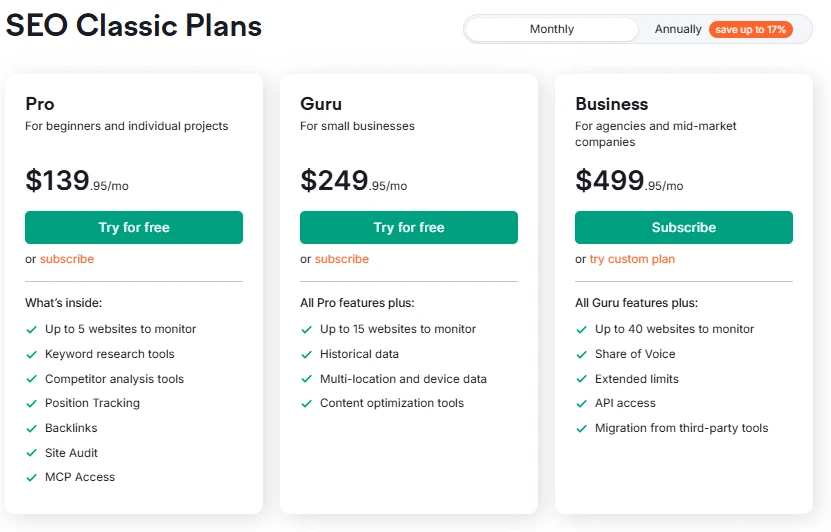
Semrush Pricing
| Plan | Monthly | Annually (per mo) |
|---|---|---|
| Pro | $139.95 | $117.33 |
| Guru | $249.95 | $208.33 |
| Business | $499.95 | $416.66 |
Semrush Monthly Plan
Semrush Annually Plan
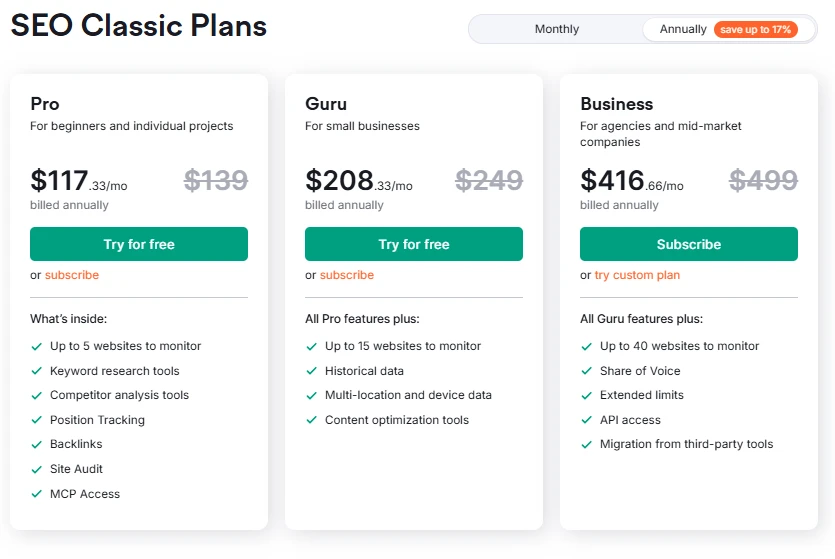
Pro covers up to 5 websites, keyword research, competitor analysis, position tracking (500 keywords), backlinks, site audit, and MCP access. Free trial available.
Guru adds historical data, multi-location and device data, content optimization tools, 15 websites to monitor, 1,500 keywords to track, JavaScript rendering in site audit, and Looker Studio integration. Free trial available.
Business is built for agencies — 40 websites, 5,000 keywords tracked, Share of Voice, API access, extended limits, and migration from third-party tools. No free trial; direct subscription only.
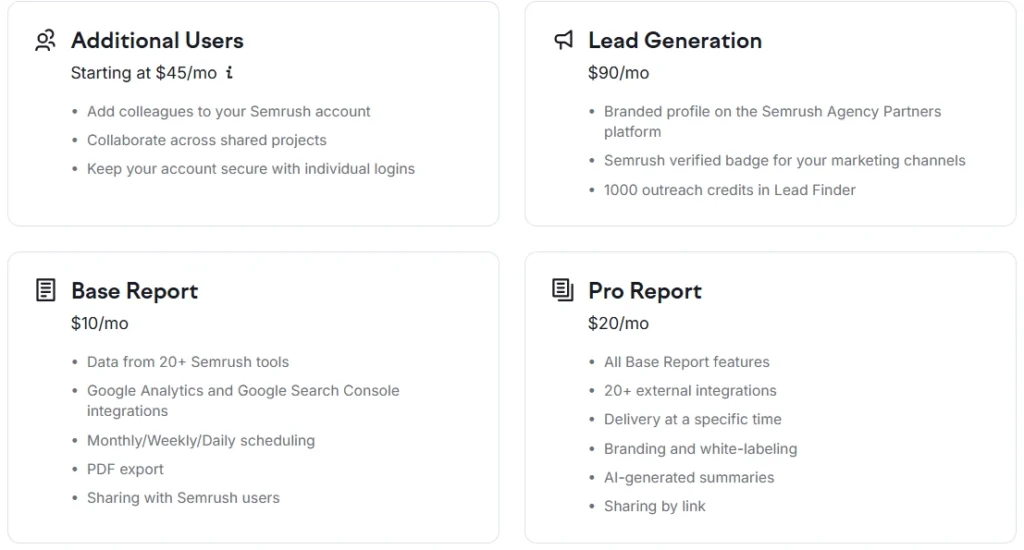
Semrush also offers add-ons if you need to extend your plan:
- Additional Users — from $45/mo
- Lead Generation — $90/mo (Semrush Agency Partners badge + 1,000 Lead Finder credits)
- Base Report — $10/mo (automated reports from 20+ tools, PDF export, Google Analytics/GSC integration)
- Pro Report — $20/mo (white-labeling, AI summaries, 20+ integrations, delivery scheduling)
Pro and Guru users can start with a free trial here before committing.
Mangools Pricing
| Plan | Monthly | Annually (per mo) | Annual Total |
|---|---|---|---|
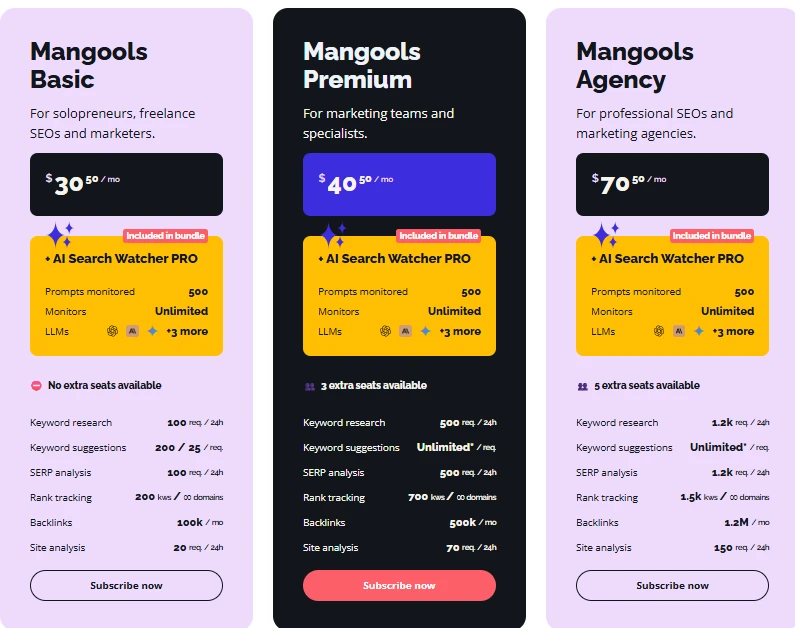
| Basic | $30.50 | $18.85 | $226.20 |
| Premium | $40.50 | $26.35 | $316.20 |
| Agency | $70.50 | $48.85 | $586.20 |
Mangools Monthly Plan
Mangools Annually Plan
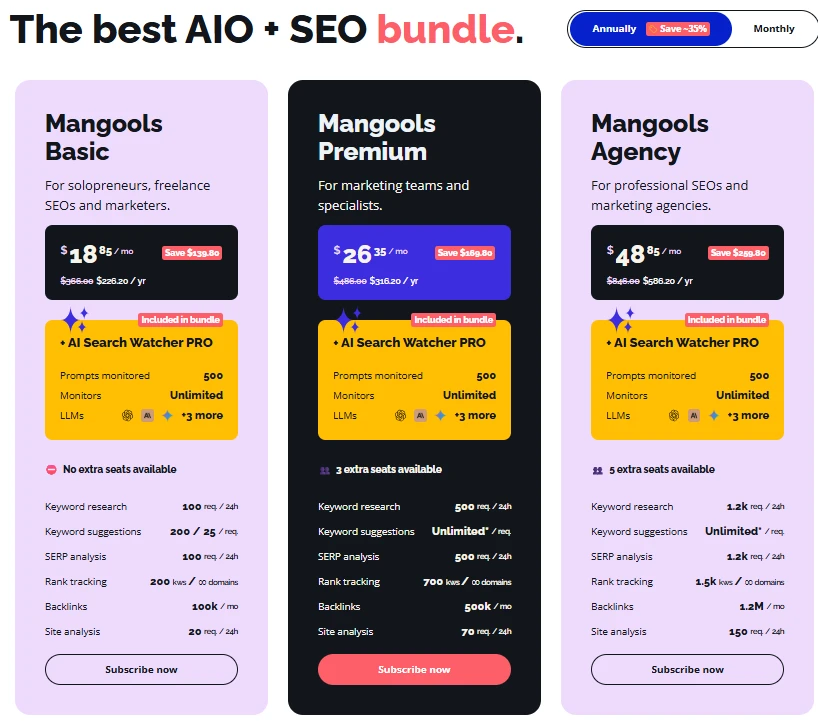
Every plan includes AI Search Watcher PRO — 500 prompts monitored, unlimited monitors, and coverage across multiple LLMs. That’s actually a smart differentiator Mangools has built in for 2026, given how much AI-driven search is changing SEO.
The Basic plan fits solopreneurs and freelance SEOs well. No extra seats, but the core limits — 100 keyword research requests/24h, 200 keyword suggestions per request, 100k backlinks/mo — are more than enough for solo projects.
Premium is where teams come in — 3 extra seats, 500 keyword research requests/24h, unlimited keyword suggestions, 500k backlinks/mo.
Agency goes up to 5 extra seats, 1.2k keyword research requests/24h, 1.2M backlinks/mo, and 1.5k rank tracking keywords across unlimited domains.
One thing worth mentioning: Mangools has a 48-hour money-back guarantee — not the longest window, but it’s clean and no-questions-asked.
Feature Comparison — Where Each Tool Actually Wins
Keyword Research
Both tools do keyword research well — but differently.
Semrush gives you volume, KD, CPC, competitive density, and keyword intent, plus SERP feature analysis and topic clustering. The Guru plan unlocks Topics, which help with content planning at scale. On Pro, you get 250 keyword metric updates per month; Guru gives 1,000; Business gives 5,000.
Mangools’ KWFinder is genuinely one of the cleaner keyword tools I’ve used. The interface doesn’t overwhelm you. In my testing on a niche site project, I found low-competition keywords in under 5 minutes that I might have spent 20 minutes chasing in Semrush’s more layered interface. That’s not a knock on Semrush — it’s just a different UX philosophy.
Rank Tracking
Semrush’s Position Tracking tracks up to 500 keywords on Pro, 1,500 on Guru, and 5,000 on Business — with daily updates and mobile data on all plans. Share of Voice (competitive visibility metric) only unlocks on Business.
Mangools tracks 200 keywords/unlimited domains on Basic, 700 on Premium, and 1,500 on Agency. Decent range, but Semrush wins here on depth — especially with Keyword Cannibalization reports (Guru+) and the Organic Traffic Insights feature.
Site Audit
Semrush crawls 100,000 pages/month on Pro, 300,000 on Guru, and 1,000,000 on Business. JavaScript rendering — which matters a lot for modern SPAs and dynamic content — is Guru and above only. AI Search Site Audit is included across all plans now.
Mangools has SiteProfiler, but it’s primarily a domain authority and backlink profile tool, not a deep technical crawler. If technical SEO auditing is a major part of your workflow, Semrush has a clear edge.
Backlink Analysis
Semrush’s backlink database is industry-leading. Mangools’ LinkMiner is capable — with 100k backlinks/mo on Basic scaling to 1.2M on Agency — but Semrush goes deeper in historical data, authority scoring, and link gap analysis.
What Mangools Has That’s Genuinely Useful in 2026
The AI Search Watcher PRO bundled across all Mangools plans is something worth paying attention to. With Google’s AI Overviews and other LLM-driven search features reshaping organic traffic, being able to monitor how your brand or keywords appear in AI-generated results is becoming more important. Most tools charge extra for this or don’t have it at all.
Who Should Actually Use Which Tool
Choose Mangools if:
- You’re a blogger, niche site builder, or freelance SEO
- Budget is a real constraint, and you need core SEO done right
- You want a clean UX without a steep learning curve
- AI search monitoring matters to you, and you don’t want to pay extra for it
Choose Semrush if:
- You’re running multiple client projects or an agency
- You need competitive intelligence beyond just keywords — traffic analytics, advertising data, and content gaps
- Historical data, Share of Voice, and API access are workflow requirements
- You want everything in one platform without stitching tools together
There’s also a middle path worth mentioning: some SEOs actually use Mangools for keyword discovery (faster, cleaner) and layer Semrush on top for competitive and content work. It’s a slightly higher combined cost, but if you’re already on Mangools Basic annually ($18.85/mo) and Semrush Pro annually ($117.33/mo), you’re getting a genuinely powerful stack for around $136/mo total.
Pros and Cons — Straight Up
Semrush
Pros:
- Massive toolset — SEO, content, social, advertising, local, competitor intel
- Industry-leading keyword and backlink database
- Historical data on Guru+
- Free trial on Pro and Guru plans
- Strong reporting with Looker Studio integration
Cons:
- Expensive — Pro starts at $139.95/mo
- Can feel overwhelming for beginners
- The business plan has no free trial
- Add-ons stack up quickly if you need extra users or advanced reports
Mangools
Pros:
- Affordable entry point — $30.50/mo, $18.85/mo annually
- Clean, beginner-friendly interface
- AI Search Watcher PRO is included on all plans
- 48-hour money-back guarantee
- Solid keyword research with KWFinder
Cons:
- No deep technical site audit capability
- Backlink database smaller than Semrush or Ahrefs
- The basic plan has no extra seats
- Limited to agencies or multi-client workflows

Semrush SEO Free Trial
Get full Pro access for 7 days — keyword research, site audit, backlink analysis & competitor research. No charge until after the trial ends.
Start Your Semrush 7-Day Free Trial →Semrush vs Mangools — Frequently Asked Questions
Is Semrush better than Mangools?
Depends on what you need. Semrush is a full-scale SEO platform with competitor analysis, content tools, advertising data, and deep backlink intelligence. Mangools is a focused keyword and rank tracking suite that’s much easier to use. If you’re running an agency or need serious competitive data, Semrush wins. For bloggers and solo SEOs on a budget, Mangools honestly gets the job done.
Which tool is cheaper — Semrush or Mangools?
Mangools is significantly cheaper. The Basic plan starts at $30.50/mo (or just $18.85/mo billed annually). Semrush Pro starts at $139.95/mo — nearly five times the price. That said, you’re also getting five times more tools with Semrush, so the price difference makes sense depending on your use case.
Does Semrush offer a free trial?
Yes — Semrush offers a free trial on both the Pro ($139.95/mo) and Guru ($249.95/mo) plans. A business plan doesn’t have a free trial; it goes straight to subscription. You can grab the Semrush free trial here.
Does Mangools offer a free trial?
Mangools doesn’t have a traditional free trial, but they offer a 48-hour money-back guarantee on all plans — no questions asked. So you can subscribe, test it properly, and get a full refund within 48 hours if it’s not for you. Just note this doesn’t apply to two consecutive subscriptions.
Which is better for keyword research — Semrush or Mangools?
Both are solid, but in different ways. Semrush gives you more data layers — intent, topic clustering, keyword gap analysis, and CPC data for paid campaigns. Mangools’ KWFinder is cleaner and faster for finding low-competition keywords quickly. In my experience, if you just need good keyword data without the noise, KWFinder is genuinely one of the better tools out there.
Can a complete beginner use Semrush?
Yes, but there’s a learning curve. Semrush has a lot going on — the dashboard is feature-heavy, and it can feel overwhelming when you first log in. Mangools is much more beginner-friendly. If you’re just starting, Mangools is the easier entry point. You can always move to Semrush once you know what you’re doing with SEO.
Which plan is best for a freelance SEO?
If you’re going with Mangools, the Basic plan at $18.85/mo annually covers most solo SEO work. For Semrush, the Pro plan at $117.33/mo annually is the starting point — it covers up to 5 websites, 500 keywords tracked, full keyword and competitor tools, and MCP access. Guru makes more sense once you need historical data or content optimization features.
Can I use Semrush and Mangools together?
You can, and some SEOs actually do. Mangools for fast keyword discovery, Semrush for competitive intelligence, and content strategy. If you’re on Mangools Basic annually ($18.85/mo) and Semrush Pro annually ($117.33/mo), you’re looking at roughly $136/mo combined — which is a genuinely strong SEO stack for the price.
Which tool is better for agencies?
Semrush, without question. The Business plan covers 40 websites, tracks 5,000 keywords, includes API access, Share of Voice, white-label reporting via add-ons, and migration from third-party tools. Mangools Agency allows 5 extra seats and handles decent volume, but it’s not built for large-scale client management the way Semrush is.
Should I start with Mangools and switch to Semrush later?
That’s actually a reasonable approach. Start with Mangools to build your SEO fundamentals — keyword research, rank tracking, and basic backlink analysis. Once your projects or client base grow and you need deeper competitive data, historical trends, or content tools, that’s when Semrush starts making financial sense. No need to jump straight to the most expensive tool if you’re just getting started.
The Honest Verdict
If you’re early in your SEO journey — building your first niche site, working solo, or just starting to take keyword research seriously — Mangools at $18.85/mo annually is a smart, low-risk place to start. You get real tools, not a watered-down experience, and the AI Search Watcher PRO addition shows they’re actually keeping pace with where search is going.
If you’re running a business, managing clients, or need the kind of competitive depth that informs strategic decisions — not just content decisions — Semrush justifies its price. The Guru plan at $208.33/mo annually is probably the sweet spot for most agencies, with historical data, content tools, and 15 sites to monitor.
What I’d suggest: start with Semrush’s free trial and run it alongside your current workflow for a week. If you’re not using more than 20% of it, Mangools is likely the better fit. If you find yourself wanting more, you’ll know Semrush is worth it.
Want to dig deeper before deciding? Here are a few related reads that might help:
- How to Get Semrush Free Trial — step-by-step if you’ve never done it before
- Semrush Pro vs Guru — if Semrush feels right, but you’re stuck on which plan
- How to Use Semrush for Free — workarounds if you’re not ready to pay
- Semrush vs Ahrefs — if you’re also considering Ahrefs in the mix
- Semrush vs SE Ranking — a budget-friendly Semrush alternative worth knowing
And if you want to give Mangools a proper look, explore Mangools here.
Best Semrush Alternatives to Consider
If Semrush’s pricing feels steep after the trial, these three tools cover most of what you need at a lower price point — SE Ranking, Mangools, and Ubersuggest all offer free trials too.
SE Ranking
More affordable entry pricing, solid rank tracking and audit features. Good for small agencies and freelancers who don’t need Semrush’s full data depth.
Try SE Ranking →Mangools
Beginner-friendly, clean UI, strong keyword and SERP tools at a much lower price point. Perfect for solo bloggers who need keyword research without the complexity.
Try Mangools →Ubersuggest
Neil Patel’s SEO Tool — keyword research, site audit, and competitor analysis at a very affordable price. Great for beginners and small business owners on a tight budget.
Try Ubersuggest →