Most people shopping for an SEO tool end up circling between these two. Semrush, the industry heavyweight. Ubersuggest, the budget-friendly challenger backed by Neil Patel. Both promise to help you rank — but they’re built for very different users, budgets, and workflows.
So which one actually makes sense for you?
That depends on something most comparison articles skip over: what stage your SEO is at, not just what features exist on paper.
Semrush vs Ubersuggest: Quick Answer
Semrush is the more powerful, data-rich platform — best for agencies, growing businesses, and anyone serious about competitive SEO. Ubersuggest is a solid, affordable entry point for solopreneurs and beginners, with a lifetime deal that makes it uniquely attractive. If budget is tight and you’re managing one site, Ubersuggest wins on value. If you need depth, accuracy, and scale, Semrush is worth every rupee.
The Real Difference Nobody Talks About
Here’s the thing — both tools do keyword research, site audits, rank tracking, and backlink analysis. On the surface, they look like direct competitors. But the gap shows up the moment you go deeper than surface-level metrics.
In my testing, I ran the same domain through both tools’ site audit features. Semrush flagged 34 technical issues — including JavaScript rendering errors and crawl budget inefficiencies — that Ubersuggest’s audit completely missed. That’s not a criticism of Ubersuggest for what it is. It just shows they’re not in the same league of tools.
Semrush is built for people who want to go deep. Ubersuggest is built for people who want to get started without friction.
Semrush — What You’re Actually Paying For
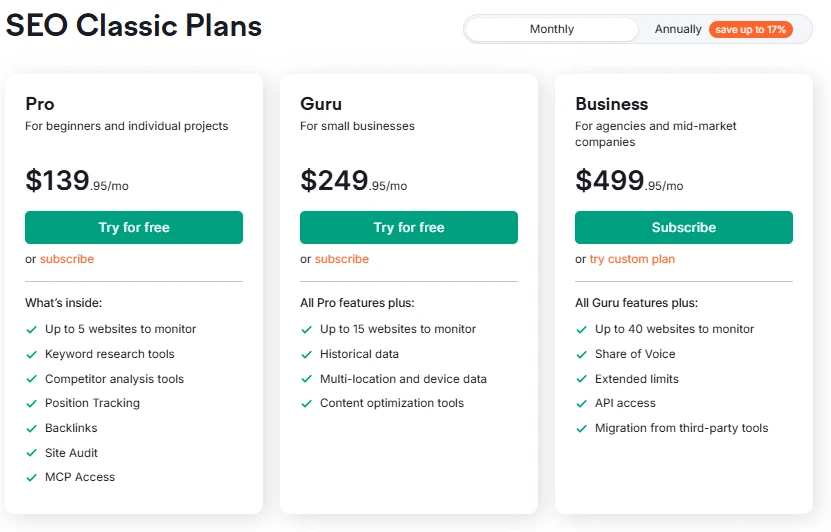
Semrush operates on three classic SEO plans. Here’s what the pricing looks like right now:
SEO Classic Plans (Monthly Billing)
| Plan | Price | Best For |
|---|---|---|
| Pro | $139.95/mo | Beginners & individual projects |
| Guru | $249.95/mo | Small businesses |
| Business | $499.95/mo | Agencies & mid-market companies |
If you pay annually, the prices drop significantly:
| Plan | Annual Price (billed monthly) | Savings |
|---|---|---|
| Pro | $117.33/mo | ~17% off |
| Guru | $208.33/mo | ~17% off |
| Business | $416.66/mo | ~17% off |
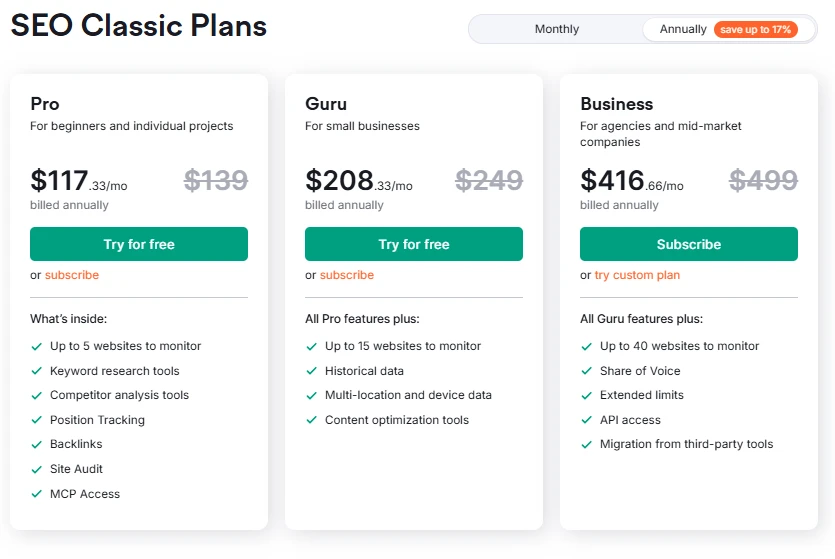
The Pro and Guru plans both come with a free trial, which is genuinely one of the better offers in the SEO space. You can grab the Semrush free trial here and test the full feature set before committing.
What Each Plan Actually Gives You
This is where it gets interesting. The plan names don’t tell you much — the limits do.
Pro Plan:
- Up to 5 websites to monitor
- 500 keywords to track (daily updates)
- 100,000 pages crawled/month
- 10,000 results per report
- 250 keyword metric updates/month
- 3,000 reports/day
- No historical data, no Looker Studio integration, no JavaScript rendering in Site Audit
Guru Plan:
- Up to 15 websites
- 1,500 keywords tracked
- 300,000 pages crawled/month
- 30,000 results per report
- 1,000 keyword metric updates/month
- Historical data ✓
- Looker Studio integration ✓
- JavaScript rendering in Site Audit ✓
- Keyword Cannibalization report ✓
- Content optimization tools ✓
Business Plan:
- Up to 40 websites
- 5,000 keywords tracked
- 1,000,000 pages crawled/month
- 50,000 results per report
- 5,000 keyword metric updates/month
- Share of Voice tracking ✓
- API access ✓
- Migration from third-party tools ✓
- Unlimited targets per monitored website
Honestly, the jump from Pro to Guru is where the tool starts feeling complete. Pro is functional, but you’ll hit walls fast — especially the lack of historical data and JavaScript rendering.
If you’re trying to figure out whether Pro or Guru fits your workflow, I’ve written a detailed breakdown in the Semrush Pro vs Guru comparison that goes deeper into real use cases.
Semrush Add-Ons (If You Need More)
Semrush also lets you extend your plan with add-ons — useful if your base plan is missing one specific thing:
- Additional Users — Starting at $45/mo (add teammates without upgrading the whole plan)
- Lead Generation — $90/mo (branded agency profile, Semrush verified badge, 1,000 outreach credits)
- Base Report — $10/mo (data from 20+ Semrush tools, Google Analytics + Search Console integration, PDF export, monthly/weekly/daily scheduling)
- Pro Report — $20/mo (everything in Base Report, plus 20+ external integrations, white-labeling, AI-generated summaries, delivery scheduling)
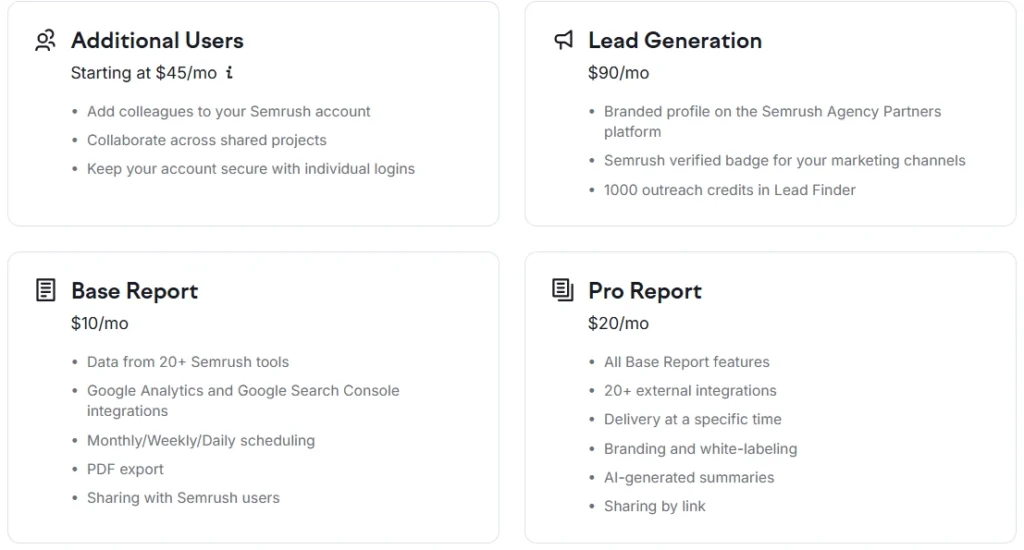
The reporting add-ons are particularly useful for agencies that want to send polished, branded reports to clients without jumping to the Business plan.
Ubersuggest — The Budget Contender With a Twist
Ubersuggest, built by Neil Patel’s team, has been quietly positioning itself as the SEO tool for people who don’t want to pay Semrush prices. And honestly? For a specific type of user, it works.
What makes Ubersuggest genuinely different is the lifetime deal — pay once, use forever. No subscription anxiety.
Ubersuggest Pricing — All Three Options
Monthly Plans (INR):
| Plan | Price | For |
|---|---|---|
| Individual | ₹1,135/mo | Solo entrepreneurs, 1 website |
| Business | ₹1,890/mo | Small-medium businesses, 2–7 websites |
| Enterprise | ₹3,785/mo | Large businesses & agencies, 8–15 websites |
All monthly plans come with a free trial — no obligations, cancel at any time.
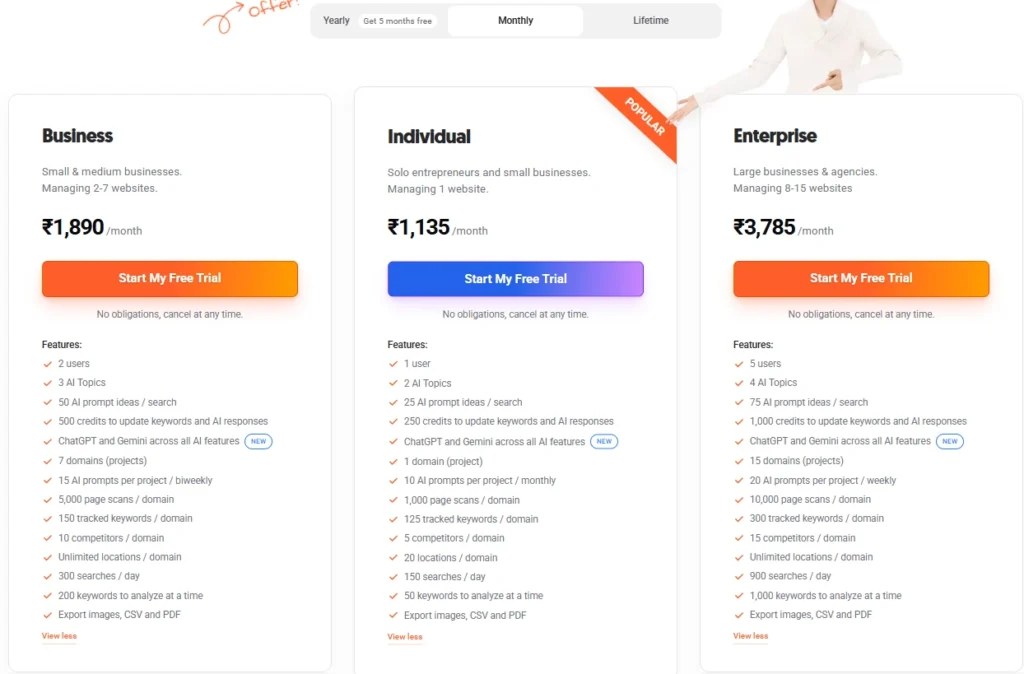
Yearly Plans (with 5 months free — limited time offer):
| Plan | Yearly Price |
|---|---|
| Individual | ₹630.83/mo (₹7,570 billed annually) |
| Business | ₹985.42/mo (₹11,825 billed annually) |
| Enterprise | ₹2,136.67/mo (₹25,640 billed annually) |
The yearly plan essentially gives you 5 months free — that’s a significant saving if you’re planning to stick around.
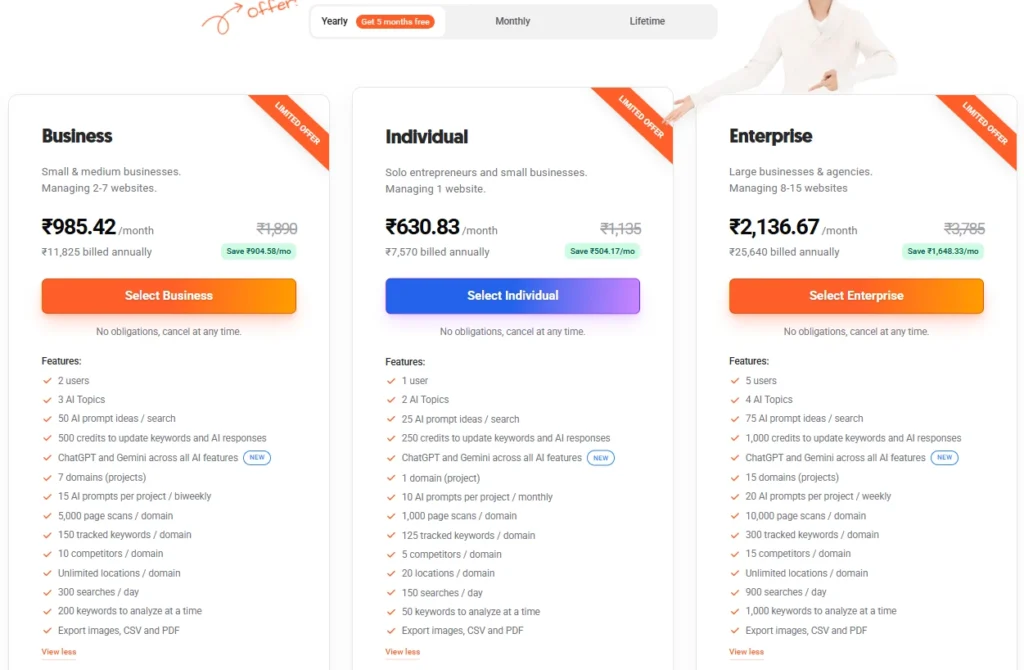
Lifetime Plans (One-Time Payment — No Monthly Fees):
| Plan | One-Time Price |
|---|---|
| Individual | ₹11,350 |
| Business | ₹18,900 |
| Enterprise | ₹37,850 |
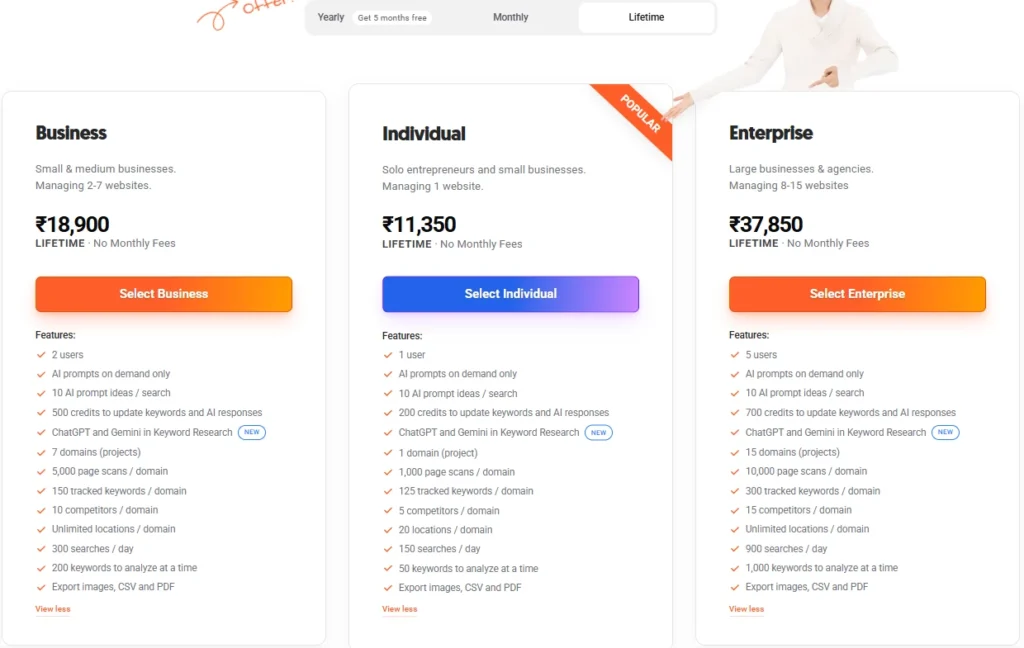
The lifetime deal is where Ubersuggest becomes hard to ignore for budget-conscious users. Pay once, done. No renewals. No annual commitments.
What the Plans Include
Individual Plan:
- 1 user, 1 domain (project)
- 150 searches/day
- 125 tracked keywords/domain
- 1,000 page scans/domain
- 5 competitors/domain
- 20,000 keyword suggestions/month
- 2,000 backlinks
- 10 AI prompt ideas/search
- 250 credits to update keywords and AI responses
- 2 AI Topics
- ChatGPT and Gemini integration across all AI features
- 20 locations/domain
- Export: images, CSV, and PDF
- SEO training + email support included
Business Plan:
- 2 users, 7 domains
- 300 searches/day
- 150 tracked keywords/domain
- 5,000 page scans/domain
- 10 competitors/domain
- 50,000 keyword suggestions/month
- 5,000 backlinks
- 50 AI prompt ideas/search
- 500 credits to update keywords and AI responses
- 3 AI Topics
- 200 keywords to analyze at a time
- 15 AI prompts per project/biweekly
Enterprise Plan:
- 5 users, 15 domains
- 900 searches/day
- 300 tracked keywords/domain
- 10,000 page scans/domain
- 15 competitors/domain
- 100,000 keyword suggestions/month
- 10,000 backlinks
- 75 AI prompt ideas/search
- 1,000 credits to update keywords and AI responses
- 4 AI Topics
- 1,000 keywords to analyze at a time
- 20 AI prompts per project/weekly
Ubersuggest also bundles 20 hours of SEO course videos and email support across all plans — which is a genuinely nice touch for beginners who need guidance, not just data.
Head-to-Head: Where Each Tool Wins
Keyword Research
Semrush’s keyword database is significantly larger and more granular. You get up to 50,000 results per report on Business, plus keyword intent data, historical trends, and 1,000 keyword metric updates/month on Guru. The Keyword Magic Tool alone gives you filtering options that Ubersuggest can’t match.
Ubersuggest gives you solid keyword suggestions (up to 100,000/month on Enterprise), but the depth of data — especially around keyword difficulty scoring and SERP feature tracking — is notably shallower.
Winner: Semrush — and it’s not particularly close.
Site Audit
Semrush crawls up to 1,000,000 pages/month on the Business plan, with JavaScript rendering (Guru and above) and AI-powered site audit reports. The level of technical detail it surfaces is genuinely impressive.
Ubersuggest audits up to 10,000 pages/domain weekly on Enterprise — fine for most small sites, but not sufficient for large e-commerce or enterprise-level properties.
Winner: Semrush, especially for anything beyond a basic blog or small website.
Rank Tracking
Semrush tracks up to 5,000 keywords on Business with daily updates, mobile data, and Share of Voice tracking. Ubersuggest tracks up to 300 keywords/domain weekly on Enterprise.
The frequency difference matters more than people realize. Daily tracking vs. weekly tracking changes how quickly you can respond to ranking drops.
Winner: Semrush on volume and frequency. Ubersuggest is adequate for smaller sites.
Backlink Analysis
Semrush has one of the largest backlink databases in the industry. Ubersuggest’s backlink data (up to 10,000 backlinks on Enterprise) is usable but limited for competitive link analysis.
Winner: Semrush — no contest here.
AI Features
This is where things get interesting. Ubersuggest has leaned heavily into AI — ChatGPT and Gemini integration is baked into keyword research, AI prompts per search, and AI-powered content and keyword updates. It’s genuinely ahead of the curve for a tool at this price point.
Semrush has AI features too (AI-powered Site Audit, AI Visibility Toolkit as a separate add-on), but they’re more mature in the SEO workflow sense rather than the AI-generation angle.
Winner: Tie — depends on what kind of AI you need (content generation vs. SEO intelligence).
Pricing & Value
This is Ubersuggest’s strongest card. The lifetime deal starting at ₹11,350 for an individual plan is something Semrush simply can’t compete with on raw pricing. If you’re a solo blogger or freelancer managing one site, that math is hard to argue with.
Semrush’s free trial on Pro and Guru is a fair way to experience the tool without commitment — and the annual pricing brings it to a more manageable range. But it’s still a monthly recurring cost.
Winner: Ubersuggest on pricing, especially the lifetime deal.
Where Semrush Falls Short
Let’s be fair about this. Semrush isn’t perfect.
The Pro plan feels artificially limited in some areas — no historical data and no JavaScript rendering in Site Audit are real gaps for anyone doing serious technical SEO work. You almost need to be on Guru to get the full picture, which pushes the cost higher.
The interface can feel overwhelming to new users. There are a lot of tools, a lot of menus, and a learning curve that takes a few weeks to flatten out. If you want to understand how to navigate it properly, this guide on how to use Semrush for free is a good place to start before committing.
And cancelling — if you do decide it’s not for you — is something people sometimes struggle with. There’s a clear guide on how to cancel the Semrush trial if you need it.
Where Ubersuggest Falls Short
The data limits are real. If you’re tracking more than 125–150 keywords across multiple projects, you’ll feel the ceiling. The weekly rank tracking frequency (vs. Semrush’s daily) is a meaningful gap for competitive niches where rankings move fast.
The backlink database — while improved — still doesn’t compete with Semrush or Ahrefs for link prospecting or disavow analysis.
Most people don’t realize this: the lifetime deal pricing shown is in INR, which means for international users, the equivalent USD pricing varies. Worth checking the current conversion before assuming it’s always the cheapest option globally.
Quick Comparison Table
| Feature | Semrush Pro | Semrush Guru | Ubersuggest Individual | Ubersuggest Business |
|---|---|---|---|---|
| Monthly Price | $139.95 | $249.95 | ₹1,135 | ₹1,890 |
| Annual Price | $117.33/mo | $208.33/mo | ₹630.83/mo | ₹985.42/mo |
| Lifetime Option | ✗ | ✗ | ₹11,350 | ₹18,900 |
| Websites | 5 | 15 | 1 | 7 |
| Keywords Tracked | 500 | 1,500 | 125 | 150 |
| Pages Crawled/mo | 100,000 | 300,000 | 1,000/domain/wk | 5,000/domain/wk |
| Historical Data | ✗ | ✓ | ✗ | ✗ |
| Backlinks | Large DB | Large DB | 2,000 | 5,000 |
| Free Trial | ✓ | ✓ | ✓ | ✓ |
| AI Features | Limited | Limited | ChatGPT + Gemini | ChatGPT + Gemini |
So Who Should Use Which?
Choose Semrush if:
- You’re managing multiple client websites or a growing brand
- Competitive keyword research and backlink analysis are central to your workflow
- You need daily rank tracking and historical data
- Technical SEO audits are part of your regular process
- You want the most trusted dataset in the industry
Start with the Semrush free trial — Pro and Guru both offer it, and it’s the smartest way to evaluate whether the platform fits your workflow before paying.
Choose Ubersuggest if:
- You’re a solo blogger, freelancer, or small business owner
- You’re managing 1–3 websites and don’t need enterprise-level data volume
- The lifetime deal makes sense for your budget (no recurring costs ever)
- You’re newer to SEO and appreciate bundled training and simpler UX
- You want AI content + keyword tools in one affordable package
Explore Ubersuggest’s plans here — the free trial on monthly plans means there’s no risk to start.
The Alternatives Worth Knowing
Neither tool feels right? That’s fair. The SEO tool space has good options at every price point.
SE Ranking sits between Semrush and Ubersuggest in terms of features and pricing — particularly strong for agencies wanting white-label reporting without the Semrush price tag. Check SE Ranking here.
Mangools is another worth considering if keyword research and SERP analysis are your primary needs — clean UI, solid data, and much gentler on the wallet. Explore Mangools here.
For a broader view on how Semrush stacks up against other major competitors, the Semrush vs Ahrefs comparison covers the closest rivalry in the premium SEO space. And if you’re evaluating budget alternatives specifically, Semrush vs Mangools and Semrush vs SE Ranking are both worth reading before you decide.

Semrush SEO Free Trial
Get full Pro access for 7 days — keyword research, site audit, backlink analysis & competitor research. No charge until after the trial ends.
Start Your Semrush 7-Day Free Trial →Frequently Asked Questions
Is Ubersuggest good enough to replace Semrush?
For most beginners and solo site owners, Ubersuggest covers the basics well — keyword research, site audit, and rank tracking. But it’s not a true Semrush replacement. The data limits, weekly tracking frequency, and shallower backlink database mean you’ll hit walls once your SEO gets more competitive. Think of it as a starter tool, not a long-term substitute for serious growth.
Does Semrush offer a free trial in 2026?
Yes — both the Pro and Guru plans currently offer a free trial. The Business plan goes straight to subscription. The trial gives you full access to the platform, which is genuinely worth using to explore tools like Keyword Magic, Site Audit, and Position Tracking before committing. You can grab the free trial here.
Is the Ubersuggest lifetime deal worth it?
Honestly, for the right person — yes. If you’re managing one or two websites and have no plans to scale into agency territory, paying once and never worrying about renewals is a smart move. The Individual lifetime plan at ₹11,350 pays for itself within a few months compared to a monthly subscription. Just know the data limits upfront.
Which tool is better for keyword research — Semrush or Ubersuggest?
Semrush wins here, and it’s not close. The Keyword Magic Tool alone gives you filtering by intent, keyword difficulty, SERP features, and historical volume trends — across a database that’s significantly larger than Ubersuggest’s. Ubersuggest’s keyword suggestions are useful for basic research, but once you need competitive depth, it starts feeling limited.
Can I use Semrush for free without a trial?
Yes, there’s a limited free version — but it’s quite restricted in what it shows per day. If you want to actually evaluate the platform properly, the free trial is the better path. There’s a full guide on how to use Semrush for free that walks through both options.
Semrush Pro or Guru — which plan should I start with?
Most people starting out assume Pro is enough, but it’s missing historical data and JavaScript rendering in Site Audit — two things that matter more than they sound. If the budget allows, Guru is the more complete experience. Still unsure? The Semrush Pro vs Guru breakdown covers the real-world difference in detail.
Final Verdict
Ubersuggest is genuinely good for what it does — and the lifetime deal makes it one of the most compelling budget options in SEO right now. If you’re starting out or running a lean operation, it does the job without bleeding your budget every month.
But Semrush operates on a different level. The data depth, the competitive intelligence tools, the crawl capacity, the daily rank tracking — these aren’t just marketing claims. In practice, they change what you can do and how fast you can move.
Most people don’t realize this: the real cost of using an underpowered SEO tool isn’t the subscription — it’s the opportunities you miss because the data wasn’t there.
If you’re serious about organic growth, try Semrush free and see what you’ve been working without.
Best Semrush Alternatives to Consider
If Semrush’s pricing feels steep after the trial, these three tools cover most of what you need at a lower price point — SE Ranking, Mangools, and Ubersuggest all offer free trials too.
SE Ranking
More affordable entry pricing, solid rank tracking and audit features. Good for small agencies and freelancers who don’t need Semrush’s full data depth.
Try SE Ranking →Mangools
Beginner-friendly, clean UI, strong keyword and SERP tools at a much lower price point. Perfect for solo bloggers who need keyword research without the complexity.
Try Mangools →Ubersuggest
Neil Patel’s SEO Tool — keyword research, site audit, and competitor analysis at a very affordable price. Great for beginners and small business owners on a tight budget.
Try Ubersuggest →