Contents
- 1 What Is Semrush?
- 2 The Engine First — Where Semrush Data Actually Comes From
- 3 So What Is Semrush, Exactly?
- 4 How Semrush Actually Works — The Workflow Logic
- 5 What It Costs — Current Pricing
- 6 What Semrush Doesn’t Do Well
- 7 How Semrush Stacks Up Against the Alternatives
- 7.1 Semrush SEO Free Trial
- 7.2 Frequently Asked Questions
- 7.3 What exactly does Semrush do?
- 7.4 How does Semrush get its data — is it accurate?
- 7.5 Does Semrush work for beginners?
- 7.6 What’s the difference between Semrush SEO Classic plans and Semrush One?
- 7.7 How does Semrush compare to Ahrefs?
- 7.8 Can Semrush track how my brand appears in AI answers?
- 7.9 Is there a free trial?
- 7.10 The Real Picture
- 8 Everything You Need About Semrush Free Trial
Imagine you’re about to enter a new niche. You don’t know which keywords to target, who your real competitors are, what’s wrong with your site technically, or whether your brand even shows up when someone asks an AI chatbot a question in your industry.
Semrush is built to answer all of that — from a single platform.
But “what it is” is only half the picture. The more useful question is how it actually works — where does the data come from, how does it get processed, and what does it actually do when you run a search or audit? That’s what most articles skip.
Quick Answer: Semrush is a brand visibility management platform powered by a proprietary dataset built over 17+ years of continuous web crawling — 25B+ keywords, 43T+ backlinks, 260M+ AI prompts, and 800M+ domain profiles. It works by continuously collecting, indexing, and updating data across search engines and AI platforms, then surfacing that data through specialized tools for SEO, competitive research, content, PPC, local SEO, and AI visibility tracking.
What Is Semrush?
Semrush is a brand visibility management platform built for marketers, SEO professionals, and businesses who want to understand — and grow — their presence across search.
It started back in 2008 as a keyword research tool. What it’s become since then is something considerably larger: a centralized intelligence system that tells you where your brand stands in search, where your competitors are pulling ahead, and exactly what needs fixing on your end.
At its core, Semrush lets you:
- Spy on any competitor’s strategy — organic keywords, backlink sources, paid ads, top-performing pages
- Audit your site for technical issues — broken links, crawl errors, page speed problems, Core Web Vitals failures
- Find content opportunities — rankable keywords, topic gaps, content scoring against top competitors
- Track daily rankings — keyword positions across devices and locations
- Monitor AI search visibility — whether your brand gets mentioned in ChatGPT, Gemini, or Perplexity responses
All of this runs on a proprietary database accumulated over 17+ years of continuous web crawling — 25B+ keywords, 43T+ backlinks, 260M+ AI prompts, and 800M+ domain profiles. That data depth is what separates Semrush from lighter tools — it’s not just the features, it’s what’s powering them underneath.
One thing worth saying clearly: most users will only ever use 30–40% of what Semrush offers. That’s completely fine — even that subset is enough to run serious SEO and content operations.
The Engine First — Where Semrush Data Actually Comes From
Most people think of Semrush as a dashboard. That’s the surface. What’s actually running underneath is one of the largest independently maintained SEO datasets in the world.
Here’s how the data pipeline works:
Semrush runs its own web crawlers — constantly. These crawlers scan billions of web pages, index backlinks, track which keywords trigger which URLs in search results, and record SERP features (featured snippets, People Also Ask boxes, local packs, and more). This process has been running for over 17 years without stopping, which is why the database depth is hard to match.
On top of traditional search data, Semrush now also tracks AI-generated answers. It monitors what responses ChatGPT, Gemini, Perplexity, and other LLM platforms generate for millions of prompts — recording which brands get mentioned, how often, and in what context.
The result: when you type any keyword or domain into Semrush, you’re not triggering a live Google search. You’re querying a pre-built, continuously updated proprietary index. That’s why results appear instantly — and why the data can sometimes differ from what you see in Google Search Console directly.
So What Is Semrush, Exactly?
It’s a brand visibility management platform. That’s Semrush’s own official description — and it’s more accurate than calling it an “SEO tool.”
The distinction matters. Traditional SEO tools track rankings and backlinks. Semrush does that too, but it’s built around a broader question: where is your brand visible, and where is it invisible?
That includes:
- Google and Bing search results
- AI-generated answers (ChatGPT, Gemini, Perplexity)
- Local search (Google Maps, local pack)
- Paid search (Google Ads, competitor ad strategies)
- Content performance across topics and channels
When I first started using Semrush with client projects, I made the mistake most people make — I treated it purely as a keyword tool. It took a few months before I started using Domain Overview and the Traffic Analytics module together to build a full picture of a competitor’s strategy: organic traffic sources, paid campaigns, top-performing pages, all cross-referenced. That’s when the platform’s actual value became clear. It’s not a keyword tool with extras. It’s a competitive intelligence system that happens to include keyword research.
How Semrush Actually Works — The Workflow Logic
Understanding Semrush is easier when you understand what question each tool is designed to answer. Here’s how the different parts connect:
You Start With a Question About a Domain or Keyword
Everything in Semrush begins with either a domain (yours or a competitor’s) or a keyword. Enter a competitor’s domain into Domain Overview, and you immediately get: estimated monthly organic traffic, top organic keywords they rank for, their paid keyword activity, top backlink sources, and how their traffic has trended over time.
Enter a keyword into Keyword Overview, and you get: search volume, keyword difficulty score, SERP features currently showing, top-ranking pages, and related keyword variations.
This is the intelligence layer — it tells you where opportunities exist before you do any work.
Then You Investigate Deeper
From that starting point, Semrush lets you drill into specifics:
Keyword Magic Tool
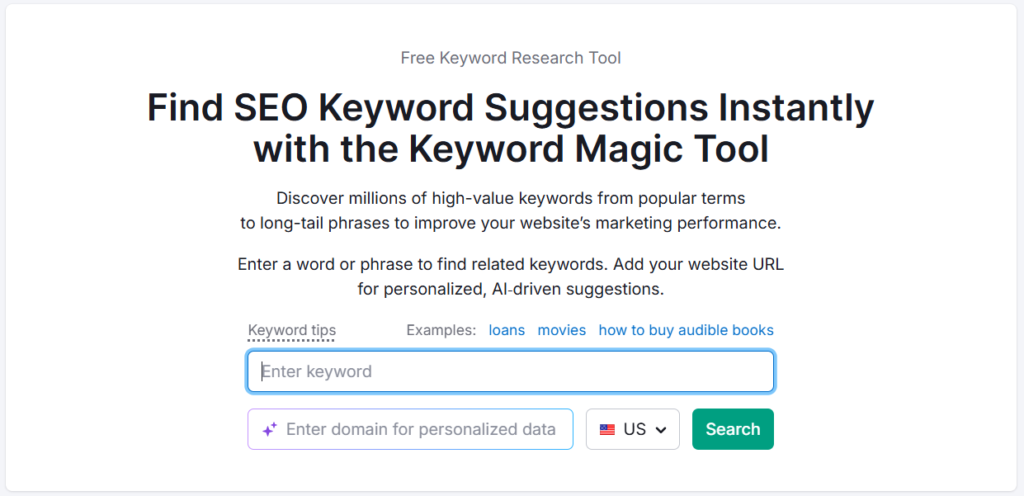
Takes a seed keyword and expands it into thousands of variations, grouped by topic cluster and intent. This is where actual content planning happens. In my experience auditing content strategies for clients, the most valuable part of this tool isn’t the high-volume terms — it’s the filters. Sorting by keyword difficulty under 40 with volume over 500 surfaces genuinely rankable opportunities that most manual research misses.
Organic Research
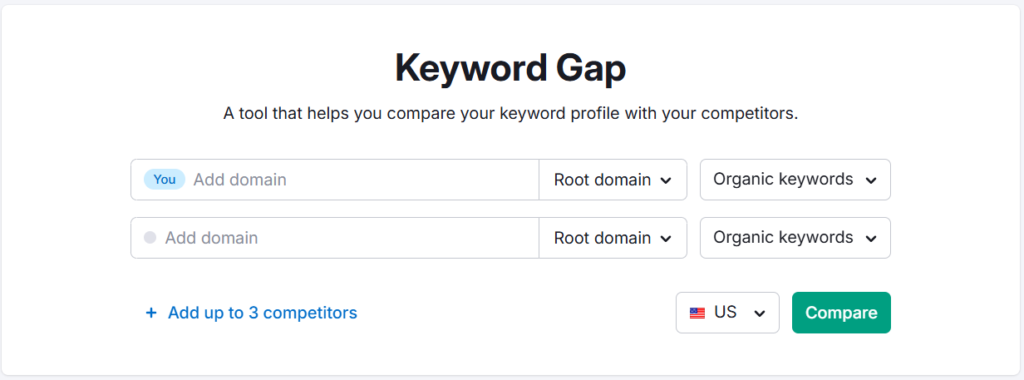
Shows exactly which keywords any domain ranks for, their positions, and estimated traffic per keyword. Combine this with the Keyword Gap tool, and you can identify every keyword a competitor ranks for that you don’t — instantly.
Backlink Analytics
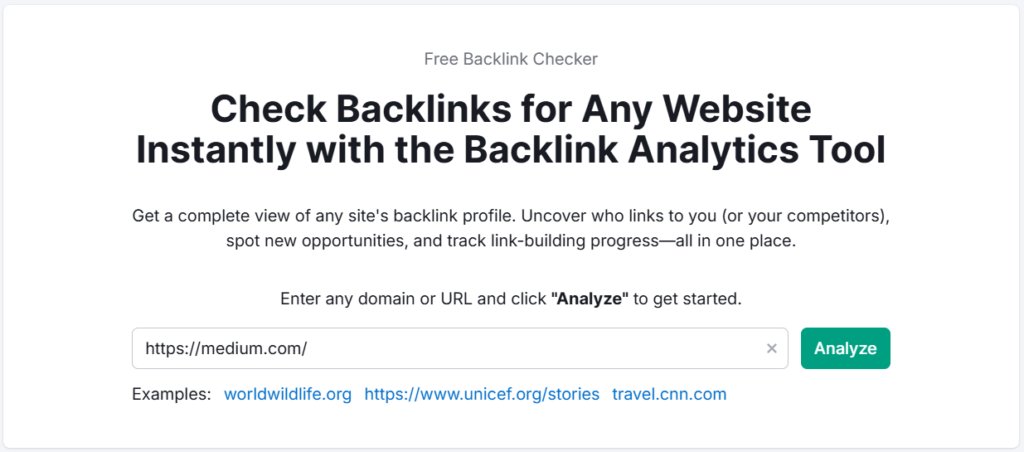
Queries Semrush’s 43T+ backlink index to show referring domains, anchor text distribution, new and lost links over time, and toxic link signals. This works on any domain, not just yours.
Then You Fix What’s Broken
Once you know what to target, the technical layer kicks in:
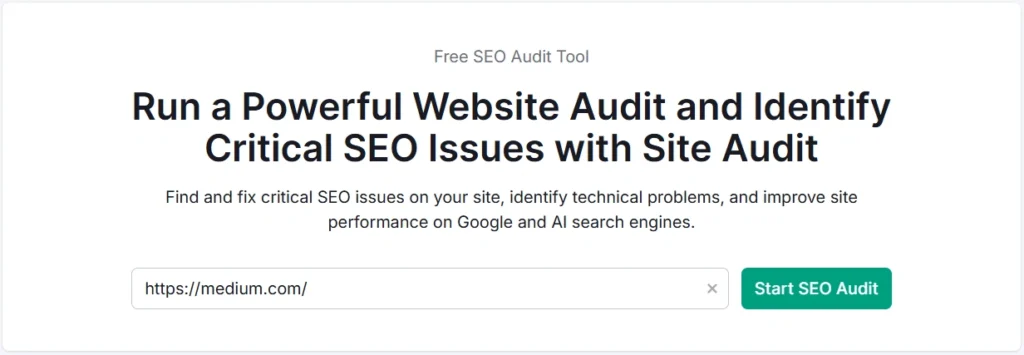
Site Audit crawls your website and surfaces issues affecting crawlability and rankings: broken internal links, slow pages, missing canonical tags, duplicate content, Core Web Vitals failures, and more. The audit doesn’t just list problems — it prioritizes them by severity and explains the fix.
One practical note worth knowing: JavaScript rendering in Site Audit requires Guru plan or above (and Pro+ in Semrush One). On the Pro/Starter tier, the crawler won’t execute JavaScript — meaning if your site uses React, Next.js, or similar frameworks, you’ll get an incomplete picture. I’ve seen this cause real confusion when clients on Pro-level plans wondered why certain page issues weren’t being flagged.
Position Tracking then monitors daily ranking changes for your target keywords — across devices, locations, and SERP features.
Then You Monitor What Competitors Do Next
This is where Semrush separates from simpler tools. You’re not just optimizing your own site — you’re watching the competitive landscape in real time.
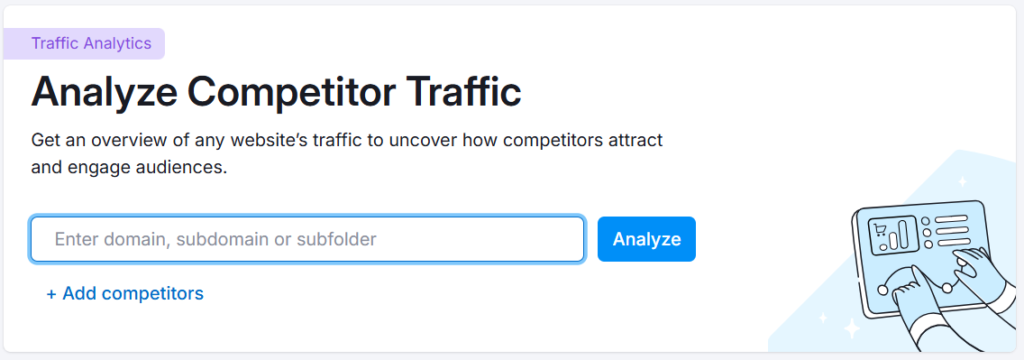
Traffic Analytics estimates competitor traffic sources: organic, paid, direct, referral, and social. Advertising Research shows competitor ad copy, keywords they’re bidding on, and estimated ad spend. Together, these give you a picture of how the market moves — not just where you stand.
And Now — AI Visibility
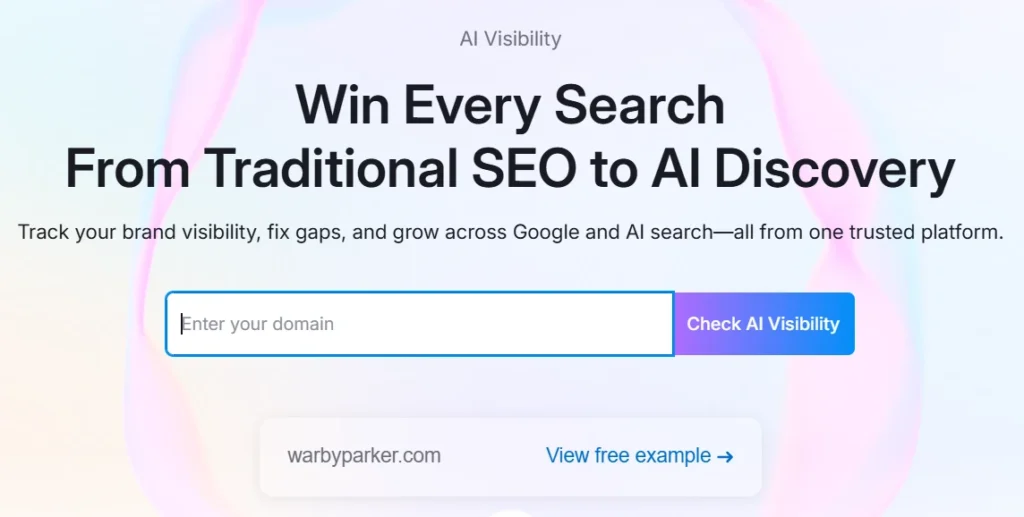
The newest layer in Semrush’s workflow is AI search tracking. Through Semrush One plans and the standalone AI Visibility Toolkit, you can monitor:
- How often does your brand appear in AI-generated answers
- Which AI platforms mention competitors more than you
- What prompts are driving brand citations (and which aren’t)
- Share of voice in AI results over time
This part of the workflow is genuinely new territory for everyone. But the data infrastructure Semrush has built — 260M+ prompts tracked across AI platforms — means it’s already more comprehensive than anything else available for this specific use case.
Two Versions of Semrush Worth Knowing
Before getting into pricing, this distinction trips people up:
Self-serve Semrush — what most marketers and SEOs use. You sign up, start a free trial, and build your stack from modular toolkits. This is what this article covers.
Semrush for Enterprise — custom-configured for large organizations. Includes Enterprise SEO, Enterprise AIO (AI Optimization), and Enterprise SI (Site Intelligence) modules. Custom pricing, dedicated support, advanced integrations.
If you’re not running a large-scale enterprise operation, you’re in the self-serve world.
What It Costs — Current Pricing
Two plan families exist right now. The right choice depends on whether AI visibility tracking is part of your workflow.
SEO Classic Plans — Traditional SEO Focus
| Plan | Monthly | Billed Annually |
|---|---|---|
| Pro | $139.95/mo | $117.33/mo |
| Guru | $249.95/mo | $208.33/mo |
| Business | $499.95/mo | $416.66/mo |
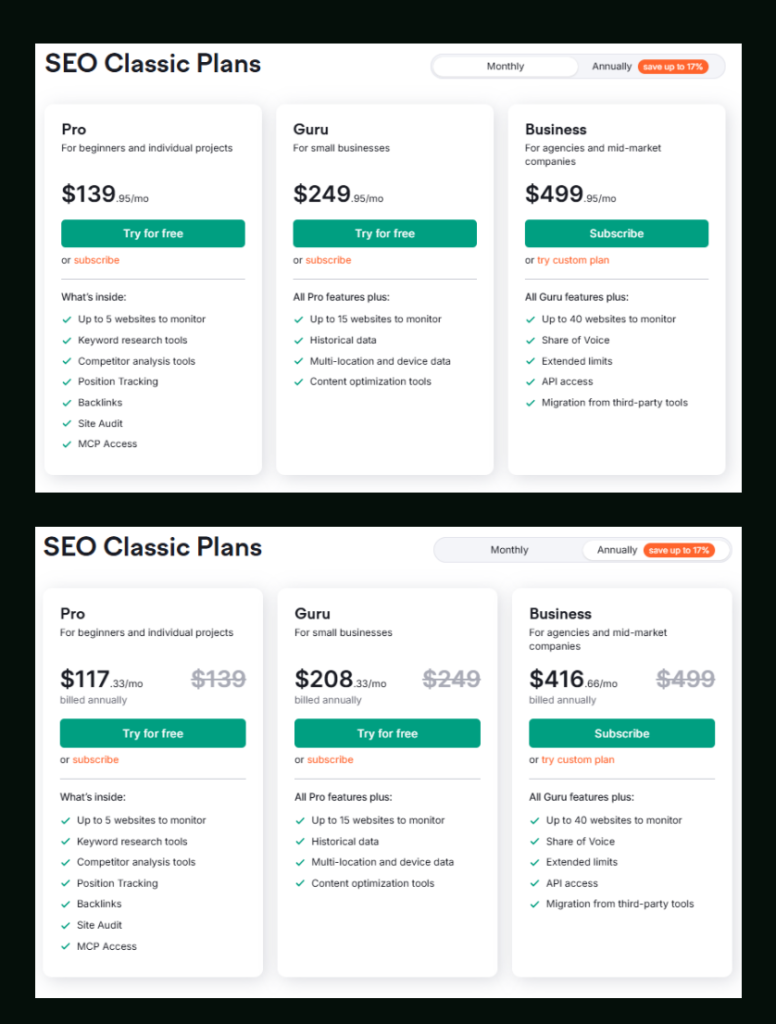
Pro is the entry point: 5 websites, 500 daily tracked keywords, site audit (100K pages/month), backlinks, keyword research, competitor analysis, and MCP access. No historical data, no JavaScript rendering in audits, no Looker Studio integration.
Guru adds the features that matter most for serious content work: historical data, JavaScript rendering in Site Audit, keyword cannibalization reports, multi-location/device tracking, content optimization tools, and 15 websites. The jump in capability between Pro and Guru is meaningful — if you’re comparing both, this breakdown explains the practical differences clearly.
Business is built for agencies: 40 websites, 5,000 daily keywords, 1,000,000 pages crawled/month, API access, Share of Voice tracking, and migration from third-party tools.
Pro and Guru come with a 7-day free trial. Business requires direct subscription.
Semrush One — SEO + AI Visibility Bundled
This is Semrush’s newer unified plan. It combines traditional SEO tools with AI visibility tracking in a single subscription. Currently tagged as “Introductory Pricing.”
| Plan | Monthly | Billed Annually |
|---|---|---|
| Starter | $199/mo | $165.17/mo |
| Pro+ | $299/mo | $248.17/mo |
| Advanced | $549/mo | $455.67/mo |
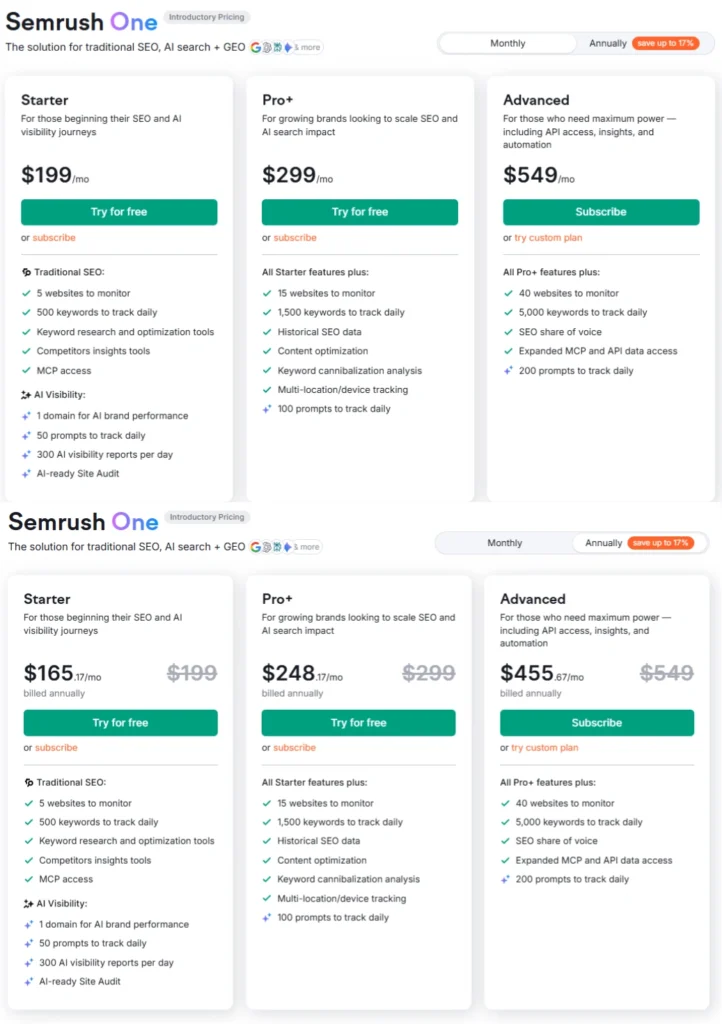
Starter covers 5 websites, 500 daily keywords, plus AI visibility features: 1 domain for AI brand performance, 50 daily AI prompts tracked, 300 AI visibility reports/day, and AI-ready Site Audit.
Pro+ scales to 15 websites, 1,500 keywords, 100 daily AI prompts, and adds historical data, content optimization, keyword cannibalization analysis, and multi-location/device tracking.
Advanced unlocks 40 websites, 5,000 keywords, 200 daily AI prompts, SEO share of voice, and expanded MCP and API access.
Starter and Pro+ include a 7-day free trial. Advanced requires direct subscription.
If you’re actively managing both Google rankings and AI search presence, Semrush One is the stronger long-term choice. For pure traditional SEO on a tighter budget, the classic Pro plan still holds up.
Try Semrush free for 7 days — no charge until the trial ends.
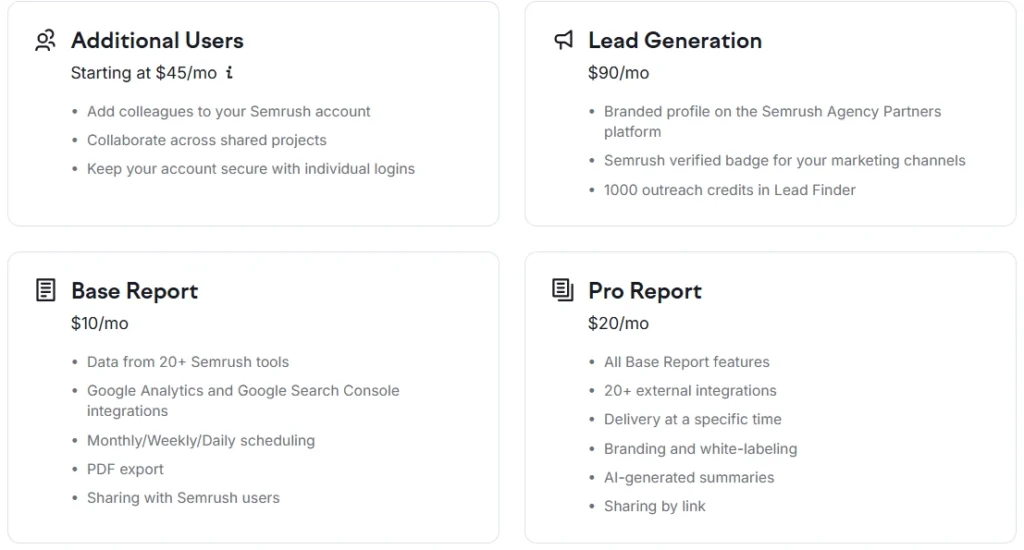
Add-Ons Available on Both Plan Families
- Additional Users — from $45/user/mo
- Lead Generation — $90/mo (Agency Partners profile, verified badge, 1,000 Lead Finder credits)
- Base Report — $10/mo (automated reports from 20+ tools, GA + GSC integration, PDF export)
- Pro Report — $20/mo (white-label branding, AI-generated summaries, 20+ external integrations, delivery scheduling)
What Semrush Doesn’t Do Well
A few honest gaps worth knowing before committing:
It estimates, it doesn’t measure. Semrush’s traffic figures and keyword volumes are based on its own data models — they’re directionally accurate, not exact. For your own site’s true numbers, Google Search Console is always the authoritative source. Semrush is best used for competitive benchmarking, not as a replacement for first-party analytics.
The learning curve is genuine. The platform has 50+ tools. New users often spend the first week clicking around without a clear workflow. The fix is to start with one specific goal — ranking a page, auditing a site, researching a competitor — and use only the tools relevant to that goal. Semrush Academy’s free courses help significantly.
Some toolkits are add-ons, not included. Social, Local, Advertising, and Traffic & Market toolkits aren’t bundled into the classic plans by default. If you need them, factor in the additional cost.
AI tracking is still early. The AI visibility features are more developed than anything else on the market, but the broader industry is still figuring out what “optimizing for AI search” looks like in practice. The data is real — the playbook is still being written.
How Semrush Stacks Up Against the Alternatives
Most people searching for “what is Semrush” are also quietly asking: is this actually the right tool, or should I be looking elsewhere? Fair question. Here’s an honest look at how it compares to the four most common alternatives — with actual current pricing.
| Tool | Entry Price (Monthly) | Entry Price (Annual) | Best Known For |
|---|---|---|---|
| Semrush Pro | $139.95/mo | $117.33/mo | All-in-one SEO + AI visibility |
| Ahrefs Lite | $129/mo | $108/mo | Backlink analysis depth |
| SE Ranking Core | $129/mo | $103.20/mo | Budget-friendly SEO + GEO |
| Moz Pro Standard | $99/mo | $79/mo | Beginner-friendly interface |
| Mangools Basic | $30.50/mo | $18.85/mo | Affordable keyword research |
A few things worth saying clearly about this table:
Ahrefs is the closest competitor to Semrush in terms of data depth — particularly for backlinks. Ahrefs’ crawler is the second most active on the web, and its keyword data is solid. Where Semrush pulls ahead is breadth: PPC research, content tools, local SEO, and now AI visibility tracking are all built in. Ahrefs doesn’t have a comparable AI search monitoring layer yet. For a deeper head-to-head, the Semrush vs Ahrefs breakdown covers the key differences properly.
SE Ranking has made serious strides recently — particularly with its GEO and AI search features built into core plans. At $103.20/mo annually, it’s actually cheaper than Semrush Pro while including AI visibility tracking. Worth considering if budget is a constraint and you’re managing a small number of sites. Full comparison: Semrush vs SE Ranking.
Moz Pro is the most beginner-accessible of the group. The interface is cleaner, the learning curve is gentler, and $79/mo annually is genuinely affordable for smaller operations. The tradeoff is data depth — Moz’s keyword and backlink databases are smaller than Semrush’s or Ahrefs’. Their Domain Authority metric is useful, but it’s a Moz-specific score, not a universal standard. See Semrush vs Moz Pro if you’re weighing both.
Mangools is in a different category entirely — at $18.85/mo annually, it’s built for solopreneurs and bloggers who primarily need keyword research and SERP analysis without the complexity of a full platform. The data breadth isn’t comparable to Semrush, but for a single-site content creator, it covers the essentials at a fraction of the cost. Detailed comparison: Semrush vs Mangools.
The honest summary: If you need one platform to handle SEO, competitive intelligence, content, PPC research, and now AI visibility — Semrush is hard to beat from a single subscription. If you primarily need backlink depth, Ahrefs competes directly. If budget is the main constraint, SE Ranking or Mangools cover the core use cases at significantly lower price points.

Semrush SEO Free Trial
Get full Pro access for 7 days — keyword research, site audit, backlink analysis & competitor research. No charge until after the trial ends.
Start Your Semrush 7-Day Free Trial →Frequently Asked Questions
What exactly does Semrush do?
Semrush tracks brand visibility across traditional search, AI-generated answers, local search, and paid channels. At a practical level, it lets you research keywords, analyze competitor strategies, audit your site for technical issues, track daily rankings, build links, optimize content, and now monitor how your brand appears in ChatGPT, Gemini, and Perplexity responses — all from one platform.
How does Semrush get its data — is it accurate?
Semrush runs its own web crawlers continuously and has been building its database for 17+ years. The dataset currently includes 25B+ keywords, 43T+ backlinks, and 800M+ domain profiles. Traffic and volume figures are model-based estimates — accurate for competitive direction, not as precise as first-party tools like Google Search Console. For your own site, always cross-reference with GSC.
Does Semrush work for beginners?
Yes, but there’s a real onboarding investment. The tools are well-documented, and Semrush Academy offers free courses. The practical advice: don’t try to use everything at once. Start with keyword research and a site audit — two tools that give immediate, actionable output — then expand from there. If you want to explore without paying first, here’s how to use Semrush for free to understand what the no-cost tier offers.
What’s the difference between Semrush SEO Classic plans and Semrush One?
Classic plans are traditional SEO-focused — keyword research, rank tracking, site audits, backlinks, and competitive intelligence. No AI visibility bundled in. Semrush One combines all of that with AI search tracking in a single subscription. Semrush One starts at $165.17/month annually (Starter); Classic Pro starts at $117.33/month annually. If AI visibility matters to your strategy, Semrush One is the more future-proof option.
How does Semrush compare to Ahrefs?
Both are strong platforms with significant data depth. The core difference: Ahrefs has historically been stronger for backlink analysis depth, while Semrush covers a broader range of use cases — PPC research, content tools, local SEO, social, and now AI visibility tracking. For most SEOs who need one platform to cover multiple channels, Semrush’s breadth tends to win. For a detailed side-by-side, see Semrush vs Ahrefs.
Can Semrush track how my brand appears in AI answers?
Yes — through Semrush One plans and the standalone AI Visibility Toolkit. It tracks brand mentions across ChatGPT, Gemini, Perplexity, and other LLM platforms, monitoring share of voice, sentiment, and which competitor prompts are triggering competitor citations instead of yours. Starter plan tracks 50 prompts daily; Advanced goes up to 200.
Is there a free trial?
Yes — Semrush Classic Pro and Guru plans, and Semrush One Starter and Pro+ plans, all include a 7-day free trial with full access to paid features. No charge until the trial period ends. Business and Advanced plans require direct subscription.
The Real Picture
Semrush isn’t a tool you open, run one search in, and close. The way it’s actually designed to work is as an ongoing intelligence layer underneath your SEO and content workflow — one that tells you what the market looks like, where your gaps are, what competitors are doing differently, and increasingly, how AI platforms are representing your brand to the people asking them questions.
That’s a different thing from a keyword tracker. And understanding that distinction is what separates people who get real value from the platform from those who pay for it and feel underwhelmed.
The 7 days in the trial are genuinely enough to feel this difference — if you go in with a specific site to audit and a competitor to research. Start here.
Everything You Need About Semrush Free Trial
Activate your Semrush free trial directly, read our step-by-step guide on how to get it, or learn how to cancel before getting charged — all in one place.
Start Semrush Free Trial
Get full Pro access for 7 days — keyword research, site audit, backlink analysis & competitor research. No charge until after the trial ends.
Start Free Trial →How to Get Free Trial
Step-by-step guide to activate your Semrush free trial — what you unlock, how to use it right, and how to get maximum value in 7 days.
Read Full Guide →How to Cancel Trial
Don’t get charged by mistake. Step-by-step guide to cancel your Semrush trial before the billing date — timing tips included.
Read Cancel Guide →