Contents
- 1 The Core Difference Nobody Talks About
- 2 What Semrush Actually Covers
- 3 Feature-by-Feature: Where They Overlap and Where They Diverge
- 4 Semrush vs Wordtracker: Honest Strengths and Limitations
- 5 Who Should Actually Use Each Tool
- 6 Best Semrush Alternatives to Consider
- 7 Everything You Need About Semrush Free Trial
- 7.1 Start Semrush Free Trial
- 7.2 How to Get Free Trial
- 7.3 How to Cancel Trial
- 7.4 Semrush One Free Trial
- 7.5 Semrush Pro & Guru Free Trial
- 7.6 Frequently Asked Questions
- 7.7 Is Wordtracker good enough to replace Semrush for basic SEO?
- 7.8 Does Wordtracker have a free trial?
- 7.9 What’s the difference between Semrush SEO Classic Plans and Semrush One?
- 7.10 Can I use Semrush for free without a trial?
- 7.11 Is the Semrush annual plan worth it over monthly?
- 7.12 How does Semrush compare to Ahrefs instead of Wordtracker?
- 7.13 The Verdict
Most comparisons online treat this like a straightforward face-off — Semrush on one side, Wordtracker on the other. Pick the bigger one or the cheaper one and move on.
That framing misses the whole point.
Semrush and Wordtracker aren’t really competing for the same users. They solve different problems at different scales for different budgets. Understanding that distinction is what actually helps you make the right call — not a checklist of features laid side by side.
Quick Answer: Semrush is a full-stack SEO and marketing suite used by agencies, in-house teams, and serious professionals who need deep data across keyword research, competitor analysis, site auditing, content, and more. Wordtracker is a focused keyword intelligence tool built around simplicity and affordability — it does keyword research, domain analysis, and rank tracking exceptionally well, without the overhead of 50+ tools you may never touch. If you need one platform for everything, Semrush. If keyword research is your primary need and budget matters, Wordtracker is hard to beat at its price point.
The Core Difference Nobody Talks About
Here’s the thing most reviews gloss over: the comparison between Semrush and Wordtracker isn’t really about which tool has better keyword data. It’s about what kind of SEO workflow you’re trying to build.
Semrush is designed around comprehensiveness. The logic is simple — the more workflows that live inside one platform, the less time agencies and large teams spend switching between tools. That’s genuinely valuable when you’re managing 15 client websites, running PPC campaigns, auditing technical SEO, and producing content reports every week.
Wordtracker is designed around the opposite philosophy. It’s been focused on keyword research since 1998 — before most of today’s SEO tools even existed. No social media scheduler, no content assistant, no advertising toolkit. Just keyword discovery, competitor keyword analysis, and rank tracking done cleanly and affordably.
Neither approach is wrong. They just serve fundamentally different users.
In my experience auditing SEO tool stacks across client projects, I’ve seen people massively overpaying for Semrush when they were only using the keyword research and position tracking features. Wordtracker would have done both of those jobs at a fraction of the cost. I’ve also seen solo bloggers try Wordtracker and hit its limits once they started running site audits, managing backlinks, and needing historical data — at which point Semrush made much more sense.
The tool that’s right for you depends on what percentage of Semrush’s feature set you’d actually use.
What Semrush Actually Covers
Semrush isn’t just a keyword tool. It’s closer to an SEO operating system — and that’s both its greatest strength and the reason it can feel overwhelming at first.
Currently, Semrush offers two plan tracks: the traditional SEO Classic Plans (Pro, Guru, Business) and the newer Semrush One (Starter, Pro+, Advanced), which layers AI visibility and GEO features on top of traditional SEO.
SEO Classic Plans
These are the core plans most users know. They cover everything you’d expect from an enterprise-grade SEO platform.
Monthly pricing:
- Pro — $139.95/mo
- Guru — $249.95/mo
- Business — $499.95/mo
Annual pricing (billed annually):
- Pro — $117.33/mo
- Guru — $208.33/mo
- Business — $416.66/mo
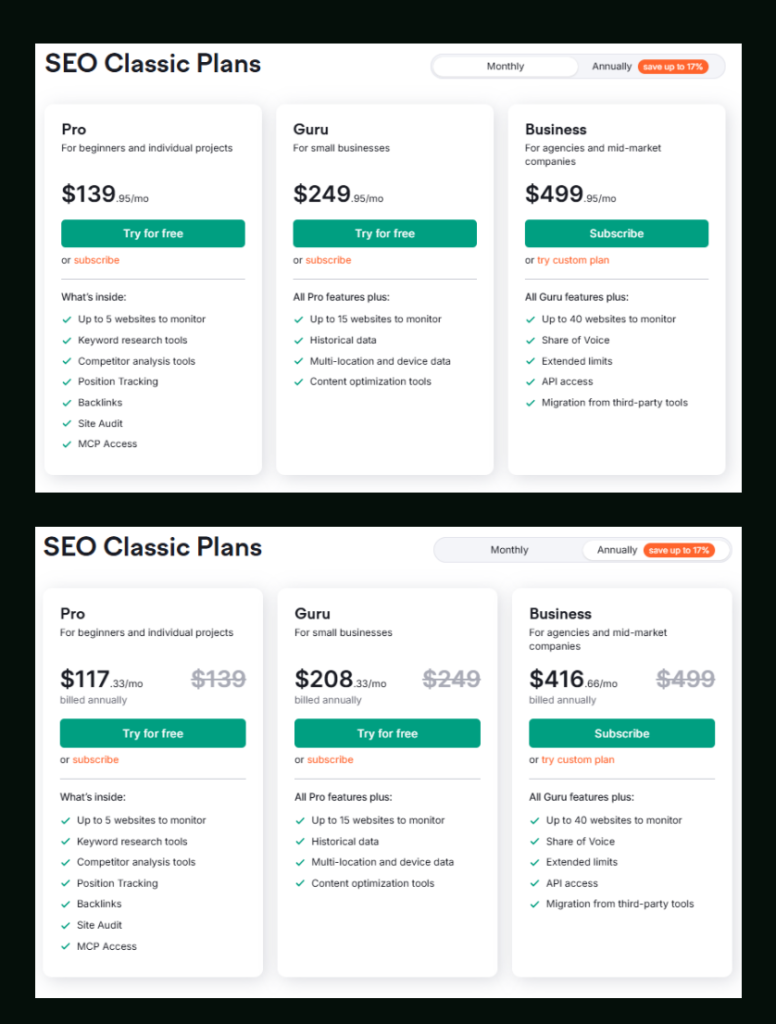
Pro suits individual consultants and small projects — 5 websites, 500 keywords tracked daily, keyword research tools, competitor analysis, Position Tracking, Backlinks, Site Audit, and MCP Access. What it doesn’t include: historical data, multi-location/device tracking, JavaScript rendering in Site Audit, or Topics in keyword analytics. For a lot of users doing straightforward SEO work, Pro is genuinely enough.
Guru adds historical data, multi-location and device tracking, content optimization tools, keyword cannibalization analysis, JavaScript rendering in Site Audit, Looker Studio integration, and expands limits to 15 websites and 1,500 keywords tracked daily.
Business is for agencies and mid-market teams — 40 websites, 5,000 keywords tracked daily, Share of Voice, API access, extended limits, and migration from third-party tools.
If you’re deciding between Pro and Guru specifically, Semrush Pro vs Guru breaks down exactly where the upgrade makes sense.
Semrush One — The AI + Traditional SEO Bundle
Semrush One is their newer offering — described as “the solution for traditional SEO, AI search + GEO.” It’s currently at introductory pricing and adds AI visibility tracking on top of everything in the classic plans.
Monthly pricing:
- Starter — $199/mo
- Pro+ — $299/mo
- Advanced — $549/mo
Annual pricing (billed annually):
- Starter — $165.17/mo
- Pro+ — $248.17/mo
- Advanced — $455.67/mo
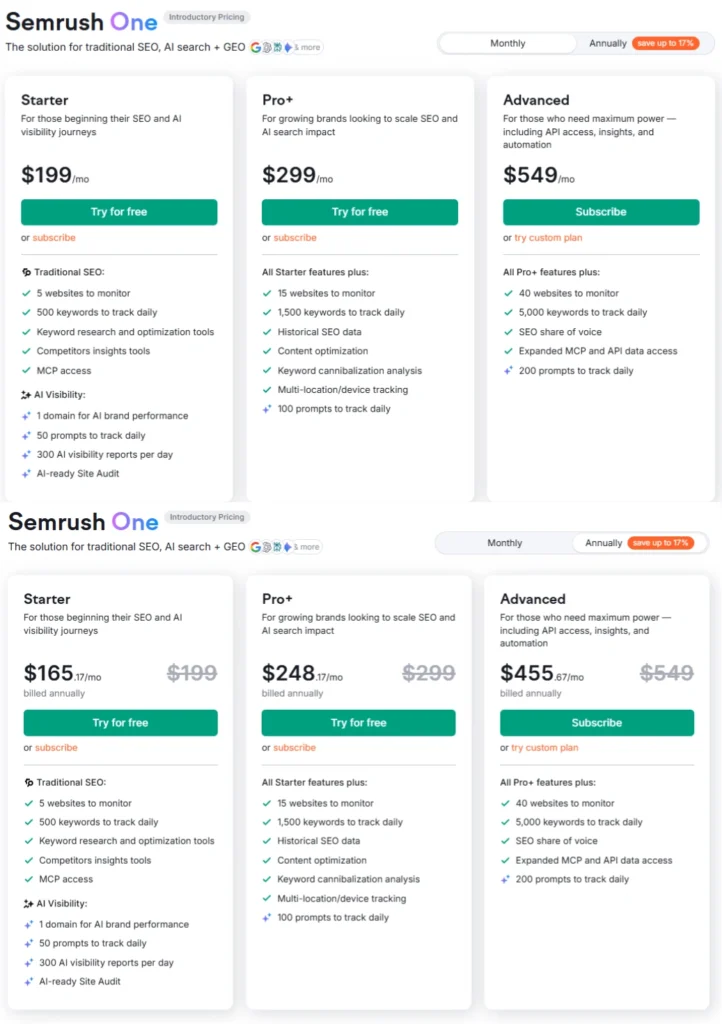
The AI Visibility layer is what separates these from Classic Plans. Every Semrush One plan includes 300 AI visibility reports per day, an AI-ready Site Audit, AI share of voice analysis, AI brand performance monitoring, brand sentiment analysis, competitive positioning insights, and prompt research. You’re essentially tracking not just where you rank on Google, but how AI-powered search surfaces (like ChatGPT, Gemini, and Perplexity) are representing your brand.
Semrush One Starter includes 1 domain for AI brand performance, 50 custom prompts to track daily, and 5 websites for traditional SEO (500 keywords tracked). Pro+ expands to 100 prompts daily and 1,500 keywords. Advanced opens up to 200 prompts, 5,000 keywords, expanded MCP and API data access, and SEO share of voice.
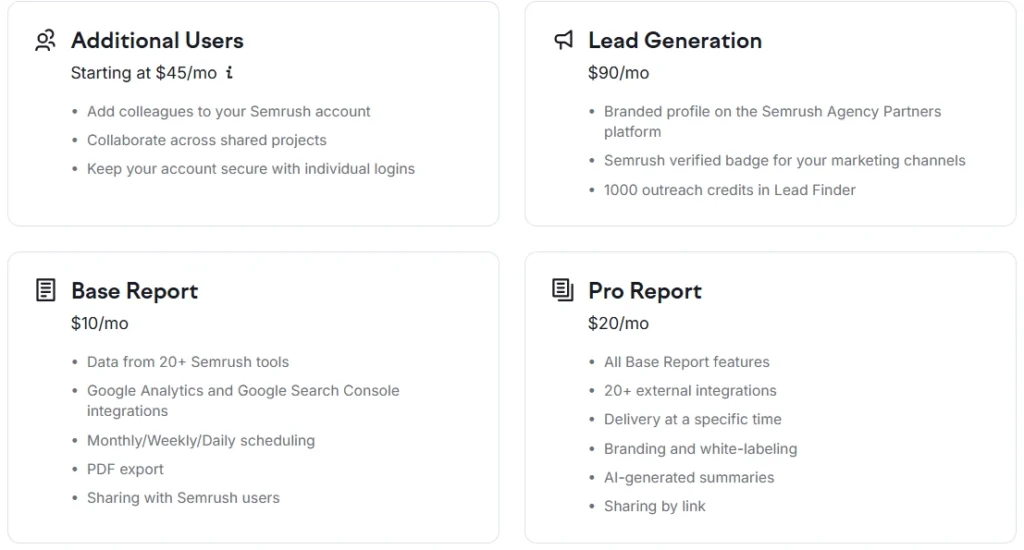
Add-ons available across plans: Additional Users (starting at $45/user), Lead Generation ($90/mo), Base Report ($10/mo), Pro Report ($20/mo).
For users who want to test the waters before committing, Semrush offers a 7-day free trial on SEO Classic Plans and Semrush One Starter and Pro+.
Where Semrush Genuinely Stands Out
The Keyword Magic Tool is honestly in a league of its own for raw depth. Entering a single seed keyword pulls keyword variations, questions, broad/phrase/exact match groupings, and intent signals across a 26-billion keyword database. For agencies building content clusters across multiple client verticals, that depth is difficult to replicate elsewhere.
Competitor analysis is similarly comprehensive — Domain Overview surfaces organic traffic, paid traffic, backlinks, referring domains, keyword distribution, and top competitor benchmarks all in one report. You can map an entire competitive landscape in under 30 minutes.
The tradeoff is the learning curve and the price. Pro at $139.95/month is the entry point — and for a solo blogger running one website, that’s a significant investment.
What Wordtracker Actually Covers
Wordtracker does three things: keyword research, domain competitor analysis, and rank tracking. That’s it — and that deliberate focus is what keeps it both affordable and fast to use.
The tool has been around since 1998, which means its database and methodology are mature. It accesses a 2-billion keyword database across 200+ territories, includes Search Console integration that overlays impressions, clicks, CTR, and position data directly onto keyword research results, and uses KEI (Keyword Effectiveness Index) metrics to surface genuinely winnable keywords.
No credits. No daily search caps tied to a credit pool. Just clean the daily search limits that reset automatically.
Wordtracker Pricing
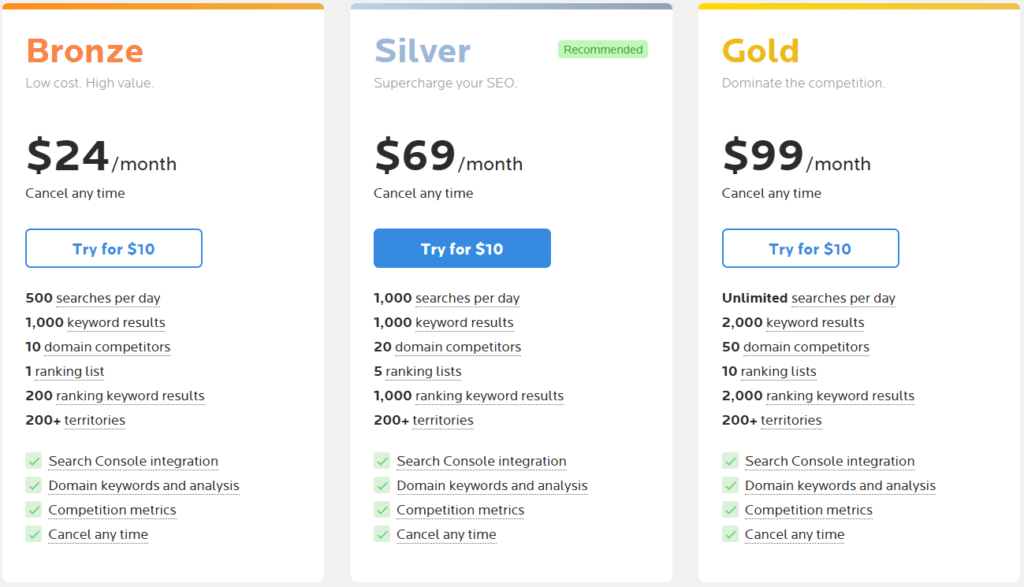
Wordtracker runs all plans through a $10 first-month trial — applicable to any plan tier, monthly or annual. After the first month, you roll onto the plan pricing you selected.
Monthly pricing:
- Bronze — $24/mo
- Silver — $69/mo
- Gold — $99/mo
Annual pricing (billed yearly):
- Bronze — $17/mo ($195/year, saves $93)
- Silver — $38/mo ($449/year, saves $379)
- Gold — $54/mo ($640/year, saves $548)
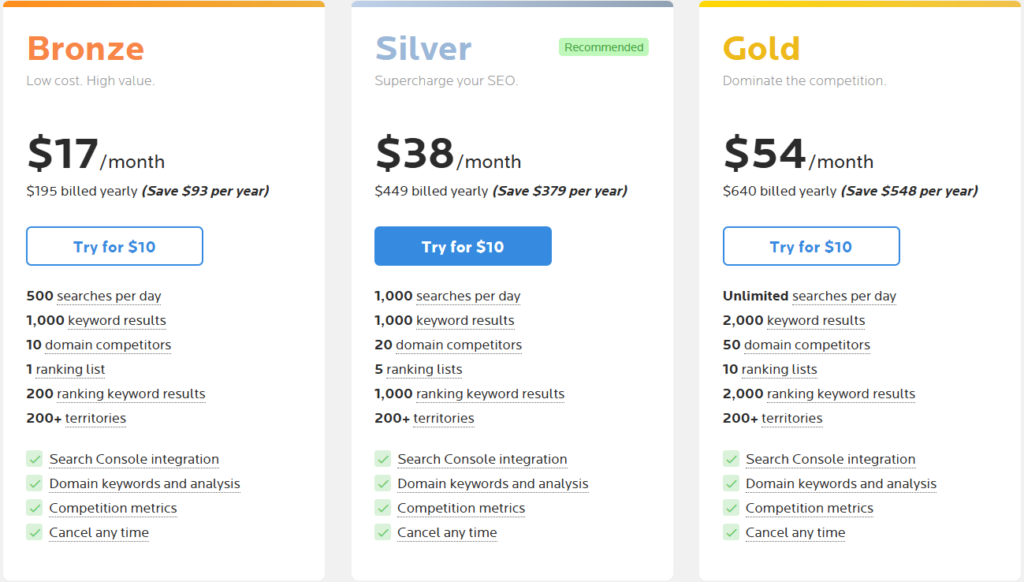
Bronze ($24/mo monthly, $17/mo annually): 500 searches per day, 1,000 keyword results, 10 domain competitors, 1 ranking list, 200 ranking keyword results, 200+ territories, Search Console integration, domain keywords and analysis, competition metrics.
Silver ($69/mo monthly, $38/mo annually) — Recommended: 1,000 searches per day, 1,000 keyword results, 20 domain competitors, 5 ranking lists, 1,000 ranking keyword results, 200+ territories, all Bronze features.
Gold ($99/mo monthly, $54/mo annually): Unlimited searches per day, 2,000 keyword results, 50 domain competitors, 10 ranking lists, 2,000 ranking keyword results, 200+ territories, all Silver features.
The annual savings are substantial — Gold drops from $99/mo to $54/mo annually, saving $548 per year. Silver drops from $69 to $38 monthly. If you’re committing to the year, the annual plans are noticeably better value.
One thing worth noting: even Wordtracker’s Bronze plan at $17/mo annually tracks 1,000 keywords — more than Semrush’s $117.33/mo Pro plan’s 500-keyword daily tracking limit. That’s not an apples-to-apples comparison since Semrush tracks daily Google rankings while Wordtracker’s tracking works differently — but for pure rank monitoring volume at entry-level pricing, the contrast is striking.
Feature-by-Feature: Where They Overlap and Where They Diverge
| Feature | Semrush (Pro) | Wordtracker (Bronze) |
|---|---|---|
| Keyword Research | ✅ Deep (26B keywords) | ✅ Solid (2B keywords) |
| Rank Tracking | ✅ 500 keywords/day | ✅ 200 ranking keywords |
| Competitor Analysis | ✅ Full-spectrum | ✅ Keyword-focused |
| Site Audit | ✅ Yes (100K pages/mo) | ❌ No |
| Backlink Analysis | ✅ Yes | ❌ No |
| Historical Data | ❌ (Guru+) | ❌ |
| Content Optimization | ❌ (Guru+) | ❌ |
| AI Visibility Tracking | ✅ (Semrush One) | ❌ |
| Search Console Integration | ✅ | ✅ |
| Social Media Tools | ✅ | ❌ |
| PPC/Ad Research | ✅ | ❌ |
| Monthly Entry Price | $139.95 | $24 |
The overlap is meaningful in keyword research and rank tracking. The divergence is massive everywhere else.
If your SEO workflow requires site audits, backlink monitoring, content optimization, or PPC competitive analysis, Wordtracker simply doesn’t cover those. Semrush does all of them. The flip side: if your primary workflow is keyword discovery and rank monitoring, you’re paying for a lot of tools in Semrush that you may not regularly open.
Semrush vs Wordtracker: Honest Strengths and Limitations
Where Semrush Wins
Data depth and breadth — The Keyword Magic Tool’s 26-billion keyword database, combined with 10,000–50,000 results per report (depending on plan), gives serious researchers more angles to explore than any focused tool can match.
All-in-one workflows — Site Audit, Position Tracking, Backlinks, Content Optimization, Social Media, and PPC Research all under one login. For agencies managing multiple clients, this consolidation has real value.
AI search visibility — Semrush One’s AI tracking layer is a genuine differentiator right now. Tracking how your brand appears in ChatGPT, Gemini, and Perplexity responses is emerging as a real SEO discipline, and Semrush is one of the few tools with actual infrastructure around it.
Historical data — From Guru upward, access to historical keyword and traffic data is invaluable for spotting trends, recovering from algorithm updates, and understanding seasonal patterns.
Where Semrush Falls Short
Price — $139.95/month at the entry level is a real commitment. For a solo blogger or niche site owner doing basic SEO, much of that cost goes toward features they’ll never touch.
Complexity — There’s a genuine learning curve. First-time users can easily spend days just understanding what each tool does and how workflows connect. That’s fine for a team with training resources, less ideal for someone who needs results quickly.
Credit limitations — On Classic Plans, keyword metric updates are capped (250/month on Pro, 1,000 on Guru, 5,000 on Business). Heavy researchers will hit these.
Where Wordtracker Wins
Entry-level pricing — $24/month, $17/month annually, with every plan starting at a $10 trial month. For budget-conscious users, that’s genuinely accessible.
No credit-counting friction — Daily search limits that reset automatically mean you research at your own pace without mentally tallying query costs.
Search Console integration — The overlay of GSC data (impressions, clicks, CTR, position) onto keyword research results is a smart workflow shortcut that saves time switching between tools.
Rank tracking generosity at price — Even at Bronze, 200 ranking keywords with email updates is solid for small sites. Gold’s 10,000-keyword tracking capacity at $54/month annually is an extraordinary value for what you’re paying.
Speed and simplicity — No onboarding maze. The interface is clean. You can be productive within minutes of signing up.
Where Wordtracker Falls Short
No site auditing — Technical SEO issues go undetected. If you’re managing a site with crawl errors, Core Web Vitals problems, or on-page issues, you’ll need another tool.
No backlink analysis — Link building requires a separate solution entirely.
Smaller keyword database — 2 billion keywords versus Semrush’s 26 billion. For most keyword research tasks, this is perfectly sufficient, but for exhaustive enterprise-level research, the gap shows.
No PPC or content tools — Paid campaign management and content optimization workflows aren’t on Wordtracker’s roadmap.
Who Should Actually Use Each Tool
Use Semrush if:
- You manage multiple websites or client accounts
- Your workflow spans keyword research, technical SEO, backlinks, and content
- You need historical data for trend analysis or algorithm recovery work
- You’re interested in tracking AI search visibility (Semrush One)
- Budget is less of a constraint than consolidation and data depth
Use Wordtracker if:
- Keyword research, competitor keyword discovery, and rank tracking are your primary needs
- You’re a blogger, niche site builder, or solo consultant who doesn’t need a full-suite tool
- Budget matters, and you’d rather not pay for 40 features to use 3
- You want to start quickly without a complex onboarding process
- You want a low-risk entry point — a $10 trial month applies to every plan
Consider both if:
- You’re in an early growth phase: Wordtracker for core keyword work now, Semrush later when your SEO needs expand
For users comparing Semrush against other mid-tier alternatives, it’s also worth checking how it stacks up against SE Ranking and Mangools, which occupy a similar positioning to Wordtracker in the market.
Best Semrush Alternatives to Consider
If Semrush’s pricing feels steep after the trial, these three tools cover most of what you need at a lower price point — SE Ranking, Mangools, and Ubersuggest all offer free trials too.
SE Ranking
More affordable entry pricing, solid rank tracking and audit features. Good for small agencies and freelancers who don’t need Semrush’s full data depth.
Try SE Ranking →Mangools
Beginner-friendly, clean UI, strong keyword and SERP tools at a much lower price point. Perfect for solo bloggers who need keyword research without the complexity.
Try Mangools →Ubersuggest
Neil Patel’s SEO Tool — keyword research, site audit, and competitor analysis at a very affordable price. Great for beginners and small business owners on a tight budget.
Try Ubersuggest →The Pricing Reality Check
Let’s be direct about the cost gap, because it matters.
Wordtracker’s most expensive plan — Gold at $99/mo monthly, $54/mo annually — costs less than Semrush’s cheapest entry point at $139.95/month (monthly). Even at Semrush’s annual Pro pricing of $117.33/month, you’re paying more than double Wordtracker Gold’s annual rate.
That doesn’t make Semrush overpriced — for what it delivers, the value is defensible, especially if your team uses it across multiple workflows. But if keyword research is your primary use case, you’re essentially paying $117+ monthly for a keyword tool when a $17–24 alternative exists that handles the same core job.
The honest calculation: estimate what percentage of Semrush’s feature set you’d realistically use in an average week. If that number is under 30%, Wordtracker deserves a serious look.
If you do decide Semrush is the right fit, you can start a 7-day free trial here before committing to a plan.
Everything You Need About Semrush Free Trial
Activate your Semrush free trial directly, read our step-by-step guide on how to get it, or learn how to cancel before getting charged — all in one place.
Start Semrush Free Trial
Get full Pro access for 7 days — keyword research, site audit, backlink analysis & competitor research. No charge until after the trial ends.
Start Free Trial →How to Get Free Trial
Step-by-step guide to activate your Semrush free trial — what you unlock, how to use it right, and how to get maximum value in 7 days.
Read Full Guide →How to Cancel Trial
Don’t get charged by mistake. Step-by-step guide to cancel your Semrush trial before the billing date — timing tips included.
Read Cancel Guide →Semrush One Free Trial
Dominate the future of AI search. Unlock advanced brand share of voice, monitor generative AI visibility, automate insights, and scale marketing impact across all digital channels.
Semrush Pro & Guru Free Trial
Master your organic rankings. Run comprehensive site audits, track keyword positions, analyze backlink profiles, and spy on competitor SEO strategies completely risk-free for 7 days.
Frequently Asked Questions
Is Wordtracker good enough to replace Semrush for basic SEO?
For keyword research and rank tracking specifically, yes — Wordtracker covers both capably and at a fraction of the price. Where it can’t replace Semrush is in technical SEO (site audits, JavaScript rendering), backlink analysis, content optimization tools, and PPC research. If those features are part of your regular workflow, Wordtracker won’t cut it as a full replacement. But for bloggers and niche site operators whose SEO work centers on finding keywords and monitoring rankings, Wordtracker handles the essentials well.
Does Wordtracker have a free trial?
Wordtracker doesn’t offer a traditional free trial, but every plan — Bronze, Silver, and Gold, on both monthly and annual billing — starts at $10 for the first month. After that, you automatically roll onto the plan pricing you selected. It’s a low-risk way to test the tool properly before committing to full pricing.
What’s the difference between Semrush SEO Classic Plans and Semrush One?
Semrush Classic Plans (Pro, Guru, Business) cover traditional SEO: keyword research, site auditing, backlinks, rank tracking, content optimization, and competitor analysis. Semrush One adds an AI visibility layer on top — tracking how your brand appears in AI-powered search platforms like ChatGPT, Gemini, and Perplexity, with features like prompt tracking, AI share of voice analysis, and AI brand performance monitoring. Semrush One starts at $199/month (or $165.17/month billed annually) versus Pro at $139.95/month.
Can I use Semrush for free without a trial?
Yes. Semrush has a free account tier that gives you limited access to several tools — useful for light keyword lookups and basic domain overviews. The limitations are tight, though. If you want to properly evaluate the platform, the 7-day free trial unlocks full access to the plan you select. You can also explore how to use Semrush for free in more detail to understand what the free tier covers.
Is the Semrush annual plan worth it over monthly?
The annual discount is around 17% across both Classic Plans and Semrush One. On Pro, that’s the difference between $139.95/month and $117.33/month — a saving of roughly $272 annually. For Guru, it’s $249.95/month versus $208.33/month, saving about $500 per year. If you’re confident you’ll use Semrush consistently for 12 months, the annual plan is clearly the better deal. The caveat is flexibility — monthly billing lets you pause or cancel without locking in a year’s worth of spend.
How does Semrush compare to Ahrefs instead of Wordtracker?
That’s a different kind of comparison — Ahrefs is a full-suite competitor to Semrush rather than a focused specialist tool like Wordtracker. The key differences come down to backlink database size, keyword data freshness, and UI philosophy. For a detailed breakdown, Semrush vs Ahrefs covers the full picture.
If you’re looking for a deeper explanation of how these two tools fundamentally differ in scope and philosophy, read What Is The Difference Between Semrush and Wordtracker.
The Verdict
Semrush and Wordtracker are both legitimate tools. They’re just not the same kind of tool, and treating them as direct competitors causes a lot of people to make the wrong decision.
If you need the full spectrum — audits, backlinks, content, competitor intelligence, PPC, and now AI visibility — Semrush earns its price. The data depth is real, the platform is mature, and Semrush One’s AI tracking layer is genuinely forward-looking for teams worried about visibility beyond traditional Google rankings.
If keyword research, competitor keyword discovery, and rank tracking are what you actually need — and budget is a consideration — Wordtracker at $10 for your first month is worth testing before spending $140+ monthly on a tool whose features you might only partially use.
The best SEO tool isn’t always the most expensive one. It’s the one that matches the problems you’re actually trying to solve.