Contents
- 1 Two Different Questions With Two Different Answers
- 2 What KD% Is Actually Built On
- 3 Where the Gap Opens Up
- 4 The Factors KD% Doesn’t Fully Capture
- 5 How to Use Both Metrics Together
- 6 A Practical Example of the Gap in Action
- 7 Where Semrush’s KD% Gets It Right
- 8 Frequently Asked Questions
- 8.1 Is Semrush KD% an accurate measure of ranking difficulty?
- 8.2 Why did I rank easily for a high-KD keyword?
- 8.3 Why couldn’t I rank for a low-KD keyword?
- 8.4 What is Personal Keyword Difficulty (PKD%) and how is it different?
- 8.5 How do I find keywords where KD% overstates actual difficulty?
- 8.6 Should I target keywords based on KD% or PKD%?
- 9 Final Thought
- 10 Everything You Need About Semrush Free Trial
You pull up a keyword in Semrush. KD% says 28 — Easy. You write a solid piece, build a few links, and wait three months.
Nothing moves.
Or the opposite happens: KD% reads 61, you target it anyway, and you’re on page one within six weeks.
Both scenarios are more common than most SEO content admits. And the reason comes down to one thing — the gap between what Semrush’s KD% score measures and what ranking a keyword actually requires.
What Is SEMrush Keyword Difficulty (KD%)?
Semrush Keyword Difficulty (KD%) is a 0–100 percentage score that estimates how hard it would be for any website to rank in Google’s top 10 for a specific keyword. The score is calculated by analyzing the backlink profiles, domain authority, and SERP characteristics of the pages currently ranking — the higher the score, the stronger the competition.
What Is “Actual Difficulty” in SEO?
Actual difficulty is the real-world ranking effort required specifically for your website. It factors in search intent alignment, content gaps in the existing top 10, your domain’s topical authority, and SERP feature saturation — elements that KD% only partially reflects. Two sites targeting the same keyword can face genuinely different actual difficulty, even when the KD% score is identical for both.
Quick Answer
Semrush’s KD% is a backlink-and-authority-weighted estimate of ranking difficulty based on the current top 10. Actual difficulty is shaped by content quality gaps, search intent alignment, SERP feature saturation, topical authority, and competitive momentum — factors the KD% score only partially captures. The two numbers can diverge significantly, and understanding why is what makes keyword research reliable.
Two Different Questions With Two Different Answers
Semrush’s KD% answers one specific question: how strong are the pages currently ranking for this keyword?
That’s a useful question. But it’s not the same as asking: how hard would it actually be for my site to rank here?
Actual difficulty is a broader, messier question. It depends on your domain’s authority, your content’s depth, how well you match search intent, how much SERP real estate is eaten by features, and whether there’s a genuine gap in the existing content — or whether ten well-optimized pages already exist that are genuinely hard to beat.
Semrush KD% captures the first question well. It captures the second question only partially. Knowing which is which changes how you act on the data.
What KD% Is Actually Built On
Before comparing the two, it helps to be precise about what goes into the KD% calculation.
Semrush builds the score from signals observed in the current Google top 10:
- Median referring domains pointing to ranking URLs — the core backlink signal
- Median follow-to-nofollow ratio of those backlinks — cleaner profiles score harder
- Authority Scores of ranking domains — Semrush’s composite measure of link power, organic traffic, and spam profile
- Search volume — higher volume attracts more competition, which pushes KD up
- SERP feature presence — featured snippets, PAA boxes, and other features reduce organic click share
- Branded keyword dynamics — brand-dominated SERPs structurally favor the brand owner
- Keyword word count — longer queries typically draw fewer competing pages
What this makes KD% is essentially a competitive landscape snapshot — a picture of how entrenched the current top 10 is, based on their link and authority profiles.
It is not a prediction of whether you can crack that top 10. That’s the gap.
Where the Gap Opens Up
When KD% Is Low But Actual Difficulty Is High
This happens more often than the tool suggests, and it’s the scenario that burns people most.
A keyword can show KD 25 and still be genuinely difficult to rank for — not because the competition has strong backlinks, but because the intent is locked down in a way the KD% doesn’t see.
Consider a navigational query that technically has low competition. The SERP is dominated by one brand’s own pages and Reddit threads. The KD% is low because those pages don’t have enormous backlink profiles. But your ability to rank there? Near zero — because the intent is navigational, Google is serving what users are looking for, and a third-party informational article simply doesn’t match what the SERP is doing.
Intent mismatch is invisible to KD%. It doesn’t care whether your content matches what the SERP is serving — it only measures how strong the current pages are.
Other situations where KD understates actual difficulty:
- Freshness-sensitive SERPs — news-adjacent or rapidly evolving topics where recency is a de facto ranking signal. A KD of 30 on a trending keyword is almost meaningless if Google is actively refreshing results every few days.
- SERP feature saturation — a keyword with KD 35, but four SERP features above the fold may leave you fighting for clicks even if you rank in position 2.
- Thin-but-entrenched content — occasionally, weak pages rank because they were first and have accumulated passive links over the years. New content faces not just the current authority but the accumulated time advantage.
When KD% Is High But Actual Difficulty Is Lower
This is the more exciting scenario — and the one that creates real opportunities for sites that look beyond the headline score.
A KD of 62 doesn’t mean every site on the internet needs to produce extraordinary content to rank. It means the average competing page has a strong backlink profile. If your domain has established topical authority in that subject area, and the existing top-10 content has genuine gaps — incomplete coverage, outdated information, poor intent matching — the actual barrier can be meaningfully lower than the KD suggests.
In my experience auditing keyword strategies across different niches, the highest-ROI opportunities tend to sit in this zone: keywords that look difficult on paper but have content gaps or intent mismatches that a well-structured, genuinely useful page can exploit.
This is also where Personal Keyword Difficulty (PKD%) becomes the more honest metric. While general KD% measures difficulty for any site, PKD% factors in your domain’s specific authority and topical relevance. A keyword with KD 60 might show PKD 32 for a domain that has already built strong content clusters in that subject, which is a very different signal, and a much more actionable one.
The Factors KD% Doesn’t Fully Capture
Search Intent Alignment
The most consequential gap. KD% has no intent layer. It doesn’t know whether the pages ranking for a keyword are informational, commercial, transactional, or navigational — and it doesn’t know whether your content matches that intent.
A keyword can be genuinely winnable at KD 55 if your content nails the intent and the current top 10 doesn’t. The same keyword becomes unreachable at KD 30 if intent is locked to a format or source type you can’t replicate.
Always check the actual SERP before acting on any KD score. The 30 seconds it takes to look at what’s actually ranking tells you more about actual difficulty than any metric can.
Content Quality Gaps in the Existing Top 10
This one takes more time to evaluate but consistently reveals the most overlooked opportunities.
Not every high-KD SERP is protected by excellent content. Some are protected by link authority alone — the pages’ rankings are mediocre, but they’ve accumulated backlinks over the years, and Google hasn’t found a better option yet.
When the content gap is real — outdated information, superficial treatment of subtopics, poor answer quality — a well-researched, genuinely comprehensive page can outrank established authority over time. The KD% doesn’t flag this. It sees the backlinks, not the content quality.
Topical Authority at the Domain Level
Two sites targeting the same KD 50 keyword will face genuinely different actual difficulty based on how much topical depth they’ve built around that subject.
A site with 30 pieces of interlocking content on a subject — covering related questions, subtopics, and adjacent concepts — carries more topical weight for keywords in that space than a site with a single isolated page, even if the domain authority metrics look similar.
Semrush partially addresses this through the Topical Authority signal in PKD%, but it’s a nuance that KD% alone doesn’t surface.
Competitive Velocity
KD% is a static snapshot. It reflects the current top 10 as it stands today. It doesn’t tell you whether five well-resourced sites are actively pushing content into that SERP this month — or whether the space has been quiet for two years.
In competitive niches, the time between “this keyword looks possible” and “this keyword is now overrun” can be surprisingly short. Trending topics, especially, can shift from KD 20 to KD 55 within a year as the market catches up.
How to Use Both Metrics Together
The practical answer isn’t to distrust KD% — it’s to use it correctly.
KD% is best used as a first-pass filter. It tells you which keywords are worth investigating further and which are almost certainly out of reach for your current domain strength. For a new site, filtering to KD 0–29 makes sense as a starting constraint. For an established domain, filtering to KD under 50 or 60 gives you a workable candidate pool.
PKD% is your second-pass reality check. Once you’ve shortlisted keywords by general KD, enter your domain in the Keyword Overview or Keyword Magic Tool’s AI-powered field and review PKD scores. Keywords where your PKD is significantly lower than the general KD are where your domain has a structural advantage — those are worth prioritising.
The SERP is your third-pass verification. Before committing to any keyword, look at what’s actually ranking. Ask:
- Does the content format match what you’re planning to create?
- Is there a genuine gap in coverage, depth, or freshness?
- Are SERP features consuming the majority of visible real estate?
- Is the intent truly informational, or is it navigational/branded in a way that creates a structural barrier?
This three-step process — KD% as filter, PKD% as calibration, SERP as verification — is more reliable than any single number.
If you want a deeper foundation on how Semrush builds its KD score and what each tier actually means for strategy, the full breakdown is in our guide on what keyword difficulty is in Semrush.
A Practical Example of the Gap in Action
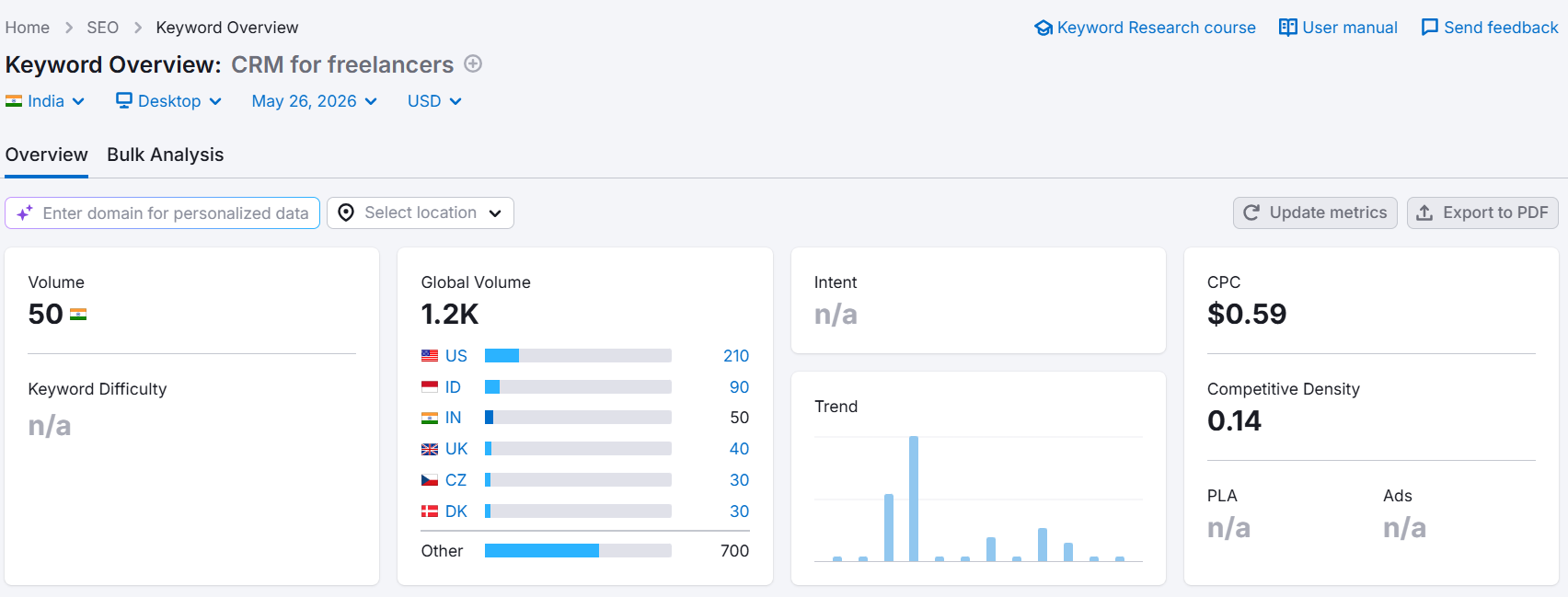
Take a real keyword: “CRM for freelancers” — pulled fresh from Semrush’s Keyword Overview.
India volume: 50/month. Global volume: 1.2K. KD%: n/a — meaning Semrush doesn’t have enough data to calculate a reliable difficulty score. CPC sits at $0.59 with a competitive density of just 0.14.
Here’s where it gets interesting.
A keyword showing n/a KD isn’t necessarily easy — and it isn’t necessarily hard. It means the SERP data is too thin for Semrush’s formula to produce a confident score. Most SEOs see “n/a” and either skip the keyword entirely or assume it’s a low-hanging fruit. Both reactions can be negative.
The actual difficulty question here has nothing to do with backlink profiles — because there aren’t enough competing pages for Semrush to meaningfully measure them. Instead, actual difficulty is driven by: whether a clear search intent exists, what content Google is currently choosing to rank, and whether the global 1.2K volume is concentrated in markets your site serves.
With a CPC of $0.59 and a competitive density of 0.14, the commercial signal is modest but present. Advertisers aren’t fighting over this term — but someone is bidding on it.
The gap lesson here isn’t about KD being too high or too low. It’s that n/a KD is its own category of uncertainty — one that requires a direct SERP check more than any other score would. The metric has nothing to show you. The SERP has everything.
That’s a scenario the KD% number alone would never flag.
Where Semrush’s KD% Gets It Right
To be fair to the metric — and this matters for using it with the right expectations — KD% is genuinely accurate at the extremes.
Keywords in the 0–14 range are almost always easy to rank for, at least with reasonable content and basic on-page work. Keywords in the 85–100 range are almost always effectively unattainable for most sites without sustained, heavy investment.
The reliability decreases in the middle bands — roughly 30–70 — where the actual difficulty depends most on the factors KD% doesn’t directly measure: intent fit, content gaps, topical authority, and competitive velocity.
That middle zone is also where the most interesting keyword opportunities live. Which is exactly why understanding the gap matters.
Semrush One Free Trial
Dominate the future of AI search. Unlock advanced brand share of voice, monitor generative AI visibility, automate insights, and scale marketing impact across all digital channels.
Semrush Pro & Guru Free Trial
Master your organic rankings. Run comprehensive site audits, track keyword positions, analyze backlink profiles, and spy on competitor SEO strategies completely risk-free for 7 days.
Frequently Asked Questions
Is Semrush KD% an accurate measure of ranking difficulty?
It’s accurate for what it measures — the strength of the current top 10 in terms of backlink profiles and domain authority. It’s less accurate as a direct prediction of whether your site can rank, because it doesn’t factor in your domain’s topical authority, content quality gaps in the SERP, intent alignment, or SERP feature saturation. Use it as a directional filter, not a final verdict.
Why did I rank easily for a high-KD keyword?
Most likely because the existing top-10 content had a genuine gap — outdated information, poor intent alignment, or weak content quality despite strong backlinks. KD% captures link strength, not content quality. When the content gap is real, a well-optimized page with the right intent match can outperform higher-authority pages over time.
Why couldn’t I rank for a low-KD keyword?
The most common reason is intent mismatch. If the SERP is serving a content type or source (navigational pages, Reddit threads, branded content) that your page can’t replicate, low KD won’t help you. SERP feature saturation is another common culprit — low competition doesn’t help if featured snippets and PAA boxes absorb most of the visible clicks. For a detailed look at how KD% is calculated, see our guide on what is keyword difficulty in Semrush.
What is Personal Keyword Difficulty (PKD%) and how is it different?
PKD% is Semrush’s site-specific difficulty score. While general KD% measures how competitive a keyword is for any website on the internet, PKD% factors in your domain’s authority and topical relevance specifically. A keyword with KD 65 might show PKD 30 for a domain with strong topical depth in that subject — meaning it’s genuinely achievable for that site, even though the general score suggests otherwise. It’s consistently the more actionable of the two metrics.
How do I find keywords where KD% overstates actual difficulty?
Look for keywords where the top-ranking pages have strong backlink authority but weak content quality — outdated information, thin coverage, or poor intent matching. Also, look at your PKD% relative to general KD%: a large gap between the two (e.g., KD 60, PKD 28) is a strong signal that the keyword looks harder than it is for your specific domain. The Keyword Magic Tool, with your domain entered in the AI-powered field, makes this filtering straightforward.
Should I target keywords based on KD% or PKD%?
Both, in sequence. Use general KD% to create an initial candidate pool based on your domain’s current authority range. Then use PKD% to prioritize within that pool — keywords where your PKD is notably lower than the general KD are where you have the strongest structural advantage. Finish with a manual SERP review to verify there’s a real content opportunity before committing.
Final Thought
Semrush’s KD% is one of the better keyword difficulty metrics available — but treating it as the complete picture is where strategies quietly underperform.
The number tells you how strong the competition is. It doesn’t tell you whether there’s a gap worth targeting, whether your content matches what the SERP is actually serving, or whether your domain specifically has an advantage the general score doesn’t reflect.
KD% is the starting point. PKD% is the calibration. The actual SERP is the reality check.
Use all three, and the gap between Semrush keyword difficulty and actual difficulty stops being a problem — and starts being something you can actively exploit.
Want to explore this yourself? The Semrush 7-day free trial gives you full access to both KD% and PKD% data across the Keyword Magic Tool and Keyword Overview — enough to run a real analysis on your target keywords before committing to any plan.
Everything You Need About Semrush Free Trial
Activate your Semrush free trial directly, read our step-by-step guide on how to get it, or learn how to cancel before getting charged — all in one place.
Start Semrush Free Trial
Get full Pro access for 7 days — keyword research, site audit, backlink analysis & competitor research. No charge until after the trial ends.
Start Free Trial →How to Get Free Trial
Step-by-step guide to activate your Semrush free trial — what you unlock, how to use it right, and how to get maximum value in 7 days.
Read Full Guide →How to Cancel Trial
Don’t get charged by mistake. Step-by-step guide to cancel your Semrush trial before the billing date — timing tips included.
Read Cancel Guide →