Contents
- 1 Two Tools Built on Completely Different Philosophies
- 2 The Scope Difference — What Each Tool Actually Does
- 3 Pricing — The Numbers Side by Side
- 4 The Pricing Gap in Plain Terms
- 5 Where Each Tool Has a Clear Edge
- 6 Best Semrush Alternatives to Consider
- 7 Frequently Asked Questions
- 7.1 What is the main difference between Semrush and Wordtracker?
- 7.2 Is Wordtracker accurate enough to use instead of Semrush for keyword research?
- 7.3 Can I use Semrush for free before paying?
- 7.4 Does Wordtracker offer a free trial?
- 7.5 Which is better for a beginner doing SEO for the first time?
- 7.6 What does Semrush One offer that regular Semrush doesn’t?
- 7.7 Is the difference between Semrush and Wordtracker mostly about price?
- 8 The Real Answer
- 9 All Semrush Toolkits — Quick Overview
You’ve probably come across both names while researching SEO tools. And at first glance, they seem to do similar things — keyword research, competitor tracking, and rankings data. So the confusion makes sense.
But honestly, once you understand what each tool was actually built to do, the difference becomes pretty obvious. They’re not really fighting for the same job.
Quick Summary: Semrush is a comprehensive SEO and digital marketing platform covering 50+ tools — keyword research, site auditing, backlink analysis, content optimization, PPC research, social media, and now AI visibility tracking. Wordtracker is a focused keyword intelligence tool that specializes in keyword research, competitor domain analysis, and rank tracking — nothing more, nothing less. The core difference is scope: Semrush is built for teams and agencies who need everything in one place; Wordtracker is built for marketers who need keyword work done efficiently at an affordable price.
Two Tools Built on Completely Different Philosophies
Most people think the difference between Semrush and Wordtracker is just about price or database size. That’s part of it — but it’s not the real story.
The real difference starts at the product philosophy level.
Semrush was built on the idea that SEO professionals shouldn’t have to jump between 10 different tools. Everything — from technical audits to social media scheduling to competitor PPC intelligence — lives inside one platform. For agencies running 20 client accounts simultaneously, that consolidation is genuinely powerful.
Wordtracker took the opposite bet. Since 1998, it has focused exclusively on keyword research, competitor keyword discovery, and rank tracking. The deliberate decision not to build 40 extra features keeps the interface clean, the learning curve minimal, and the pricing accessible.
Neither philosophy is wrong. They just attract completely different users.
In my experience working across client SEO projects, I’ve seen this play out repeatedly — teams that genuinely use Semrush’s full toolkit get enormous value from it. But individual bloggers and niche site operators often end up paying $140+/month for a platform where they only ever open the keyword research and position tracking sections. That’s a meaningful gap between what you’re paying for and what you’re actually using.
The Scope Difference — What Each Tool Actually Does
This is where the difference becomes most concrete.
What Semrush Covers
Semrush currently offers two plan tracks. The traditional SEO Classic Plans cover core SEO workflows. The newer Semrush One adds AI visibility and GEO tracking on top.
Under SEO Classic Plans, you get:
- Keyword Magic Tool (26-billion keyword database)
- Position Tracking — daily rank monitoring across desktop and mobile
- Site Audit — technical SEO crawling and issue detection
- Backlink Analytics and Backlink Audit
- Competitor Domain Overview
- Content Optimization tools (Guru and above)
- On-Page SEO Checker
- Social Media Toolkit
- PPC Advertising Research
- Local SEO tools
- MCP Access
Semrush One adds an entirely new layer — tracking how your brand appears inside AI-powered search platforms like ChatGPT, Gemini, and Perplexity. Features include AI brand performance monitoring, prompt tracking, AI share of voice analysis, brand sentiment analysis, and competitive AI positioning insights. Every Semrush One plan includes 300 AI visibility reports per day and an AI-ready Site Audit.
That’s a genuinely wide surface area. For someone who needs all of it, the value is clear.
What Wordtracker Covers
Wordtracker does three things:
- Keyword Research — Enter a seed keyword, select from 200+ territories, get search volume, competition scores, KEI (Keyword Effectiveness Index) metrics, and SERP preview data. No credits, no daily query pools — just clean daily search limits.
- Domain Analysis — Enter any competitor’s domain to surface their top-performing keywords, rising keywords, and traffic-driving pages. Useful for spotting content gaps quickly.
- Rank Tracking — Monitor keyword positions over time with email updates. No complex project setup required.
It also integrates directly with Google Search Console, overlaying impressions, clicks, CTR, and position data onto your keyword research results — which is a smart time-saver that eliminates the need to cross-reference platforms constantly.
What Wordtracker doesn’t do: site audits, backlink analysis, content optimization, PPC research, social media management, or AI visibility tracking. Those gaps are intentional — keeping the product focused keeps it fast, simple, and affordable.
The Keyword Research Difference Specifically
Since keyword research is the one area where both tools overlap, it’s worth looking at how differently they approach it.
Semrush’s Keyword Magic Tool is built for exhaustive depth. One seed keyword generates thousands of variations across broad match, phrase match, exact match, related terms, and questions — each with search volume, keyword difficulty, CPC, competitive density, intent classification, and trend data. For agencies building large content clusters or doing enterprise-level research across multiple verticals, that depth is hard to replicate.
The tradeoff is volume limits. On the Pro plan, keyword metric updates are capped at 250 per month. Reports per day max at 3,000. Results per report go up to 10,000. Serious researchers can hit these fairly quickly.
Wordtracker’s approach is different. Enter a keyword, choose your territory, and get focused results built around what matters for ranking decisions — search volume, competition score, KEI metrics, and No-Click Search estimates. The Search Console integration adds a layer most keyword tools don’t have at this price point — you’re seeing real impressions and CTR data alongside discovery metrics.
No credit system, no query counting. Bronze gives you 500 searches per day. Silver gives 1,000. Gold gives unlimited. Once your daily limit resets, you keep going.
In my testing across keyword research workflows, Wordtracker’s GSC overlay is genuinely underrated. Seeing that a keyword gets 4,200 monthly impressions but only 180 clicks tells you something important about click-through patterns — that context shapes content decisions in ways that raw search volume alone doesn’t.
Pricing — The Numbers Side by Side
This is where the difference becomes most tangible for most people.
Semrush SEO Classic Plans
Monthly pricing:
- Pro — $139.95/mo
- Guru — $249.95/mo
- Business — $499.95/mo
Annual pricing (billed annually):
- Pro — $117.33/mo
- Guru — $208.33/mo
- Business — $416.66/mo
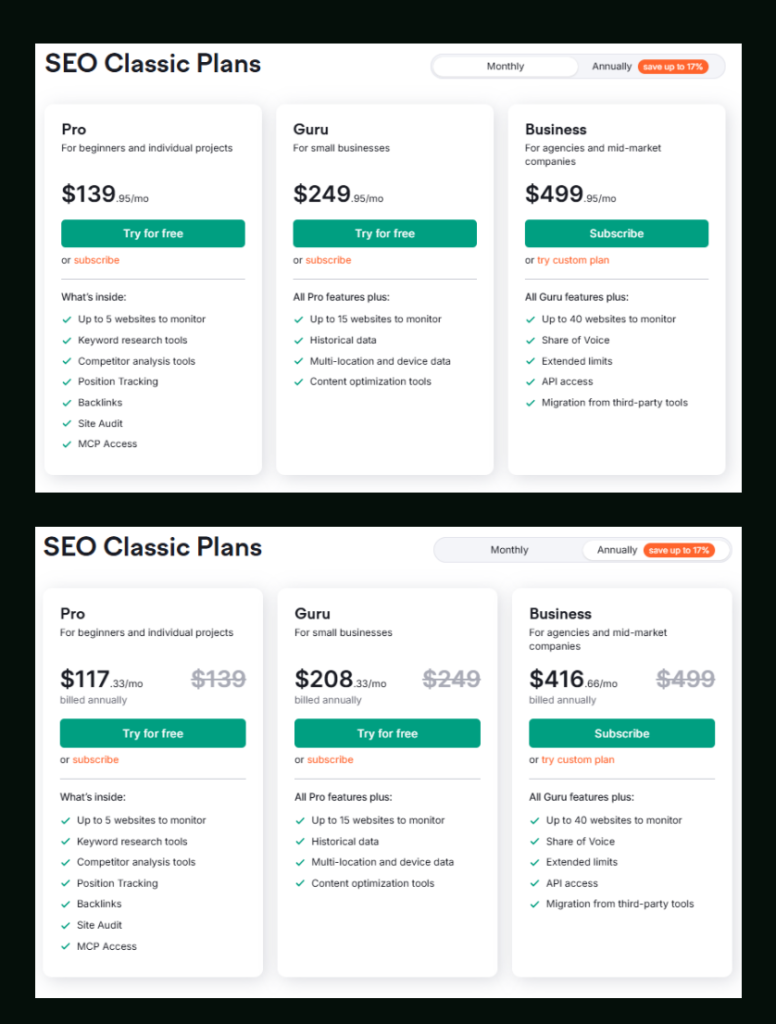
Pro includes 5 websites, 500 keywords tracked daily, keyword research tools, competitor analysis, Position Tracking, Backlinks, Site Audit, and MCP Access. No historical data, no multi-location tracking, no JavaScript rendering in Site Audit at this tier.
Guru adds historical data, multi-location and device tracking, content optimization, keyword cannibalization analysis, JavaScript rendering, and Looker Studio integration — expanding to 15 websites and 1,500 keywords tracked daily.
Business is for agencies — 40 websites, 5,000 keywords tracked daily, Share of Voice, API access, extended limits, and migration from third-party tools. Worth noting: if you’re deciding between Pro and Guru, Semrush Pro vs Guru breaks down exactly where the upgrade justifies itself.
Semrush SEO Free Trial ( Pro & Guru )
Get full Pro access for 7 days — keyword research, site audit, backlink analysis & competitor research. No charge until after the trial ends.
Start Your Semrush 7-Day Free Trial→Semrush One
Monthly pricing:
- Starter — $199/mo
- Pro+ — $299/mo
- Advanced — $549/mo
Annual pricing (billed annually):
- Starter — $165.17/mo
- Pro+ — $248.17/mo
- Advanced — $455.67/mo
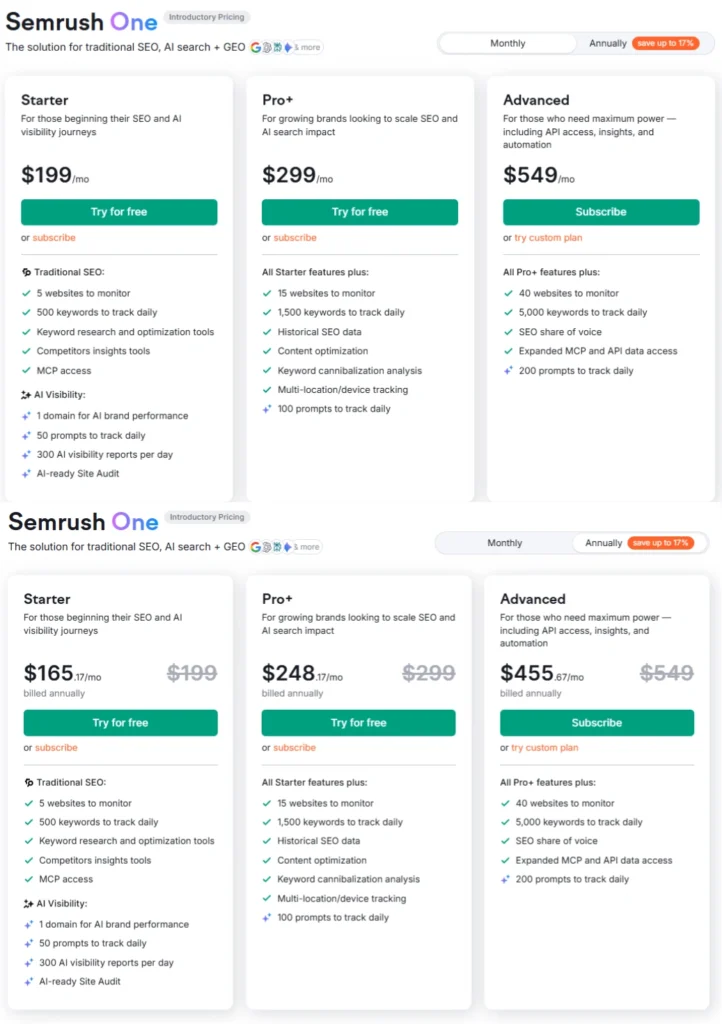
Starter covers 5 websites for traditional SEO (500 keywords tracked daily) plus AI visibility: 1 domain for AI brand performance, 50 prompts to track daily, 300 AI visibility reports per day, AI-ready Site Audit, and MCP access. Pro+ expands to 15 websites, 1,500 keywords, and 100 daily prompts. Advanced goes to 40 websites, 5,000 keywords, 200 daily prompts, SEO share of voice, and expanded MCP and API data access.
Add-ons available across all plans: Additional Users (from $45/user), Lead Generation ($90/mo), Base Report ($10/mo), Pro Report ($20/mo).
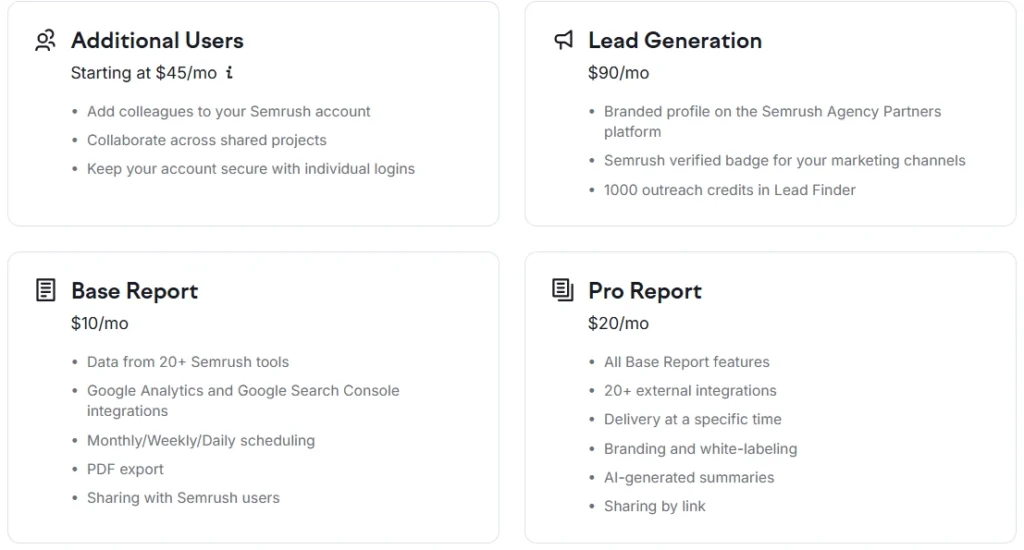
Semrush offers a 7-day free trial on SEO Classic Plans, Semrush One Starter, and Pro+.
Semrush One Free Trial
Everything you need to win AI visibility and drive SEO Success. Get full Semrush One access for 7 days — explore the Starter, Pro+, or Advanced plans. Track your website’s SEO performance, monitor AI visibility and brand share of voice, run deep site audits, and get AI-driven marketing insights. No charge until after your 7-day trial ends.
Start Your Semrush One 7-Day Free Trial →Wordtracker Pricing
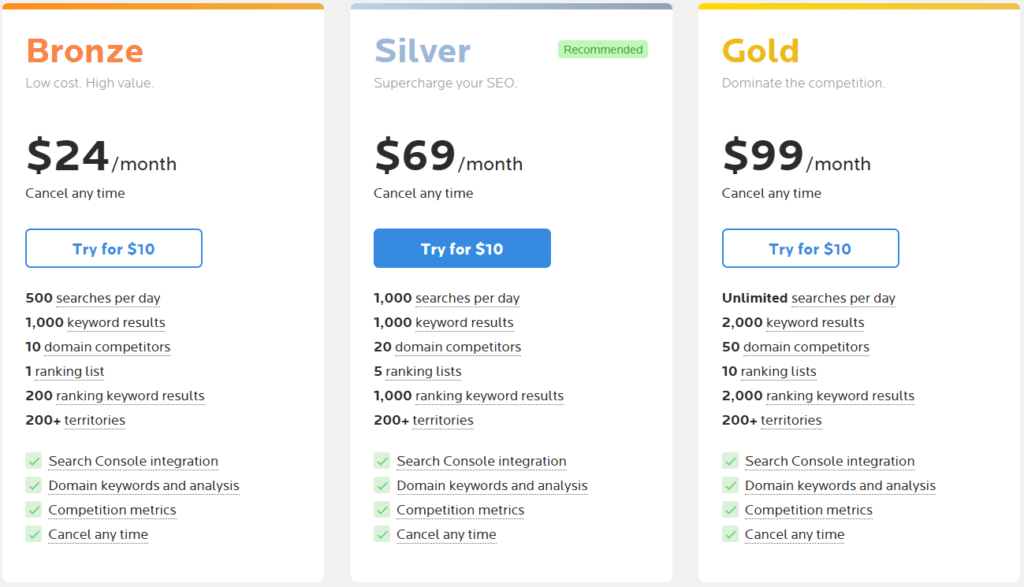
Every Wordtracker plan starts at $10 for the first month, monthly or annual, any tier. After the first month, you roll onto your selected plan pricing.
Monthly pricing:
- Bronze — $24/mo
- Silver — $69/mo
- Gold — $99/mo
Annual pricing (billed yearly):
- Bronze — $17/mo ($195/year, saves $93)
- Silver — $38/mo ($449/year, saves $379)
- Gold — $54/mo ($640/year, saves $548)
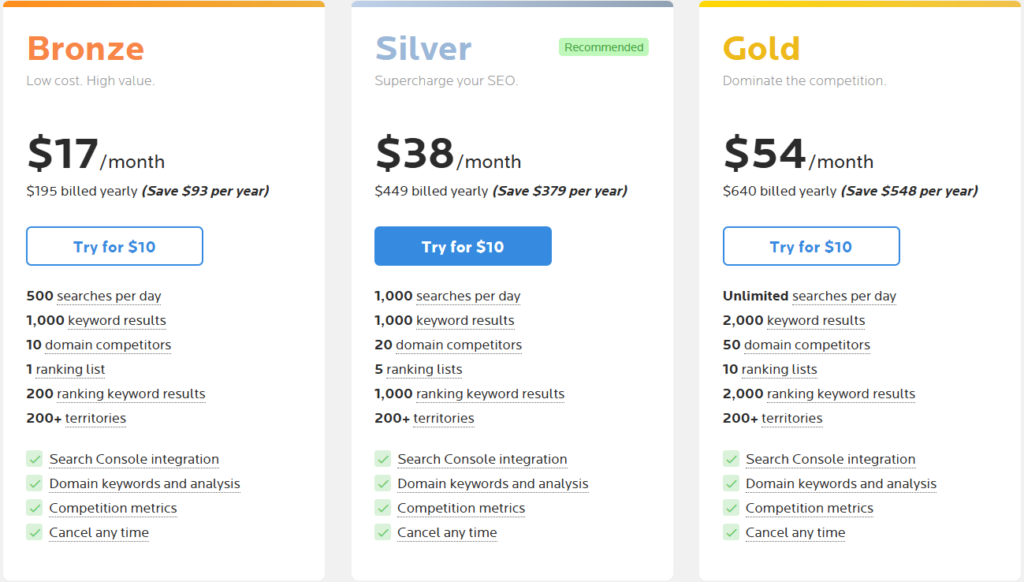
Bronze ($24/mo | $17/mo annually): 500 searches/day, 1,000 keyword results, 10 domain competitors, 1 ranking list, 200 ranking keyword results, 200+ territories, Search Console integration, domain keywords and analysis, competition metrics.
Silver ($69/mo | $38/mo annually) — Recommended: 1,000 searches/day, 1,000 keyword results, 20 domain competitors, 5 ranking lists, 1,000 ranking keyword results, 200+ territories, all Bronze features.
Gold ($99/mo | $54/mo annually): Unlimited searches/day, 2,000 keyword results, 50 domain competitors, 10 ranking lists, 2,000 ranking keyword results, 200+ territories, all Silver features.
The annual savings compound noticeably — Gold drops from $99/mo to $54/mo annually, saving $548 over the year.
The Pricing Gap in Plain Terms
| Entry Price (Monthly) | Entry Price (Annual) | |
|---|---|---|
| Semrush Pro | $139.95/mo | $117.33/mo |
| Semrush One Starter | $199/mo | $165.17/mo |
| Wordtracker Bronze | $24/mo | $17/mo |
| Wordtracker Gold | $99/mo | $54/mo |
Wordtracker’s most expensive plan costs less monthly than Semrush’s cheapest plan. That gap exists because the tools aren’t trying to do the same thing — Semrush’s price reflects 50+ tools, enterprise infrastructure, and a 26-billion keyword database. Wordtracker’s price reflects a deliberately focused product built to do three things well.
Where Each Tool Has a Clear Edge
Semrush’s Advantages
Technical SEO coverage — Site Audit crawls up to 100,000 pages per month on Pro (300,000 on Guru, 1,000,000 on Business), identifies crawl errors, Core Web Vitals issues, internal linking problems, and JavaScript rendering issues. Wordtracker has no equivalent.
Backlink intelligence — Semrush’s backlink database surfaces referring domains, anchor text distribution, toxic link signals, and link-building opportunities. Again, nothing comparable in Wordtracker.
Historical data — From Guru upward, you can track how keyword rankings, domain traffic, and competitor positions have shifted over time. Invaluable for recovering from algorithm updates or identifying seasonal patterns.
AI search visibility — Semrush One’s tracking of brand presence inside ChatGPT, Gemini, and Perplexity responses is a forward-looking differentiator that no focused keyword tool currently matches.
PPC and competitive ad research — If paid search is part of your strategy, Semrush’s advertising intelligence tools have no equivalent in Wordtracker.
Wordtracker’s Advantages
Price accessibility — $17/mo annually for a professional-grade keyword tool with Search Console integration is genuinely difficult to argue against for budget-conscious users.
Simplicity and speed — No onboarding process, no feature maze. You can be doing productive keyword research within minutes of signing up.
No credit friction — Daily search limits that reset automatically. Research at your own pace without mentally managing a query budget. This matters more than it sounds when you’re in a deep keyword discovery session.
GSC integration value — The overlay of real impression and CTR data onto keyword research results gives context that pure search volume numbers miss. For content decisions, that’s genuinely useful intelligence.
Rank tracking volume at price — Gold tracks 10,000 keywords at $54/mo annually. That’s substantial tracking capacity for the price point.
Who Each Tool Is Actually Built For
The difference between Semrush and Wordtracker isn’t just about features — it’s about what kind of SEO practitioner you are.
Semrush fits if:
- You manage multiple client websites or run an in-house team
- Your SEO work spans keyword research, technical auditing, link building, and content optimization
- You need PPC competitive intelligence alongside organic research
- Historical data and trend analysis matter to your reporting
- You want AI search visibility tracking as SEO extends beyond traditional Google results
- Budget is secondary to having everything consolidated
Wordtracker fits if:
- Keyword research, competitor keyword discovery, and rank tracking are the core of your SEO work
- You’re a blogger, niche site operator, or solo consultant who doesn’t need a full-suite platform
- You want to avoid paying for 45 features to use 4
- Fast, clean workflow matters more than exhaustive data depth
- The $10 trial month lets you validate fit before committing
If you’re considering other focused alternatives at similar price points to Wordtracker, it’s also worth looking at how Semrush compares to Mangools and Semrush against SE Ranking — both occupy a similar middle-ground positioning in the market.
Best Semrush Alternatives to Consider
If Semrush’s pricing feels steep after the trial, these three tools cover most of what you need at a lower price point — SE Ranking, Mangools, and Ubersuggest all offer free trials too.
SE Ranking
More affordable entry pricing, solid rank tracking and audit features. Good for small agencies and freelancers who don’t need Semrush’s full data depth.
Try SE Ranking →Mangools
Beginner-friendly, clean UI, strong keyword and SERP tools at a much lower price point. Perfect for solo bloggers who need keyword research without the complexity.
Try Mangools →Ubersuggest
Neil Patel’s SEO Tool — keyword research, site audit, and competitor analysis at a very affordable price. Great for beginners and small business owners on a tight budget.
Try Ubersuggest →Semrush One Free Trial
Dominate the future of AI search. Unlock advanced brand share of voice, monitor generative AI visibility, automate insights, and scale marketing impact across all digital channels.
Semrush Pro & Guru Free Trial
Master your organic rankings. Run comprehensive site audits, track keyword positions, analyze backlink profiles, and spy on competitor SEO strategies completely risk-free for 7 days.
Frequently Asked Questions
What is the main difference between Semrush and Wordtracker?
The fundamental difference is scope. Semrush is a full-stack SEO and digital marketing platform with 50+ tools covering keyword research, site auditing, backlink analysis, content optimization, PPC research, social media, and AI visibility tracking. Wordtracker is a specialized keyword intelligence tool that focuses on keyword research, competitor domain analysis, and rank tracking — nothing else. Semrush is built for agencies and teams that need everything in one platform; Wordtracker is built for marketers who need keyword work done efficiently and affordably.
Is Wordtracker accurate enough to use instead of Semrush for keyword research?
For keyword research specifically, Wordtracker is a credible tool. It accesses a 2-billion keyword database across 200+ territories and integrates directly with Google Search Console to surface real impressions and CTR data alongside keyword discovery metrics. Where it can’t substitute Semrush is outside keyword research — if you need site auditing, backlink analysis, historical data, or content optimization tools, those simply don’t exist in Wordtracker. For pure keyword discovery and rank tracking on a budget, Wordtracker holds up well.
Can I use Semrush for free before paying?
Yes — two ways. Semrush has a permanent free account tier with limited access to keyword lookups and domain overviews. For full access, Semrush offers a 7-day free trial on SEO Classic Plans and Semrush One Starter and Pro+. You can also read more about how to use Semrush for free to understand exactly what the free tier includes before signing up.
Does Wordtracker offer a free trial?
Not a traditional free trial — but every plan starts at $10 for the first month, regardless of tier or billing cycle. After the trial month, you automatically roll onto your selected plan. Bronze monthly is $24/mo after the first month, Silver is $69/mo, and Gold is $99/mo. Annual plans reduce those to $17, $38, and $54 per month, respectively.
Which is better for a beginner doing SEO for the first time?
Depends on your starting budget and goals. If you’re building your first blog or niche site and keyword research is your primary need, Wordtracker’s $10 first month is a low-risk way to start — the interface is clean, and you’ll be productive quickly. If you’re starting with professional ambitions — managing client work, running audits, building links — Semrush Pro at $139.95/month gives you the full toolkit from day one. The Semrush 7-day free trial is worth using to see how much of the platform you’d realistically use before committing.
What does Semrush One offer that regular Semrush doesn’t?
Semrush One adds AI visibility tracking on top of traditional SEO. While SEO Classic Plans cover keyword research, auditing, backlinks, and rankings on Google, Semrush One additionally tracks how your brand appears inside AI-powered platforms — ChatGPT, Gemini, Perplexity, and others. Features include prompt tracking (50–200 daily prompts depending on plan), AI share of voice analysis, brand sentiment analysis, competitive AI positioning insights, and AI-ready Site Audit. Semrush One Starter begins at $199/mo (or $165.17/mo billed annually).
Is the difference between Semrush and Wordtracker mostly about price?
Price is part of it, but it’s not the core difference. Wordtracker costs less because it’s deliberately a smaller, more focused product. Semrush costs more because it’s a significantly larger platform covering workflows that Wordtracker doesn’t touch — technical SEO, backlinks, content, PPC, social media, and AI visibility. If you only need keyword research and rank tracking, you’d be overpaying for Semrush. If you need the full spectrum of SEO capabilities, Wordtracker genuinely can’t cover the job regardless of price.
The Real Answer
The difference between Semrush and Wordtracker isn’t about which tool is better. It’s about which one matches the actual problem you’re trying to solve.
Semrush is a platform. It’s designed around the idea that modern SEO involves more than keywords — it involves auditing, link building, content, paid search, and increasingly, visibility in AI-generated responses. For teams and agencies where all of those workflows are active, Semrush’s consolidation creates real efficiency.
Wordtracker is a specialist. It does keyword research, domain analysis, and rank tracking — and it does them cleanly, affordably, and without unnecessary complexity. For the practitioner whose core SEO need is finding the right keywords and monitoring where they rank, Wordtracker removes every tool you don’t need and keeps every tool you do.
Most people searching “what is the difference between Semrush and Wordtracker” already have a sense of which direction they’re leaning. If you’re trying to justify Semrush, start the 7-day free trial and see how much of it you actually open in a week. If Wordtracker’s focused approach makes more sense for where you are right now, the $10 first month makes it genuinely low-risk to find out.
Already clear on the difference and ready to compare them head-to-head? See the full breakdown in Semrush vs Wordtracker: What Nobody Tells You.
All Semrush Toolkits — Quick Overview
Semrush is not just one tool. It’s a complete platform of 8 specialized toolkits — each built for a specific marketing goal. Pick the one that fits your workflow, or go all-in with Semrush One.