Contents
- 0.1 Where the “Fresh Data” Part Is Actually True
- 0.2 Where It Gets More Nuanced — The Historical Data Layer
- 0.3 Traffic Analytics: A Different Data Model Entirely
- 0.4 The Backlink Database: Scale Over Real-Time Freshness
- 0.5 What This Means If You’re Actually Using Domain Analytics
- 0.6 The AI Visibility Data Angle (Worth Knowing About)
- 0.7 Which Plan Actually Gives You What
- 0.8 Where Semrush Data Falls Short (Being Honest About It)
- 0.9 Semrush SEO Free Trial
- 0.10 Frequently Asked Questions
- 0.11 Does Semrush update domain analytics data in real time?
- 0.12 What’s the difference between Semrush Domain Analytics and Traffic Analytics data?
- 0.13 Does Semrush have historical data, or only live data?
- 0.14 How accurate is Semrush’s traffic data for competitor research?
- 0.15 Can I test Semrush’s data quality before paying?
- 0.16 Which Semrush plan is best if historical data matters to me?
- 0.17 Does Semrush track AI search visibility, or only traditional Google data?
- 0.18 The Bottom Line
- 1 Everything You Need About Semrush Free Trial
Most people assume Semrush is a purely real-time intelligence machine. Type in a domain, get the freshest data available — end of story. That assumption is mostly right. But “mostly” is doing a lot of work in that sentence.
Quick Answer: Semrush is built primarily around live, real-time data for domain analytics — especially keyword rankings, organic positions, and paid search visibility. But it’s not exclusively live. For specific use cases, Semrush also maintains deep historical data going back to January 2012. The type of data, and whether it’s live or modeled, depends on which tool you’re actually using.
That distinction matters more than most SEO guides let on. And if you’re making decisions based on Semrush data without understanding this, you could be misreading what you’re actually looking at.
Where the “Fresh Data” Part Is Actually True
For the core domain analytics use case — tracking organic rankings, monitoring keyword positions, auditing paid search visibility — Semrush genuinely delivers fresh, continuously updated data.
Here’s how that works in practice. Semrush partners with third-party data providers to query Google’s SERPs for hundreds of millions of keywords across its 142 geographic databases. The platform tracks both organic and paid search results, updating keyword rankings on an ongoing basis. Popular keywords get updated more frequently — sometimes daily. Less competitive or niche keywords may refresh less often, though Semrush’s own documentation notes updates can range from once a day to once a month, depending on keyword popularity.
So when you pull a Domain Overview report and see a competitor ranking for a keyword, that ranking data reflects Semrush’s most recent SERP crawl for that term. It’s not cached from six months ago. It’s not a static snapshot; someone built a report from last quarter.
In my experience auditing client sites, this freshness is one of the things that actually makes Semrush worth its price — particularly for competitive niches where ranking volatility is high. Seeing a position shift from 4 to 11 within days, and having it reflected accurately in the dashboard, is the kind of signal that drives real decisions.
Where It Gets More Nuanced — The Historical Data Layer
Here’s what most people miss: Semrush isn’t only a live data engine. It’s also one of the most comprehensive sources of historical SEO data available to marketers.
For domain and keyword analytics specifically, Semrush stores historical data going back to January 2012. That’s over a decade of SERP history accessible through the platform — competitor ranking trajectories, keyword volume trends over time, and how a domain’s visibility has shifted across algorithm updates.
This historical layer is available on Guru and Business plans (within the SEO Classic lineup), while the Pro plan gives you live data only. It’s also a key differentiator in the newer Semrush One plans, where Pro+ and Advanced tiers include historical SEO data while the Starter tier does not.
This isn’t a minor footnote. If you’re doing competitive research — say, trying to understand how a competitor built their current authority — the historical database is often where the real insights are. Live data tells you where things stand. Historical data tells you how they got there.
Traffic Analytics: A Different Data Model Entirely
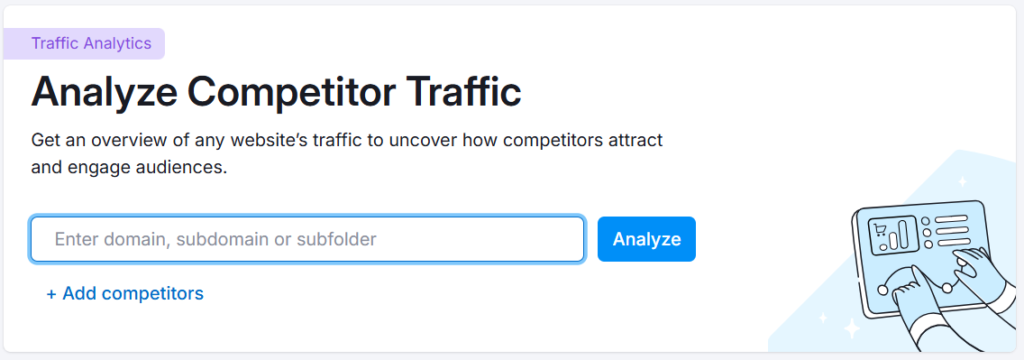
This is the part that trips up a lot of people, and honestly, it’s worth addressing directly.
Traffic Analytics — Semrush’s tool for estimating overall website traffic — does not use live SERP data. It uses a clickstream modeling approach.
Semrush draws on a panel of over 200 million real, anonymized internet users across more than 190 countries. That panel data is processed through a Neural Network algorithm, combined with Semrush’s backlink and organic position databases, to produce traffic estimates. The result is a highly accurate model — but it is a model, not a direct measurement.
This is an important distinction. If you’re pulling domain analytics to understand keyword rankings, you’re working with fresh, crawled SERP data. If you’re pulling traffic estimates to understand how much overall traffic a competitor drives, you’re working with statistically modeled estimates based on clickstream behavior.
Neither is wrong. But conflating the two leads to confusion — particularly when Semrush traffic figures diverge from what you see in Google Analytics for your own site. They measure fundamentally different things using fundamentally different methods.
The Backlink Database: Scale Over Real-Time Freshness
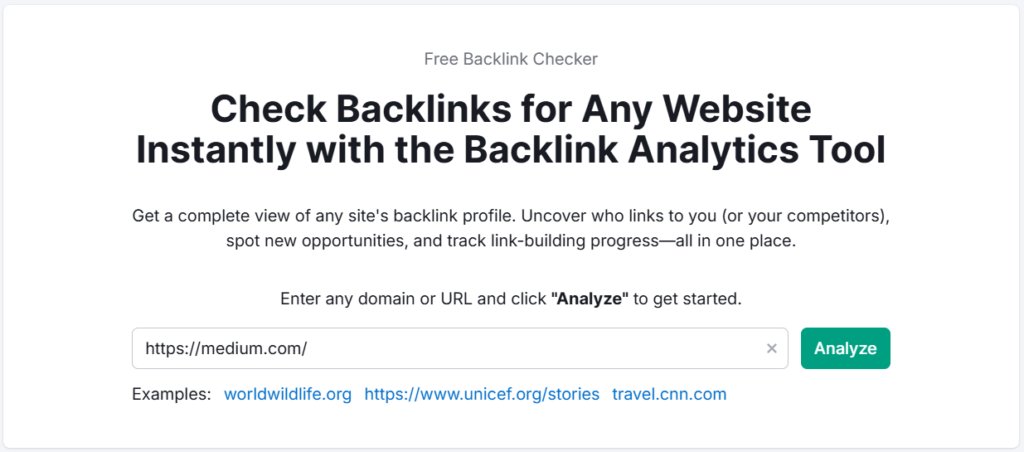
One more layer worth understanding: backlink data operates on its own crawl cycle.
Semrush’s proprietary crawler crawls approximately 10 billion web pages daily, maintaining a database of over 43 trillion backlinks. New links get added as they’re discovered. But a backlink appearing today may take a few days to surface in Semrush, depending on the crawl cycle for that page.
For most practical SEO use cases — link audits, competitor backlink analysis, toxic link identification — this lag is negligible. But if you’re expecting Semrush to show a brand-new backlink you acquired yesterday, you may need to wait a few days for it to appear.
As of the latest database figures, Semrush maintains:
| Data Type | Scale |
|---|---|
| Geographic Databases | 142 |
| Keywords | 27.9 billion |
| Domains | 808 million |
| Backlinks | 43 trillion |
| Raw Traffic Data | 500TB |
| AI Prompts Tracked | 261 million |
What This Means If You’re Actually Using Domain Analytics
Practically speaking, here’s how to think about Semrush data quality based on your use case:
If you’re tracking keyword rankings: You’re getting fresh, regularly updated SERP data. Trust it as a current signal.
If you’re researching a competitor’s historical growth: You need Guru or Business (SEO Classic) or Pro+/Advanced (Semrush One) to access historical data. The Pro/Starter tiers won’t give you this.
If you’re estimating overall traffic: You’re looking at clickstream-modeled estimates. Accurate directionally, but not equivalent to first-party analytics data. Pair it with Google Search Console and Google Analytics for your own site.
If you’re auditing backlinks: Data is comprehensive but not instantaneous. New links typically surface within a few days of being crawled.
This layered understanding is something I’ve found missing in most guides about Semrush — they either oversell the “live data” angle without explaining the exceptions, or they undersell Semrush’s actual freshness by focusing on the modeled traffic data.
The AI Visibility Data Angle (Worth Knowing About)
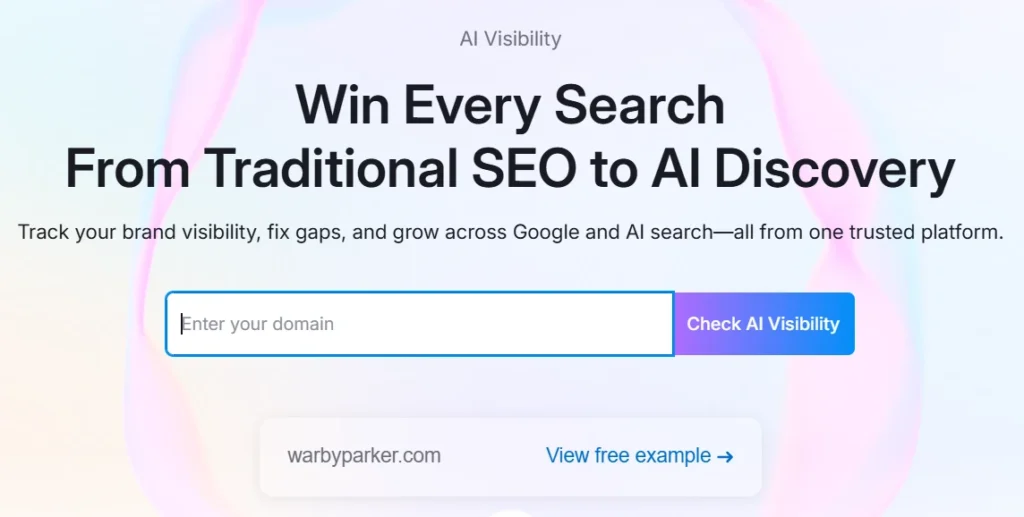
One newer dimension to Semrush’s data architecture that’s relevant here: AI Visibility data.
Semrush’s AI Visibility Toolkit collects and refreshes over 261 million prompts monthly, measuring how brands appear across ChatGPT, Google AI Mode, Gemini, Perplexity, SearchGPT, and Google AI Overviews. Brand Performance reports update weekly, while Prompt Tracking provides daily data on prompt-level performance.
This isn’t domain analytics in the traditional sense — it’s a separate data layer tracking GEO (Generative Engine Optimization) performance. But it’s becoming increasingly relevant as AI search surfaces shift how organic visibility is measured. If you want to know whether “Semrush provides only fresh live data for domain analytics” extends to AI search intelligence, it does, and the refresh cadence there is quite aggressive.
Which Plan Actually Gives You What
If the freshness and depth of Semrush data matter to your workflow, here’s where the plan structure becomes relevant.
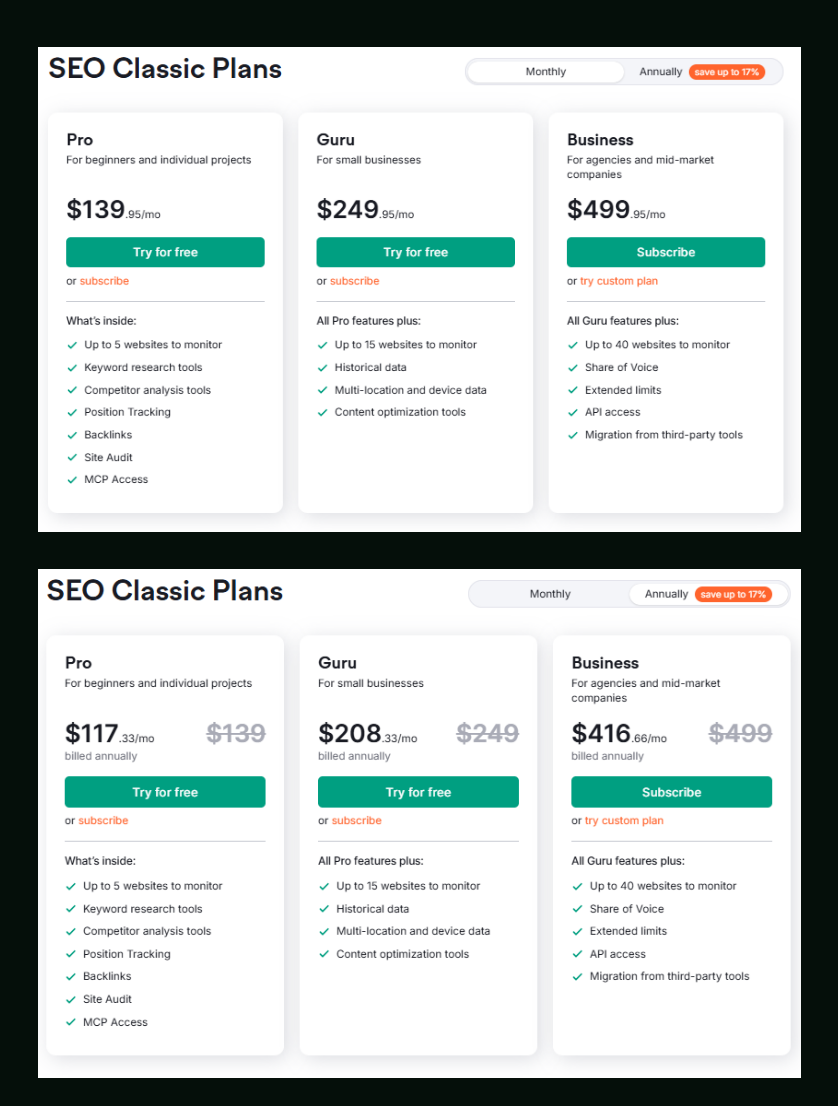
SEO Classic Plans (Monthly):
| Plan | Price | Historical Data | Keywords to Track |
|---|---|---|---|
| Pro | $139.95/mo | ✗ | 500 |
| Guru | $249.95/mo | ✓ | 1,500 |
| Business | $499.95/mo | ✓ | 5,000 |
SEO Classic Plans (Annually — save up to 17%):
| Plan | Price | Historical Data |
|---|---|---|
| Pro | $117.33/mo | ✗ |
| Guru | $208.33/mo | ✓ |
| Business | $416.66/mo | ✓ |
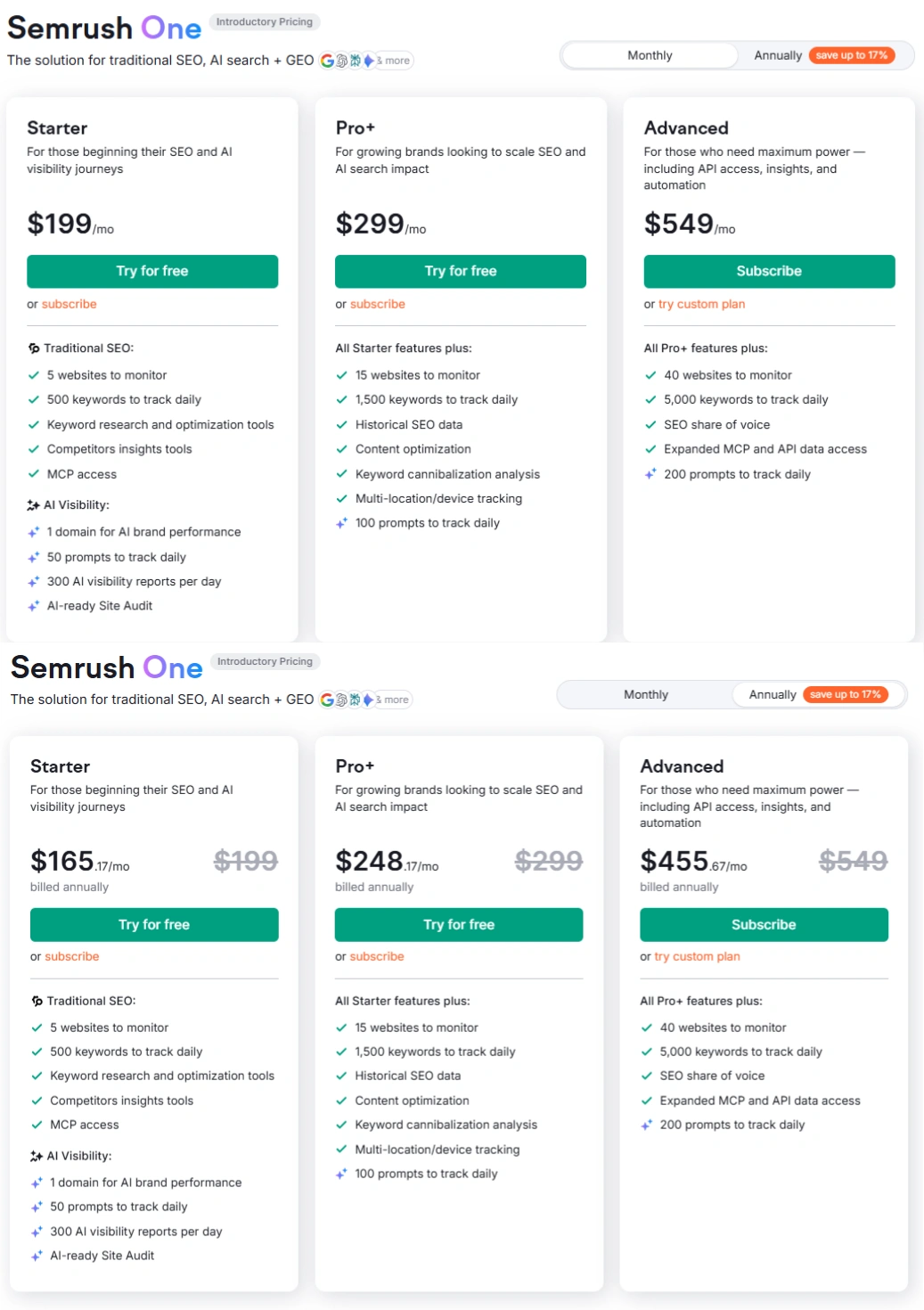
Semrush One Plans (Monthly) — Traditional SEO + AI Search:
| Plan | Price | AI Prompts/Day | Websites |
|---|---|---|---|
| Starter | $199/mo | 50 | 5 |
| Pro+ | $299/mo | 100 | 15 |
| Advanced | $549/mo | 200 | 40 |
Semrush One Plans (Annually):
| Plan | Price | Historical Data |
|---|---|---|
| Starter | $165.17/mo | ✗ |
| Pro+ | $248.17/mo | ✓ |
| Advanced | $455.67/mo | ✓ |
Pro plans (both Classic and Semrush One Starter) give you strong live data for keyword research and competitive analysis. If historical context matters for your workflow — tracking algorithm impact over time, understanding a competitor’s ranking trajectory — step up to Guru or Pro+.
Both the Pro and Guru classic plans include a 7-day free trial, giving you hands-on access to evaluate data quality before committing. If you want to test Semrush’s domain analytics firsthand, the free trial is the right starting point.
If you’re already on a classic plan and wondering whether the upgrade to Guru makes sense for your workflow, the Semrush Pro vs Guru breakdown covers exactly that decision.
Where Semrush Data Falls Short (Being Honest About It)
No tool is complete without its limitations, and being clear-eyed about these matters.
Traffic estimates aren’t first-party data. Semrush cannot access a site’s internal analytics. If you want exact traffic figures for your own site, you’ll still need Google Search Console or Google Analytics. Semrush Traffic Analytics is best used for competitor research and directional comparisons — not as a replacement for your own measurement stack.
Smaller markets have less data density. Semrush’s 142 geographic databases vary in depth. Tier-1 markets like the US, UK, and Germany are extremely well-covered. Smaller regional markets may have less keyword density and less frequent updates.
New backlinks have a short crawl lag. As mentioned, very recently acquired links may not appear immediately. For time-sensitive link monitoring, supplement with Google Search Console’s link reports.The
The Pro plan lacks historical access. If you’re on the entry-level plan and expecting a decade of SERP history, you’ll be disappointed. That’s a Guru/Business feature. Worth knowing before you sign up.

Semrush SEO Free Trial
Get full Pro access for 7 days — keyword research, site audit, backlink analysis & competitor research. No charge until after the trial ends.
Start Your Semrush 7-Day Free Trial →Frequently Asked Questions
Does Semrush update domain analytics data in real time?
Not exactly in real time, but very close. Semrush continuously queries Google’s SERPs through third-party data providers, updating keyword rankings in real time. Popular keywords can update daily, while less competitive terms may refresh less frequently. For most SEO work, the data freshness is more than sufficient for current decision-making.
What’s the difference between Semrush Domain Analytics and Traffic Analytics data?
Domain Analytics (keyword rankings, organic/paid visibility) uses live SERP crawl data — fresh and regularly updated. Traffic Analytics uses a clickstream model based on 200 million+ real users, processed through a neural network algorithm. Both are accurate, but measure different things and should be interpreted differently.
Does Semrush have historical data, or only live data?
Semrush maintains historical data going back to January 2012 for keyword and domain analytics. However, access to historical data requires a Guru or Business plan (SEO Classic) or Pro+/Advanced (Semrush One). The entry-level Pro and Starter plans provide live data only.
How accurate is Semrush’s traffic data for competitor research?
Semrush Traffic Analytics is directionally very accurate for competitor research — it’s built on 500TB of raw clickstream data from 200+ million users across 190+ countries. It won’t match the exact numbers you’d see inside a competitor’s Google Analytics, but for comparing traffic trends, estimating market share, and identifying traffic sources, it’s one of the most reliable third-party tools available. You can explore how it stacks up with tools like Semrush vs Ahrefs to see which data model fits your workflow better.
Can I test Semrush’s data quality before paying?
Yes. Both the Pro and Guru classic plans include a 7-day free trial. That’s enough time to run meaningful domain audits, keyword research, and competitive analysis to evaluate whether the data quality meets your needs. Start the free trial here.
Which Semrush plan is best if historical data matters to me?
If historical SERP data is important for your workflow — tracking algorithm impact, understanding competitor growth trajectories, or analyzing long-term keyword trends — go with at least the Guru plan ($208.33/mo annually) or Semrush One Pro+ ($248.17/mo annually). Both unlock historical data access that the entry-level plans don’t include.
Does Semrush track AI search visibility, or only traditional Google data?
Semrush now tracks AI visibility across ChatGPT, Gemini, Perplexity, Google AI Mode, SearchGPT, and Google AI Overviews through its AI Visibility Toolkit — monitoring 261 million prompts monthly. This is separate from traditional domain analytics but increasingly relevant as AI search becomes a primary discovery channel.
The Bottom Line
Semrush is primarily a live data platform, and for domain analytics, the keyword and ranking data genuinely reflect current SERP conditions. That part of the claim holds up.
But the “only fresh live data” framing misses what makes Semrush genuinely useful at scale: the combination of live SERP intelligence, a decade-plus of historical data (on the right plans), and modeled traffic estimates that are accurate enough for serious competitive research.
Understanding which layer you’re working with — and which plan unlocks it — is the difference between using Semrush as a surface-level ranking checker and using it as the competitive intelligence platform it’s built to be.
If you’re not on Semrush yet, the 7-day free trial is the cleanest way to evaluate the data quality yourself, without any commitment.
Everything You Need About Semrush Free Trial
Activate your Semrush free trial directly, read our step-by-step guide on how to get it, or learn how to cancel before getting charged — all in one place.
Start Semrush Free Trial
Get full Pro access for 7 days — keyword research, site audit, backlink analysis & competitor research. No charge until after the trial ends.
Start Free Trial →How to Get Free Trial
Step-by-step guide to activate your Semrush free trial — what you unlock, how to use it right, and how to get maximum value in 7 days.
Read Full Guide →How to Cancel Trial
Don’t get charged by mistake. Step-by-step guide to cancel your Semrush trial before the billing date — timing tips included.
Read Cancel Guide →