Two tools. Both promise competitor intelligence. Both claim to give you the edge your SEO strategy needs.
But here’s the thing — they’re built for very different types of users. And picking the wrong one doesn’t just waste money. It wastes the hours you’ll spend trying to make it work for a workflow it was never designed for.
I’ve spent time inside both platforms — running keyword gap reports, auditing backlink profiles, digging through PPC data — and the difference between them is clearer than most comparison articles let on.
Semrush vs SpyFu: Quick Answer
SpyFu wins on competitor PPC intelligence and affordability. Semrush wins on everything else — depth, breadth, and workflow coverage. If you’re running paid ads and want to reverse-engineer competitor campaigns on a budget, SpyFu is genuinely underrated. If you’re serious about SEO at scale, Semrush isn’t just better — it’s in a different category altogether.
The Problem Most Comparisons Don’t Address
Most “vs” articles treat these two tools like they’re neck-and-neck.
They’re not.
SpyFu was built with one core obsession: competitive intelligence, especially around Google Ads. It does that extremely well. Semrush started there too, but has since grown into a full marketing platform covering SEO, content, social, local, advertising, and now AI visibility.
So the real question isn’t which tool is “better.” It’s which tool is right for your situation.
What You’re Actually Getting With Semrush
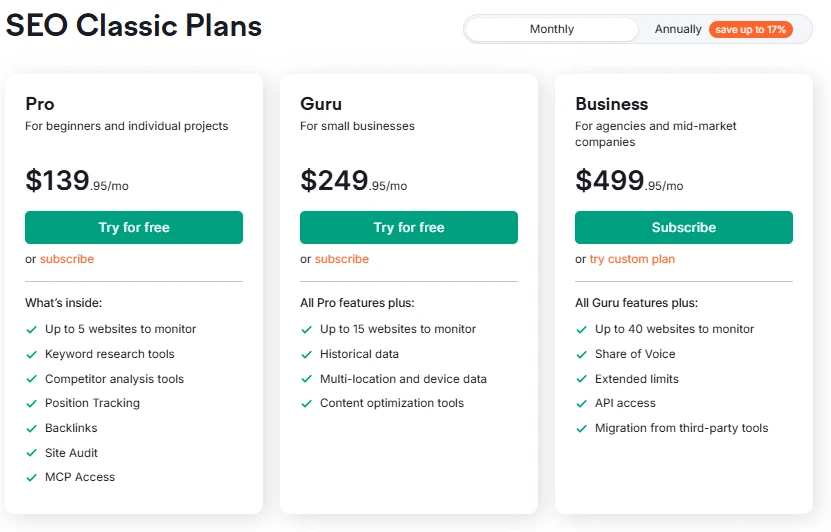
Semrush runs on three SEO Classic Plans — Pro, Guru, and Business — billed either monthly or annually (annual saves you 17%).
Monthly Pricing:
- Pro — $139.95/mo
- Guru — $249.95/mo
- Business — $499.95/mo
Annual Pricing (billed monthly):
- Pro — $117.33/mo
- Guru — $208.33/mo
- Business — $416.66/mo
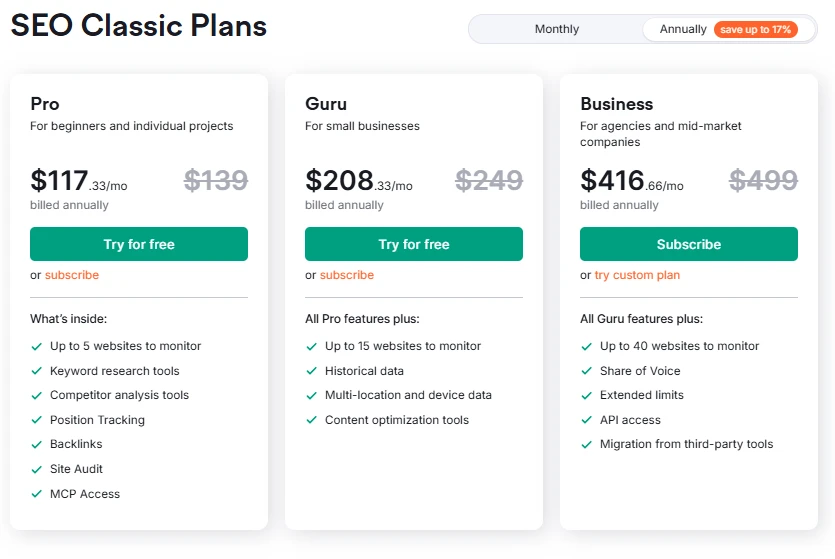
Pro and Guru both come with a free trial, so you can test the platform before committing. Business requires a direct subscription.
Here’s a quick breakdown of what separates the plans:
| Feature | Pro | Guru | Business |
|---|---|---|---|
| Websites to Monitor | 5 | 15 | 40 |
| Keywords to Track | 500 | 1,500 | 5,000 |
| Pages to Crawl/Month | 100,000 | 300,000 | 1,000,000 |
| Results Per Report | 10,000 | 30,000 | 50,000 |
| Reports Per Day | 3,000 | 5,000 | 10,000 |
| Historical Data | ✗ | ✓ | ✓ |
| Looker Studio Integration | ✗ | ✓ | ✓ |
| Share of Voice Tracking | ✗ | ✗ | ✓ |
| API Access | ✗ | ✗ | ✓ |
| SEO Idea Units/Month | 500 | 800 | 2,000 |
One thing that matters more than most people realize: historical data is locked behind Guru and above. If you’re tracking seasonal keyword trends or analyzing how a competitor’s visibility has shifted over the past year, Pro just won’t cut it.
In my testing, the Guru plan hits the sweet spot for most solo consultants and growing agencies. The jump from Pro to Guru is significant in terms of actual utility — not just numbers.
Add-Ons Worth Knowing About
Semrush also lets you expand your plan with paid add-ons:
- Additional Users — Starting at $45/mo per seat
- Lead Generation — $90/mo (includes Semrush Agency Partners badge + 1,000 Lead Finder credits)
- Base Report — $10/mo (data from 20+ tools, PDF export, GA/GSC integration)
- Pro Report — $20/mo (white-labeling, AI summaries, 20+ external integrations, delivery scheduling)
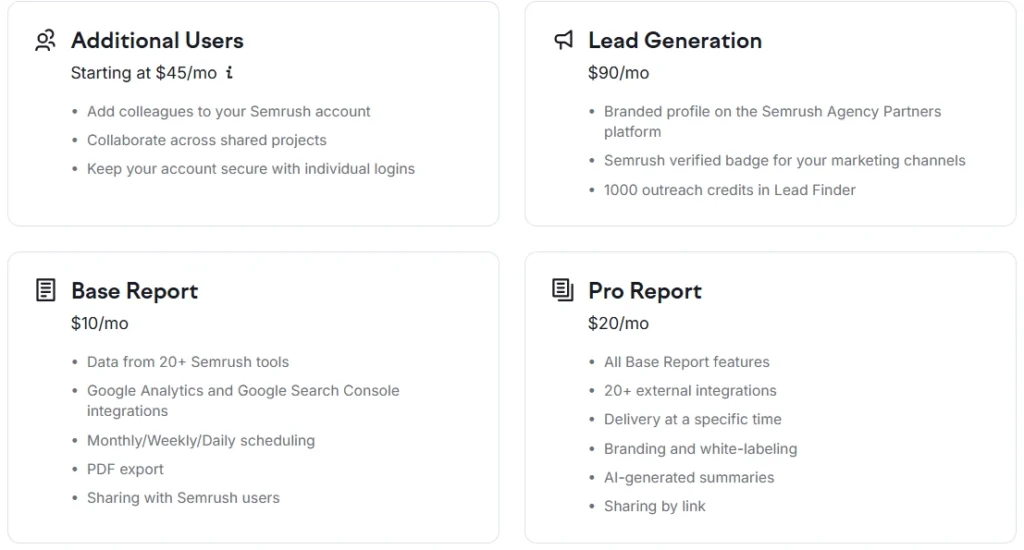
If you’re running an agency and need white-labeled reporting, the Pro Report add-on at $20/mo is honestly one of the better deals on the platform.
What You’re Actually Getting With SpyFu
SpyFu’s pricing is considerably more accessible — and that’s by design. It positions itself as the affordable competitor intelligence tool, particularly for PPC-focused marketers.
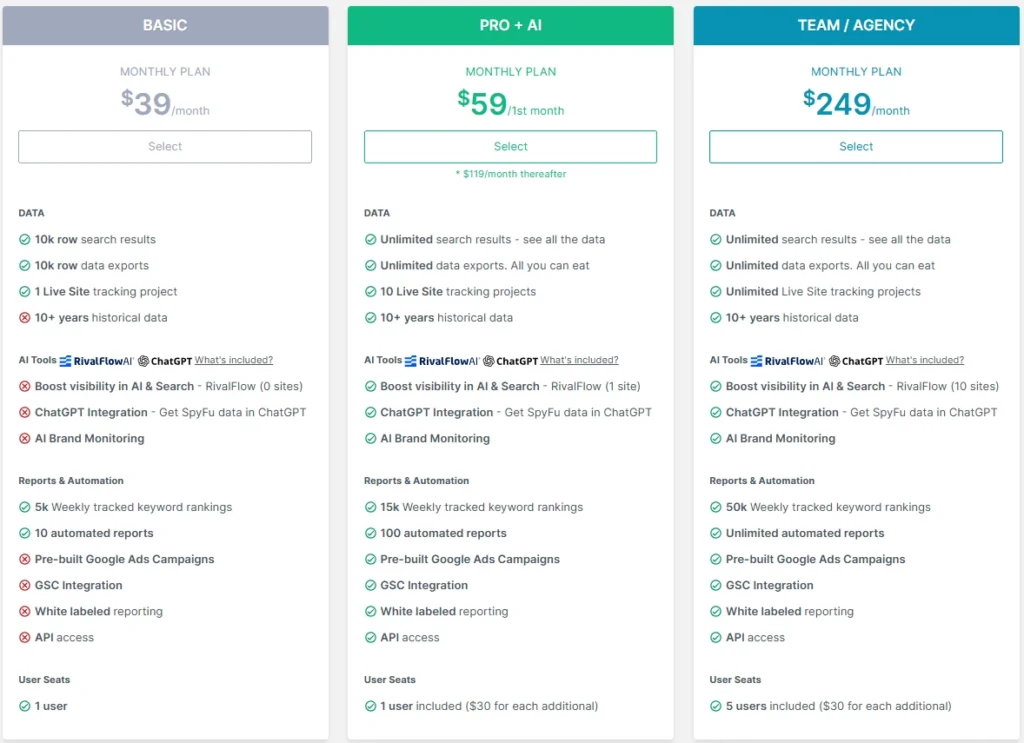
Monthly Pricing:
- Basic — $39/mo
- Pro + AI — $59/first month, then $119/mo
- Team/Agency — $249/mo
Annual Pricing (billed monthly, saves 25%):
- Basic — $29/mo
- Pro + AI — $89/mo
- Team/Agency — $187/mo
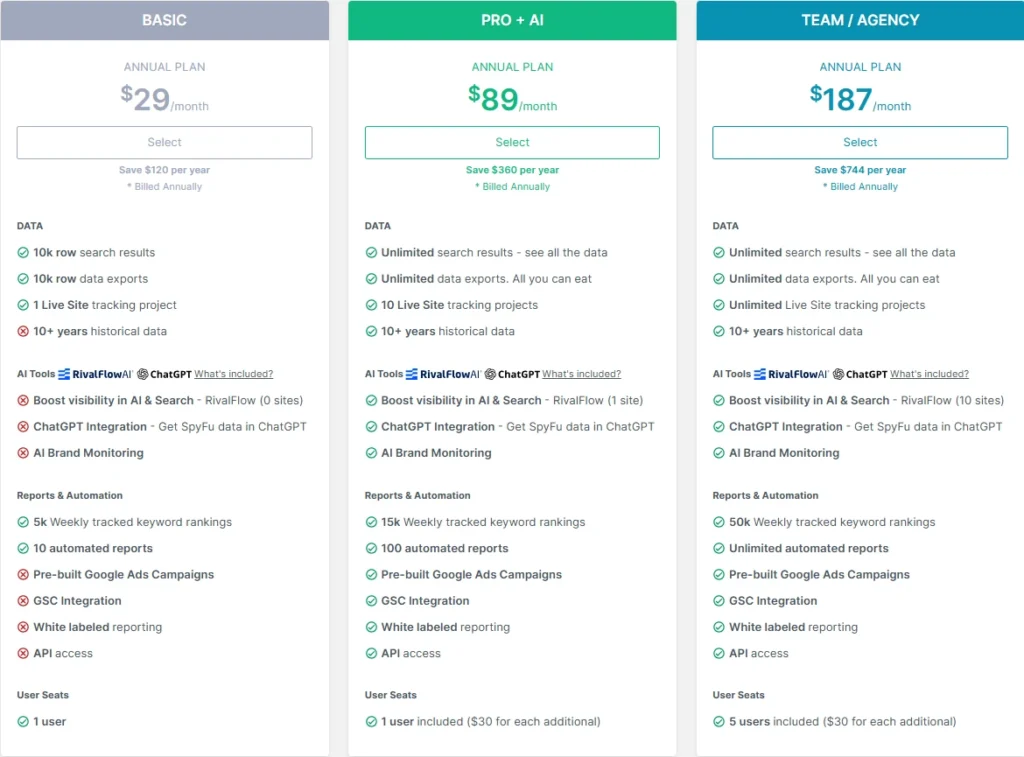
Worth noting: the Pro + AI plan is offered at a discounted $59 for the first month on monthly billing — that’s basically a soft trial offer.
Here’s how the plans compare on key features:
| Feature | Basic | Pro + AI | Team/Agency |
|---|---|---|---|
| Domain/Keyword Search Results | 10k | Unlimited | Unlimited |
| Data Exports | 10k rows | Unlimited | Unlimited |
| Live Site Tracking Projects | 1 | 10 | Unlimited |
| Keyword Rank Tracking | 5k/week | 15k/week | 50k/week |
| Automated Reports | 10 | 100 | Unlimited |
| White Labeled Reporting | ✗ | ✓ | ✓ |
| API Access | ✗ | ✓ | ✓ |
| Included API Credits | ✗ | $40 | $100 |
| GSC Integration | ✗ | ✓ | ✓ |
| RivalFlow AI (Websites) | 0 | 1 | 5 (up to 10) |
| ChatGPT Integration | Limited (3 chats) | Unlimited | Unlimited |
| Organic + Ad History (10+ years) | ✗ | ✓ | ✓ |
| Advanced Sales Lead Exports | 250 | 500 | 1,000 |
| Included Users | 1 | 1 (+$30/ea) | 5 (+$30/ea) |
The Basic plan at $29/mo annually is genuinely useful for freelancers who just want to peek at competitor keywords. But the moment you need API access, white labeling, or historical data, you’re moving to Pro + AI at minimum.
One standout feature in SpyFu’s newer plans: RivalFlow AI. It analyzes your existing content and tells you specifically what to improve to outrank competing pages. Not generic advice — actual page-level suggestions. In testing it on a client’s blog, the recommendations were surprisingly specific and actionable compared to what you’d get from manual content gap analysis.
SpyFu also offers a 30-day money-back guarantee with no forms, no questions, and no hoops. You can even cancel via Facebook or Twitter, which is either brilliantly user-friendly or a little chaotic depending on how you look at it.
Where Each Tool Actually Shines
Semrush is stronger for:
- Full SEO workflow management (audit → research → optimize → track)
- Content strategy and topic clusters
- Local SEO (via Local Toolkit add-on)
- Social media monitoring
- AI visibility tracking (separate AI Visibility Toolkit — no free trial)
- Large-scale technical audits (up to 1M pages/month on Business)
- Agencies needing Looker Studio dashboards
SpyFu is stronger for:
- PPC competitor research — this is genuinely its superpower
- Reverse-engineering Google Ads copy and bidding strategy
- Affordable entry-level competitor intelligence
- Teams that live inside ChatGPT and want SEO data piped directly in
- Agencies needing quick white-labeled reporting without massive overhead costs
Honestly, if Google Ads is a major revenue channel for your clients and your budget is under $100/mo, SpyFu Pro + AI at $89/mo annually gives you more PPC intelligence per dollar than almost anything else on the market.
The Honest Pros & Cons
Semrush
Pros:
- Most comprehensive SEO toolset available
- Strong keyword and backlink databases
- Free trial available on Pro and Guru plans
- Excellent technical audit capabilities
- Add-ons let you customize your plan
- MCP Access is included on all plans (a newer, underrated feature)
Cons:
- Pricing is steep, especially at the Business level
- Historical data locked behind Guru+
- Can feel overwhelming for beginners
- Add-ons stack up fast if you’re not careful
SpyFu
Pros:
- Very affordable, especially on annual billing
- Best-in-class PPC competitor research
- 30-day money-back, no questions asked
- RivalFlow AI is a genuinely useful content improvement tool
- ChatGPT integration is smooth and practical
- Unlimited data exports on Pro + AI and above
Cons:
- The backlink database is noticeably smaller than Semrush
- Basic plan is quite limited (no historical data, no API)
- Not built for full SEO workflow management
- Team/Agency plan at $249/mo is steep relative to what Semrush Guru offers
My Real Take: Who Should Pick What
If you’re a freelancer or solo blogger just getting into SEO, SpyFu Basic at $29/mo annually lets you start researching competitors without financial stress. It’s a low-risk entry point.
If you’re a growing content site or small agency doing serious SEO, Semrush Guru is the honest recommendation. The historical data alone justifies the price jump from Pro. You can start with the free trial here and see if the feature set matches your workflow before paying a cent.
If your business is heavy on Google Ads and you want to know exactly what competitors are bidding on, what ad copy they’re running, and how their strategy has shifted over the past decade, SpyFu Pro + AI is a sharper tool for that specific job.
If you’re running a mid-size agency managing multiple client sites with reporting, audits, rank tracking, and social — Semrush Business or even Semrush Guru with add-ons is where you want to be. The Semrush SEO Toolkit covers the core SEO workflow comprehensively.
A Quick Note on Semrush’s Broader Ecosystem
One thing that separates Semrush from SpyFu at a structural level: Semrush isn’t just an SEO tool anymore. It operates as a modular marketing platform with specialized toolkits — Content, Social, Local, Advertising, Traffic & Market, and AI Visibility. SpyFu doesn’t compete in any of these areas.
If your team’s work eventually expands beyond just keyword research and competitor tracking, Semrush grows with you. SpyFu doesn’t really.
Before You Decide — Other Tools Worth Knowing
Depending on your budget and specific needs, these are worth a look in the same category:
- SE Ranking — solid mid-range alternative with good rank tracking and white-label features
- Mangools — beginner-friendly and affordable, great for keyword research without complexity
- Ubersuggest — budget option if you’re just starting and need basic keyword data
Best Semrush Alternatives to Consider
If Semrush’s pricing feels steep after the trial, these three tools cover most of what you need at a lower price point — SE Ranking, Mangools, and Ubersuggest all offer free trials too.
SE Ranking
More affordable entry pricing, solid rank tracking and audit features. Good for small agencies and freelancers who don’t need Semrush’s full data depth.
Try SE Ranking →Mangools
Beginner-friendly, clean UI, strong keyword and SERP tools at a much lower price point. Perfect for solo bloggers who need keyword research without the complexity.
Try Mangools →Ubersuggest
Neil Patel’s SEO Tool — keyword research, site audit, and competitor analysis at a very affordable price. Great for beginners and small business owners on a tight budget.
Try Ubersuggest →For deeper context on Semrush specifically, you might also find these useful:

Semrush SEO Free Trial
Get full Pro access for 7 days — keyword research, site audit, backlink analysis & competitor research. No charge until after the trial ends.
Start Your Semrush 7-Day Free Trial →Semrush vs SpyFu: Frequently Asked Questions
Is SpyFu better than Semrush for PPC research?
For pure Google Ads competitor intelligence — yes, SpyFu has a genuine edge. It shows you 10+ years of ad history, competitor ad copy, and estimated budgets in a way that’s faster and more affordable than Semrush’s Advertising Toolkit. If paid search is your primary focus and you’re budget-conscious, SpyFu Pro + AI at $89/mo annually is hard to beat for that specific use case.
Does Semrush offer a free trial in 2026?
Yes. Semrush currently offers a free trial on both the Pro ($139.95/mo) and Guru ($249.95/mo) plans. The Business plan requires a direct subscription. You can activate the trial without committing to a paid plan upfront. Check the Semrush free trial page for current availability and exact trial terms.
Which SpyFu plan is best for a freelancer?
The Pro + AI plan on annual billing at $89/mo is the sweet spot. You get unlimited search results, unlimited data exports, white-labeled reporting, API access, 10 live site tracking projects, and RivalFlow AI for content improvement. The Basic plan at $29/mo is usable, but the 10k data cap and missing features make it feel limiting fairly quickly.
Can I use both Semrush and SpyFu together?
Some agencies actually do this — using Semrush as their primary SEO and site management platform, and SpyFu specifically for PPC competitor research and ad copy analysis. It’s not a crazy approach if Google Ads is a significant part of your client work. Whether the combined cost makes sense depends on your billing structure and how often you’d actually be inside SpyFu.
What happens if I cancel Semrush after the free trial?
You won’t be charged if you cancel before the trial period ends. Semrush allows cancellation through your account settings. For a step-by-step guide on safely canceling without getting billed, the Semrush trial cancellation guide walks through the exact process.
The Verdict
SpyFu is underrated for what it does. The PPC intelligence, the unlimited data exports at the Pro level, RivalFlow AI, and the risk-free money-back policy make it a legitimate tool — not just a budget fallback.
But Semrush is the fuller platform. If SEO is central to your business and you need one tool to handle research, auditing, tracking, content, and reporting, the comparison isn’t really close.
Start with the Semrush free trial if you haven’t already. Give it a real week of use. If you find yourself mostly caring about Google Ads competitor data on a tighter budget, come back to SpyFu.
Most people don’t regret going with the tool that has more room to grow into. Fewer people say that about the one they outgrew in three months.
— Karan Rajput, Web Developer & SEO Specialist, ToolkitFreeTrials.com