Contents
- 0.1 The Number Nobody Explains Properly
- 0.2 How SEMrush Actually Calculates It
- 0.3 Where to Find It in SEMrush
- 0.4 Why It Matters More Than You Might Think
- 0.5 The Limitations Nobody Talks About
- 0.6 What It Costs to Access This Data
- 0.7 Semrush SEO Free Trial ( Pro & Guru )
- 0.8 Semrush One Free Trial
- 0.9 The AI Search Angle Most People Are Missing
- 0.10 Semrush One Free Trial
- 0.11 Semrush Pro & Guru Free Trial
- 0.12 Frequently Asked Questions
- 0.13 What exactly does SEMrush Traffic Cost represent?
- 0.14 Is a higher traffic cost always better?
- 0.15 How accurate is the SEMrush Traffic Cost metric?
- 0.16 Can I track the traffic cost over time for a competitor?
- 0.17 Does Traffic Cost appear for paid search traffic, too?
- 0.18 Do I need a paid Semrush plan to see Traffic Cost?
- 0.19 How is Traffic Cost different from what I’d actually spend on Google Ads?
- 0.20 The Takeaway
- 1 Everything You Need About Semrush Free Trial
Most SEOs glance at this number and move on. That’s a mistake.
SEMrush Traffic Cost sits quietly in the Domain Overview and Organic Research reports — a single dollar figure that most people either misread, underuse, or ignore entirely. Spend five minutes actually understanding it, and it becomes one of the sharper competitive signals you have access to.
Quick Answer: SEMrush Traffic Cost is the estimated monthly cost to replicate a website’s organic search traffic through Google Ads. It’s calculated by multiplying the estimated traffic each keyword drives by its average CPC, then summing those values across all ranking keywords. A high traffic cost means a site is ranking for commercially valuable terms — terms advertisers are actively bidding on.
The Number Nobody Explains Properly
Here’s the thing — most articles describe Traffic Cost as “the cost to buy your organic traffic through ads.” That’s technically accurate but practically useless without context.
What it’s really telling you is the commercial quality of a site’s keyword portfolio. Two websites can each pull 100,000 monthly visitors. One is ranking for high-CPC finance or SaaS keywords worth $8–$15 per click. The other is pulling traffic from informational queries where CPC is $0.10. Their organic traffic numbers look identical. Their Traffic Cost figures look nothing alike.
That gap is the insight.
In my experience auditing client sites, traffic cost is often more revealing than raw organic traffic volume. I’ve seen mid-size B2B SaaS sites with 40,000 monthly visitors carrying a traffic cost upward of $35,000 — because every page they ranked for was a commercial-intent keyword. That’s a fundamentally different asset than a blog with ten times the visitors but a traffic cost of $12,000.
How SEMrush Actually Calculates It
Understanding the formula makes the number much easier to interpret — and harder to be misled by.
SEMrush doesn’t have access to Google’s actual bid auction data. What it does instead is build an estimate from the data it does have.
The Three Inputs
Keyword rankings: For every keyword a domain ranks for, SEMrush records the position. Position 1 has a dramatically higher click-through rate than position 7 — and the CTR model accounts for this.
Click-through rate by position: SEMrush uses clickstream data to estimate the percentage of searchers who actually click at each ranking position. The top 3 results capture a disproportionate share. A site ranking #1 for a keyword with 10,000 monthly searches gets estimated very differently than one sitting at position 9 for the same term.
Average CPC from Google Ads: For each keyword, SEMrush pulls the average cost-per-click from Google’s advertising ecosystem. This reflects what advertisers are actually bidding to appear for that term in paid search.
The Calculation
For each keyword: Estimated monthly traffic × Average CPC = Traffic cost for that keyword
Then SEMrush sums that figure across every keyword the domain ranks for. The result is the total Traffic Cost you see in the report.
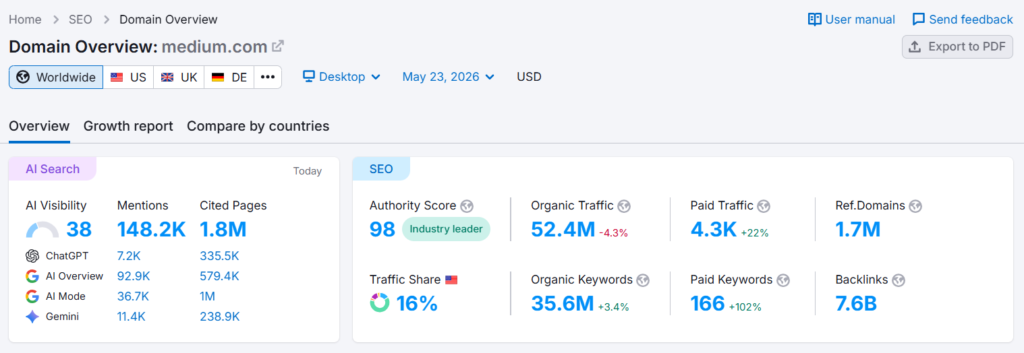
So when you look at the medium.com Domain Overview in the screenshot above — 52.4 million organic visitors, an Authority Score of 98, and 35.6 million organic keywords — you’re seeing a site with a traffic cost that reflects an enormous keyword portfolio, but one skewed toward informational content where individual CPCs tend to be lower. Meanwhile, a SaaS brand with 500,000 monthly visitors and rankings concentrated on high-intent software keywords might carry a comparable or higher traffic cost.
The volume tells you reach. The traffic cost tells you value.
Where to Find It in SEMrush
Traffic Cost doesn’t live in one place — it appears across several reports, and the version you’re looking at matters.
Domain Overview
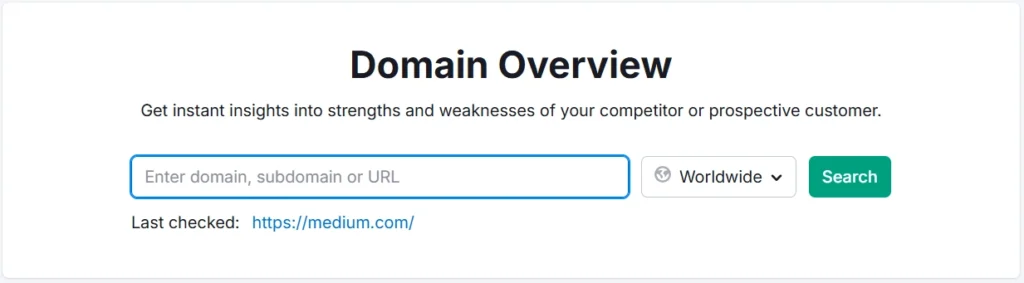
The most visible entry point. Type any domain into the Domain Overview tool and you’ll see Traffic Cost displayed alongside Organic Traffic, Authority Score, and Paid Traffic. This gives a top-level snapshot — useful for quick competitor checks.
The screenshot used throughout this article shows exactly this view: the domain, its worldwide traffic data, Authority Score, and the Traffic Cost figure alongside it.
Organic Research
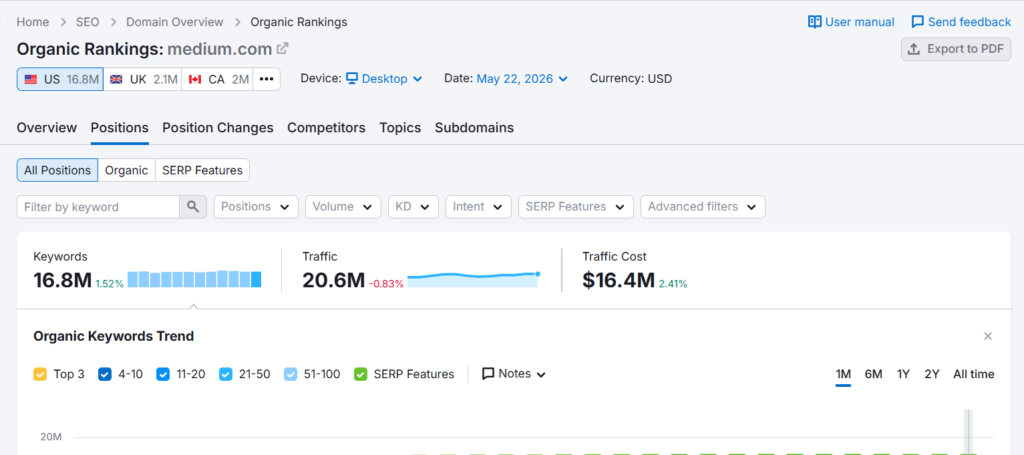
This is where things get more useful. Under the Organic Research report for any domain, you can see Traffic Cost over time, broken down by country. This lets you track whether a competitor’s SEO value is growing or eroding — not just whether their traffic is up or down.
This is the report I tend to spend more time in. In my testing across client projects, I’ve found that watching a competitor’s Traffic Cost trend over six months tells you far more than a single snapshot. A domain losing traffic but maintaining traffic cost is losing low-value pages. A domain gaining traffic but losing traffic cost is building content that ranks but doesn’t convert.
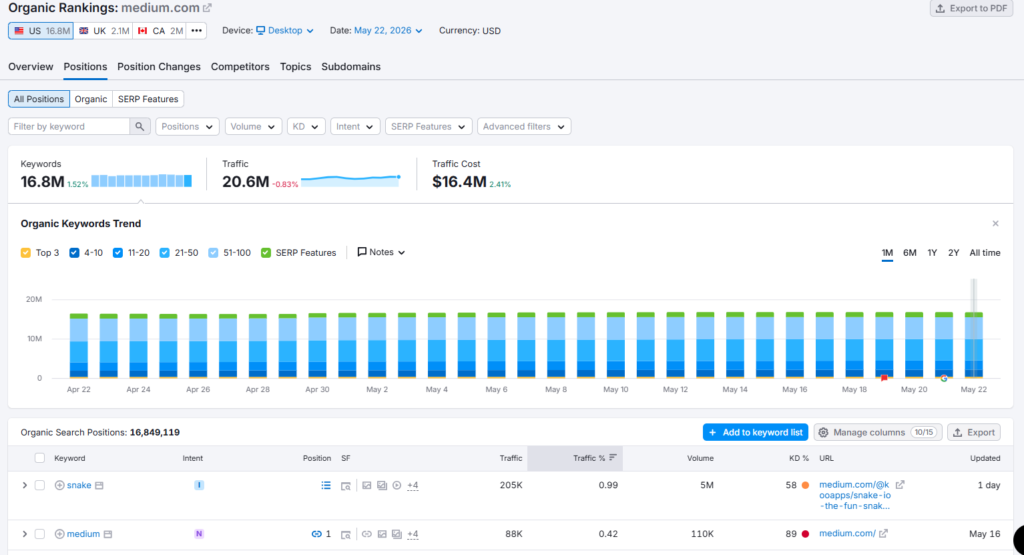
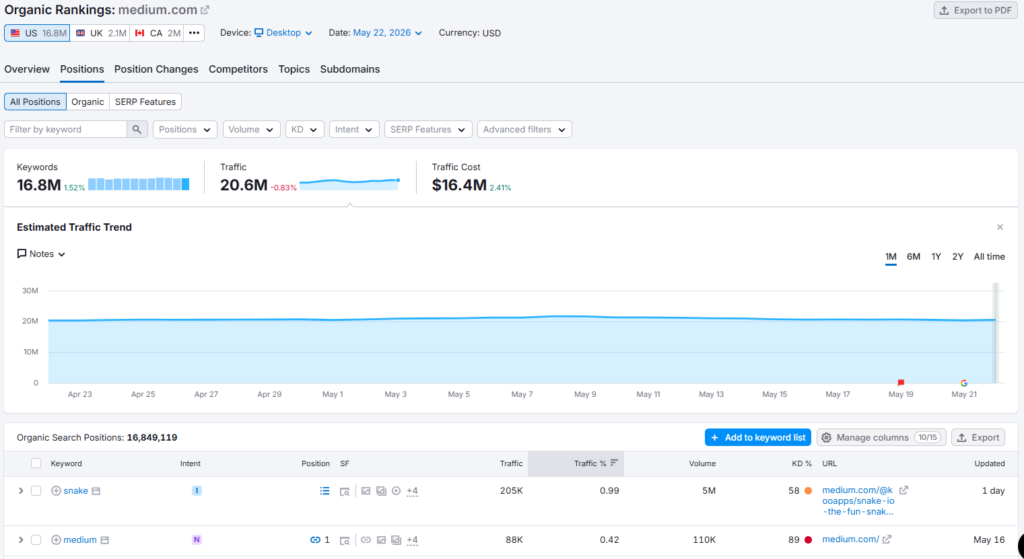
“The Positions tab within Organic Research shows the full keyword breakdown — individual keywords, their traffic share, search volume, and KD — all feeding into that single Traffic Cost figure at the top.”
Why It Matters More Than You Might Think
Traffic Cost has three practical uses that go beyond curiosity.
Measuring Your Own SEO ROI
If your organic traffic generates a traffic cost of $50,000/month, you have a defensible number to present to a client or internal stakeholder. That’s the equivalent paid search budget you’d need to replace that traffic. You didn’t spend $50k. You earned $50k in SEO value.
This framing is genuinely useful in budget conversations. It’s not about what you’re spending — it’s about what organic rankings are saving you from spending.
Competitive Gap Analysis
When you look at a competitor’s Traffic Cost alongside their keyword profile, you start seeing where they’re winning commercially valuable ground. If a competitor’s traffic cost jumped 40% over six months, that’s not random — they’re either ranking for new high-CPC keywords or climbing positions on existing ones.
Checking which keywords are driving that increase shows you exactly where to compete next. This is something I do regularly when building content strategies for new clients: find competitors with rising traffic cost, identify the keywords behind it, and assess where there’s a realistic opening.
Evaluating a Site Before You Buy It
Anyone acquiring a website — or seriously considering it — should be looking at traffic cost, not just traffic. A site with 200,000 monthly visitors and a traffic cost of $8,000 is a very different asset than one with 80,000 visitors and $95,000 in traffic cost. The first has reach. The second has commercial leverage.
The Limitations Nobody Talks About
Traffic Cost is a useful proxy. It’s not gospel.
It uses average CPC, not actual CPC. The CPC Semrush shows is an average across all advertisers bidding on a keyword globally (or by the country filter you select). Your actual cost in a real campaign would vary based on quality score, match type, landing page relevance, and competition at that exact moment.
SERP features reduce click value. If a keyword triggers a featured snippet, AI Overview, a map pack, or a shopping carousel, the actual click-through rate to organic results is lower than the standard CTR model suggests. SEMrush’s traffic cost calculation doesn’t fully account for SERP features eating into organic clicks — which means for some queries, the number may overestimate actual traffic value.
Local and niche markets behave differently. CPC data is thinner for highly localized or niche industries. The estimates hold up well for competitive national markets but can be less reliable for local service businesses or very narrow B2B verticals.
It can rise without rankings improving. If advertisers start bidding more aggressively on keywords you already rank for, your traffic cost goes up — even if your rankings and actual traffic are flat. The metric reflects keyword market dynamics as well as your own SEO performance.
None of this makes it unreliable. It makes it a signal to triangulate, not a number to take at face value.
What It Costs to Access This Data
Traffic Cost is available across Semrush’s paid plans. Here’s what’s relevant to know when choosing.
SEO Classic Plans
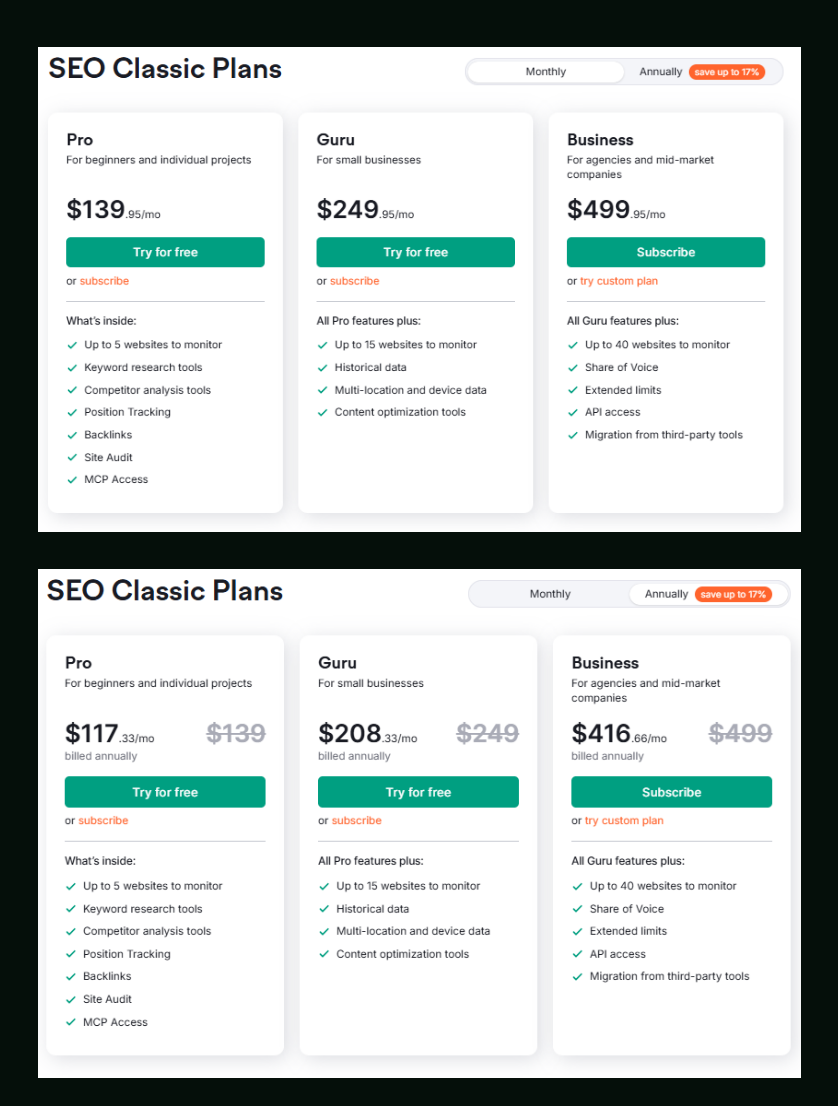
Pro — $139.95/mo (monthly) or $117.33/mo billed annually Track up to 500 keywords daily, monitor 5 websites, access keyword research and competitor analysis tools. Traffic Cost data is accessible here. Good entry point if you’re primarily analyzing your own domain and a handful of competitors.
Guru — $249.95/mo (monthly) or $208.33/mo billed annually Track up to 1,500 keywords daily, monitor 15 websites, with historical data, multi-location and device tracking, and content optimization tools. The historical data access is significant — it means you can track Traffic Cost trend lines over time, not just current snapshots. This is where competitor monitoring becomes genuinely powerful.
Business — $499.95/mo (monthly) or $416.66/mo billed annually Track up to 5,000 keywords daily, monitor 40 websites, with Share of Voice, API access, and migration from third-party tools. Built for agencies and larger teams managing multiple client domains simultaneously.
Both Pro and Guru offer a 7-day free trial — enough time to run Domain Overview reports on your top 10 competitors and pull meaningful Traffic Cost data. The Business plan requires direct subscription.
If you’re comparing plans before committing, the Semrush Pro vs Guru breakdown is worth reading — especially the historical data difference, which directly impacts how useful Traffic Cost analysis becomes over time.
Semrush SEO Free Trial ( Pro & Guru )
Get full Pro access for 7 days — keyword research, site audit, backlink analysis & competitor research. No charge until after the trial ends.
Start Your Semrush 7-Day Free Trial→Semrush One Plans (Introductory Pricing)
Semrush One is the newer bundle that combines traditional SEO with AI search visibility and GEO tracking.
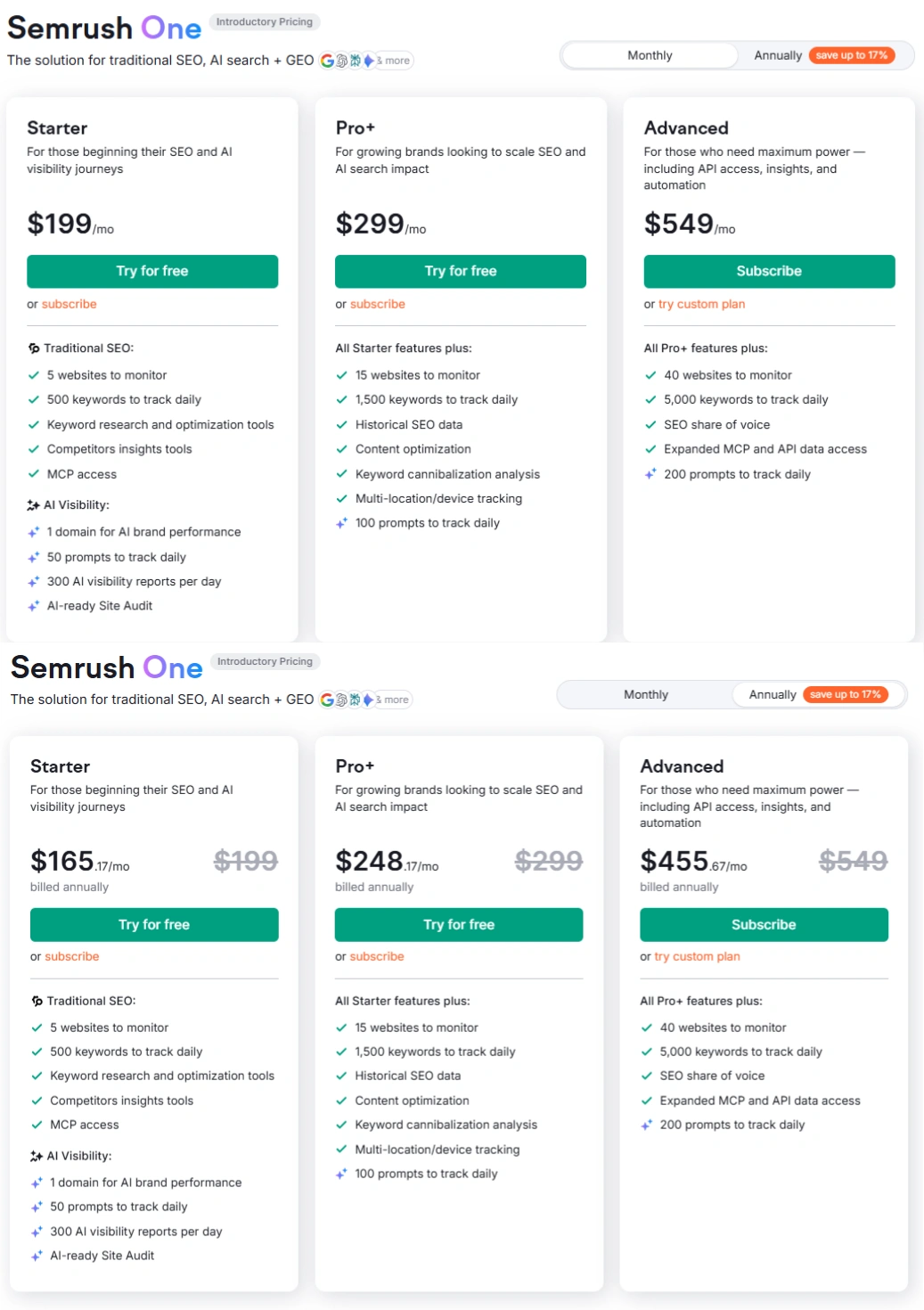
Starter — $199/mo (monthly) or $165.17/mo billed annually 5 websites, 500 keywords daily, keyword research and competitor tools, MCP access, plus AI Visibility features: 1 domain for AI brand performance, 50 prompts to track daily, 300 AI visibility reports per day, and AI-ready Site Audit.
Pro+ — $299/mo (monthly) or $248.17/mo billed annually 15 websites, 1,500 keywords daily, historical SEO data, content optimization, keyword cannibalization analysis, multi-location/device tracking, and 100 prompts to track daily.
Advanced — $549/mo (monthly) or $455.67/mo billed annually 40 websites, 5,000 keywords daily, SEO share of voice, expanded MCP and API data access, 200 prompts to track daily. For teams that need maximum coverage and automation.
Starter and Pro+ both carry “Try for free” buttons. The Semrush One plans are worth considering if AI search visibility — how your brand appears in ChatGPT, AI Overviews, and Gemini — is a growing priority alongside traditional SEO.
Semrush One Free Trial
Everything you need to win AI visibility and drive SEO Success. Get full Semrush One access for 7 days — explore the Starter, Pro+, or Advanced plans. Track your website’s SEO performance, monitor AI visibility and brand share of voice, run deep site audits, and get AI-driven marketing insights. No charge until after your 7-day trial ends.
Start Your Semrush One 7-Day Free Trial →Add-Ons Worth Knowing
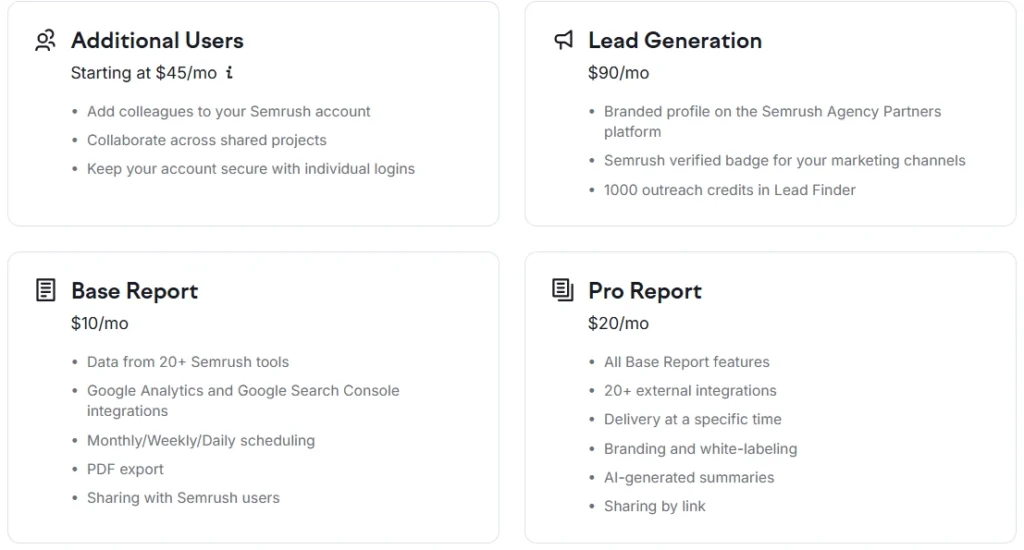
Additional Users — from $45/mo per user (SEO Classic) or $80–$100/mo (Semrush One). Relevant for teams sharing access across projects.
Lead Generation — $90/mo. Includes a branded profile on Semrush’s Agency Partners platform and 1,000 outreach credits in Lead Finder.
Base Report — $10/mo. Data from 20+ Semrush tools with Google Analytics and Google Search Console integration, PDF export, and monthly/weekly/daily scheduling.
Pro Report — $20/mo. Everything in Base Report plus 20+ external integrations, white-labeling, AI-generated summaries, and delivery scheduling.
The AI Search Angle Most People Are Missing
Here’s something that didn’t exist in most Traffic Cost discussions two years ago: AI search is starting to erode organic click-through rates on certain query types.
When an AI Overview answers a user’s question directly on the SERP, a portion of organic clicks that would have happened don’t. For the keyword categories most affected — definition queries, how-to questions, simple factual searches — the actual traffic delivered per ranking is declining, even if rankings themselves hold.
What does this mean for Traffic Cost?
The CPC component of the calculation stays stable (advertisers still bid on these terms). But the estimated traffic component becomes slightly optimistic for AI-heavy query types. Over time, sites that built their Traffic Cost on informational content may see the actual traffic those rankings deliver soften, even as the metric itself holds relatively steady.
This is partly why Semrush introduced the AI Visibility section, now visible in the Domain Overview — it tracks brand mentions, citations, and visibility across ChatGPT, Google AI Mode, Gemini, and AI Overviews separately from traditional organic rankings. Keeping an eye on both figures gives a more complete picture of how a site’s overall search visibility is evolving.
Semrush One Free Trial
Dominate the future of AI search. Unlock advanced brand share of voice, monitor generative AI visibility, automate insights, and scale marketing impact across all digital channels.
Semrush Pro & Guru Free Trial
Master your organic rankings. Run comprehensive site audits, track keyword positions, analyze backlink profiles, and spy on competitor SEO strategies completely risk-free for 7 days.
Frequently Asked Questions
What exactly does SEMrush Traffic Cost represent?
It’s the estimated monthly cost to generate a site’s current organic search traffic through Google Ads instead. Semrush calculates it by estimating the traffic each ranking keyword delivers (based on position and average CTR), then multiplying that by the keyword’s average CPC from Google’s ad auction data, and summing across all keywords. It’s a proxy for the commercial value of organic rankings — not the actual cost of anything.
Is a higher traffic cost always better?
Generally, yes, but context matters. A high traffic cost indicates a site is ranking for keywords advertisers actively compete for, which typically means commercial intent and real buyer interest behind those searches. That said, Traffic Cost can be inflated by a small number of extremely high-CPC keywords, even if the bulk of a site’s traffic comes from lower-value terms. Always look at the distribution, not just the total. You can check which keywords are contributing most through the Organic Research report.
How accurate is the SEMrush Traffic Cost metric?
Reasonably accurate as a directional signal — less reliable as a precise figure. The main sources of variance are: CPC estimates that reflect averages rather than exact bid prices; CTR modeling that may not fully account for AI Overviews and rich SERP features reducing organic clicks; and thinner data for niche or local markets. For competitive benchmarking and trend analysis, it’s one of the more useful metrics available. For budgeting or projecting actual revenue impact, treat it as an informed estimate rather than a hard number.
Can I track the traffic cost over time for a competitor?
Yes, through the Organic Research report. Select a domain, navigate to the Overview tab, and look at the Traffic Cost trend graph. You can filter by country and date range. Historical data access requires Guru, Business, or Semrush One Pro+ and above — it’s not available on the Pro or Starter plans. If tracking competitor trajectory over time is a priority, that’s the clearest reason to consider upgrading from Pro to Guru.
Does Traffic Cost appear for paid search traffic, too?
Traffic Cost in the Domain Overview and Organic Research reports reflects organic traffic only. Semrush does track paid traffic separately — the Advertising Research report covers paid keyword rankings, estimated paid traffic, and paid traffic cost as a distinct metric. If you’re looking at the Domain Overview summary, the “Paid Traffic” figure and “Traffic Cost” figure are separate columns referring to different sources.
Do I need a paid Semrush plan to see Traffic Cost?
You can see a limited version of Traffic Cost data with a free Semrush account, but the data is restricted and partial. A paid plan — or the 7-day free trial on Pro, Guru, Semrush One Starter, or Pro+ — gives you full access to the Domain Overview and Organic Research reports with complete Traffic Cost data. If you haven’t started the trial yet, here’s how to access it.
How is Traffic Cost different from what I’d actually spend on Google Ads?
Significantly different. SEMrush Traffic Cost is a theoretical equivalent — what you’d theoretically spend to buy the same clicks through paid search. Your actual Google Ads costs would vary based on your quality score, ad relevance, landing page experience, competitor activity at the time of the auction, and the exact match types you’re bidding on. The Semrush figure uses average CPCs across all advertisers bidding on a term, which smooths out those variables. Think of it as a baseline reference point, not a campaign budget estimate.
The Takeaway
Traffic Cost isn’t a vanity metric. Used correctly, it tells you something raw traffic volume can’t: how commercially valuable a site’s search presence actually is.
Whether you’re benchmarking competitors, making the case for SEO investment internally, or evaluating a site acquisition, this number deserves more than a glance. Pair it with keyword-level CPC data and historical trend lines, and you’ve got a genuinely useful lens on where organic value is being created and where it’s eroding.
Karan Rajput has been working with SEMrush across client SEO projects for over 5 years. Most of the interpretation patterns described here came from using this metric consistently in competitive analysis work — not from reading about it.
If you want to explore Traffic Cost alongside the rest of Semrush’s competitive intelligence toolkit, the 7-day free trial on SEO Classic plans is the most practical place to start. If you’re also thinking about AI search visibility, the Semrush One plans cover both angles from a single dashboard.
Everything You Need About Semrush Free Trial
Activate your Semrush free trial directly, read our step-by-step guide on how to get it, or learn how to cancel before getting charged — all in one place.
Start Semrush Free Trial
Get full Pro access for 7 days — keyword research, site audit, backlink analysis & competitor research. No charge until after the trial ends.
Start Free Trial →How to Get Free Trial
Step-by-step guide to activate your Semrush free trial — what you unlock, how to use it right, and how to get maximum value in 7 days.
Read Full Guide →How to Cancel Trial
Don’t get charged by mistake. Step-by-step guide to cancel your Semrush trial before the billing date — timing tips included.
Read Cancel Guide →