Choosing between two solid SEO platforms is never as simple as comparing price tags. You have to think about what your workflow actually looks like — are you a solo blogger, a growing agency, or somewhere in between? Because honestly, both Semrush and SE Ranking are capable tools, but they’re built for slightly different realities.
I’ve spent time inside both platforms, and this breakdown is based on real usage — not just feature lists scraped from their pricing pages.
Semrush vs SE Ranking: Quick Answer
Semrush is the more powerful platform with a deeper database and more toolkits, but it’s priced for teams with real budgets. SE Ranking is a leaner, more affordable alternative that now covers both traditional SEO and AI search visibility (GEO). If you’re a solo SEO or small agency watching costs, SE Ranking offers more value per dollar. If data depth and integrations matter most, Semrush wins.
The Core Difference Nobody Talks About
Most comparison articles will tell you that Semrush has more data. That’s true. But what they skip is why SE Ranking has become genuinely competitive — and it’s not just pricing.
SE Ranking now tracks GEO (Generative Engine Optimization) natively across AI platforms like AI Overviews, Perplexity, and ChatGPT. On the Core plan, you get 100 AI prompts tracked daily. On Growth, that jumps to 250. That’s built-in — not an add-on.
Semrush does offer AI visibility tracking, but through a separate AI Visibility Toolkit, and it carries no free trial.
That distinction matters more in 2026 than it did even a year ago. Search is shifting. If your clients or your own brand need visibility in AI-generated answers, SE Ranking is already set up for that. Semrush requires you to layer on another toolkit purchase.
Semrush Pricing — What You’re Actually Paying
Semrush runs three SEO Classic Plans:
| Plan | Monthly | Annually (save ~17%) |
|---|---|---|
| Pro | $139.95/mo | $117.33/mo |
| Guru | $249.95/mo | $208.33/mo |
| Business | $499.95/mo | $416.66/mo |
Pro and Guru both come with a free trial — Business is subscription-only.
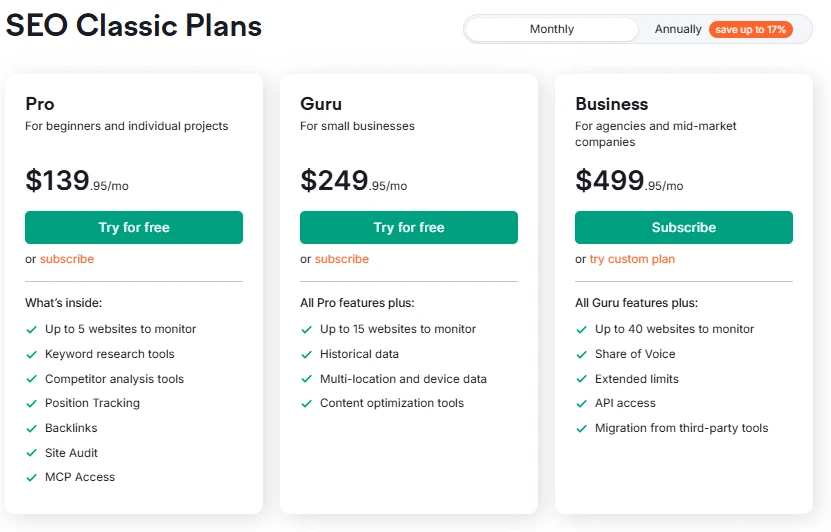
Here’s where the sticker shock kicks in for most people: the base plans don’t include everything. If you need multi-location tracking, content optimization tools, or historical data, you need Guru or above. And if you’re running an agency that needs white-label reports or advanced API access, you’re looking at Business — or buying add-ons.
Semrush Add-ons (on top of any plan):
- Additional Users: from $45/mo
- Lead Generation (Agency Partners badge + outreach credits): $90/mo
- Base Report: $10/mo
- Pro Report (white-label, AI summaries, scheduling): $20/mo
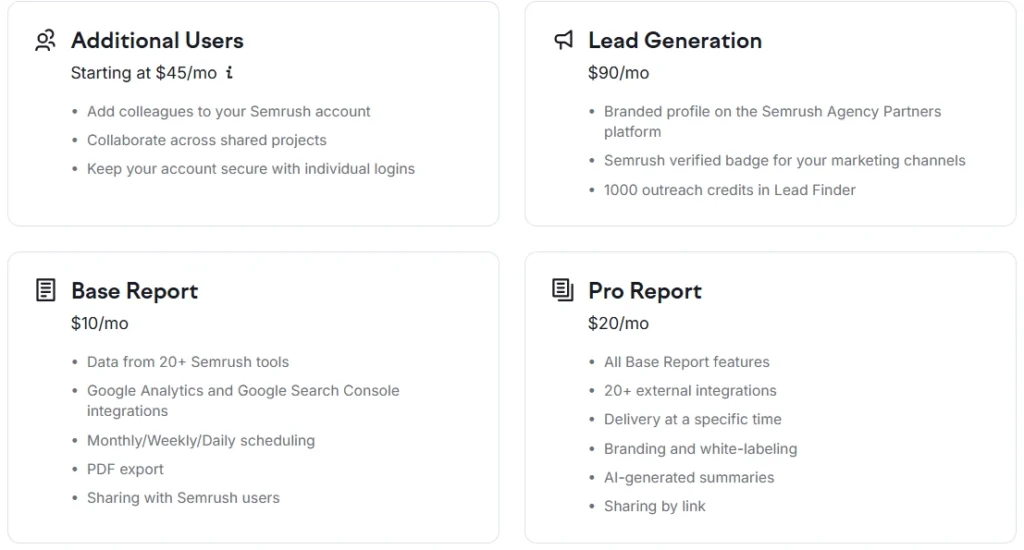
So a small agency on the Guru plan with two extra users and Pro Reports is paying roughly $208.33 + $90 + $20 = ~$320/mo annually. Not cheap.
Plan Limits Compared (Semrush):
| Feature | Pro | Guru | Business |
|---|---|---|---|
| Keywords to track | 500 | 1,500 | 5,000 |
| Pages to crawl/mo | 100,000 | 300,000 | 1,000,000 |
| Websites to monitor | 5 | 15 | 40 |
| Historical data | ✗ | ✓ | ✓ |
| Looker Studio integration | ✗ | ✓ | ✓ |
| Reports per day | 3,000 | 5,000 | 10,000 |
| JS rendering (Site Audit) | ✗ | ✓ | ✓ |
One thing I noticed during testing — the 500-keyword limit on Pro hits fast if you’re managing even two or three client sites. That alone pushes most professionals toward Guru.
SE Ranking Pricing — More Transparent Than It Looks
SE Ranking keeps it simpler with two main plans:
| Plan | Monthly | Annually (save 20%) |
|---|---|---|
| Core | $129.00/mo | $103.20/mo |
| Growth | $279.00/mo | $223.20/mo |
Both plans include a 14-day free trial, no credit card required. That’s a meaningful difference from Semrush — you can actually test the full platform before committing.
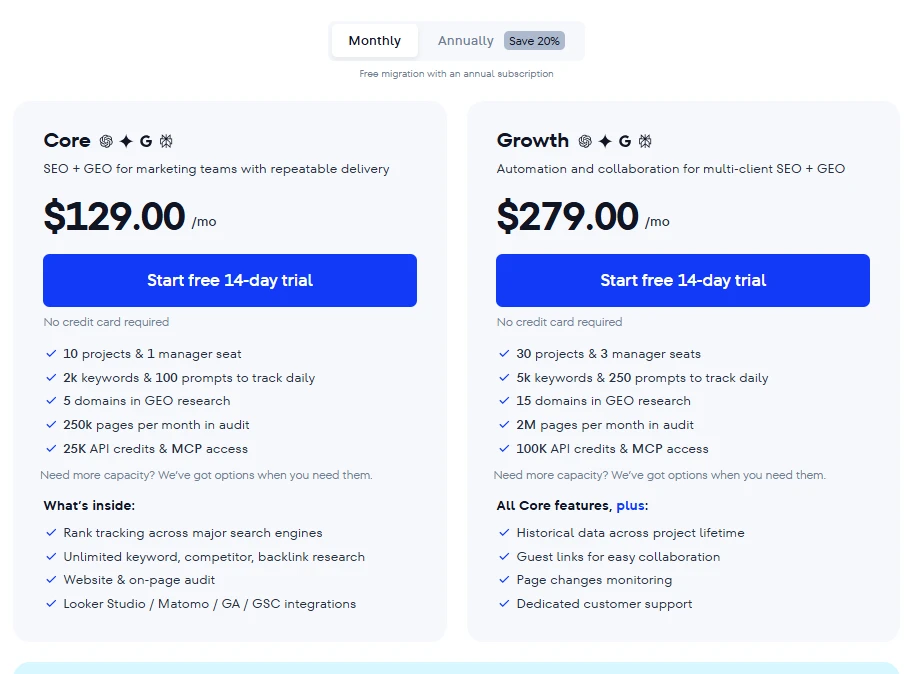
What’s in each plan:
| Feature | Core | Growth |
|---|---|---|
| Projects | 10 | 30 |
| Manager Seats | 1 | 3 |
| Keywords tracked daily | 2,000 | 5,000 |
| GEO prompts/day | 100 | 250 |
| Domains in GEO research | 5 | 15 |
| Audit pages/month | 250,000 | 2,000,000 |
| API credits/month | 25,000 | 100,000 |
| Historical data | 6 months | All time |
| Page changes monitoring | ✗ | ✓ |
| Guest links | ✗ | ✓ |
| Dedicated support | ✗ | ✓ |
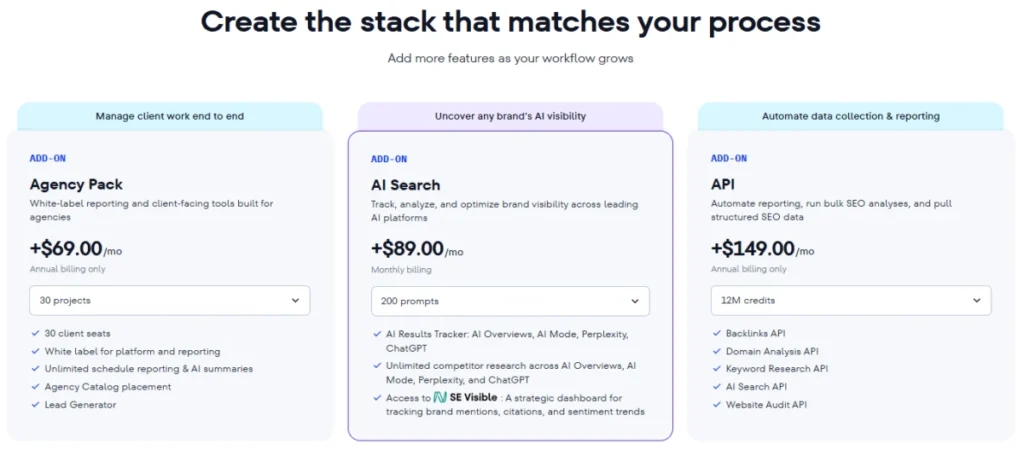
For agencies, SE Ranking also offers add-ons:
- Agency Pack: +$69/mo (annual only) — 30 client seats, white-label reporting, agency catalog placement, Lead Generator
- AI Search add-on: +$89/mo — tracks brand visibility across AI Overviews, Perplexity, AI Mode, and ChatGPT
- API add-on: +$149/mo (annual only) — bulk SEO analysis, backlinks API, keyword research API
There’s also a Planable bundle (social media management) starting from $33/mo with a 20% discount when bought alongside SE Ranking.
Pro Observation: The Core plan’s 6-month historical data window is a real limitation for competitive research. If you’re doing any serious competitor analysis — tracking ranking trends over time — you’ll want the Growth plan’s all-time historical access. In my testing, this made a noticeable difference when trying to identify seasonality patterns in a client’s keyword performance.
Feature-by-Feature Reality Check
Keyword Research
Semrush’s keyword database is larger — there’s no debate there. The Keyword Magic Tool is genuinely one of the best in the industry.
SE Ranking’s keyword tools are solid for most use cases. For standard research workflows — finding clusters, checking difficulty, validating search intent — it gets the job done. Where it falls short is in obscure long-tail discovery at scale.
Edge: Semrush
Rank Tracking
Both tools track rankings across major search engines. SE Ranking tracks across Google, Bing, Yahoo, and others, with daily updates. The Core plan handles 2,000 keywords daily; Growth goes to 5,000.
Semrush Pro gives you 500 tracked keywords — that’s notably lower than SE Ranking Core’s 2,000 at a comparable price point.
Edge: SE Ranking (especially at lower price tiers)
Site Audit
Semrush Pro crawls 100,000 pages/month. SE Ranking Core crawls 250,000. That’s a meaningful gap — SE Ranking gives you significantly more crawl budget at the entry level.
Semrush does add JavaScript rendering from Guru up. SE Ranking includes it too, though the specifics depend on your plan setup.
Edge: SE Ranking at entry level
AI & GEO Tracking
This is where SE Ranking has made its clearest differentiation move. GEO (tracking brand/keyword visibility in AI search answers) is baked into both Core and Growth plans. You’re tracking up to 5 LLMs, with unlimited AI source tracking and unlimited AI competitive research reports.
Semrush’s AI visibility features sit behind the AI Visibility Toolkit — a separate purchase with no free trial.
Edge: SE Ranking (significant)
Backlink Analysis
Semrush’s backlink database is one of the largest available. If backlink prospecting and deep link analysis are central to your work, Semrush is the stronger choice here.
SE Ranking includes backlink research and monitoring on both plans, and it’s genuinely useful. But the raw database size doesn’t match Semrush.
Edge: Semrush
Reporting & Integrations
Both tools integrate with Google Analytics, Google Search Console, and Looker Studio — but Semrush locks Looker Studio integration to Guru and above. SE Ranking includes it on Core, along with Matomo and GA4 support.
For white-label reporting, SE Ranking’s Agency Pack add-on ($69/mo) makes it accessible at a lower entry point than Semrush’s Business tier.
Edge: SE Ranking for agencies on a budget
Who Should Actually Use Each One
Choose Semrush if:
- You need the deepest keyword and backlink databases available
- Your workflow depends heavily on competitive intelligence at scale
- You’re already using (or planning to use) multiple Semrush toolkits — Social, Advertising, Content, Local
- Budget isn’t the primary constraint
Choose SE Ranking if:
- You want AI/GEO tracking included without paying extra
- You’re managing multiple client projects on a tighter budget
- You need more tracked keywords at a lower price tier
- A no-credit-card 14-day trial matters to your evaluation process
- You’re a small-to-mid agency that wants white-label reporting without enterprise pricing
Where Each Tool Falls Short
Semrush’s weak spots:
The price jump from Pro to Guru is steep — you’re going from $117.33 to $208.33/mo annually for features that arguably should be in the base plan (historical data, Looker Studio, JS rendering). And the AI visibility features requiring a separate toolkit purchase feel like a miss given how central AI search has become.
SE Ranking’s weak spots:
The keyword database isn’t as deep. For highly competitive niches where you need to surface every possible long-tail opportunity, you may hit the edges of what SE Ranking can show you. The Core plan’s 6-month historical data cap also stings if you’re doing retrospective competitive analysis.
The Price Overlap That Changes the Decision
Here’s something worth doing the math on:
SE Ranking Growth annually = $223.20/mo Semrush Guru annually = $208.33/mo
They’re almost the same price at the annual tier. At that crossover point, the decision becomes purely about features and database size — not cost. Semrush Guru gives you more keyword data and a larger backlink database. SE Ranking Growth gives you 5,000 daily tracked keywords (vs Guru’s 1,500), 2 million crawl pages (vs 300K), and built-in AI tracking.
For most SEO professionals managing active campaigns, the keyword tracking and crawl limit difference actually favors SE Ranking Growth — even at identical spend.
My Take
If I were starting a new agency today and had to pick one, I’d probably run the SE Ranking 14-day trial first — specifically to test the GEO tracking and see how the audit tool holds up on a real client site. The no-credit-card trial removes the friction, and the Core plan’s 2,000 daily keywords are enough to evaluate it properly.
For enterprise-level work where data breadth is non-negotiable — Semrush is still the standard. But for solo consultants and growing agencies, the pricing structure and GEO-native approach make SE Ranking worth a serious look before defaulting to the bigger name.
→ Start your free 14-day SE Ranking trial here — no credit card needed.
→ Try Semrush free on Pro or Guru to compare firsthand.

Semrush SEO Free Trial
Get full Pro access for 7 days — keyword research, site audit, backlink analysis & competitor research. No charge until after the trial ends.
Start Your Semrush 7-Day Free Trial →Common Questions
Does SE Ranking have a free plan?
No permanent free plan — but the 14-day trial is fully functional with up to 10 projects, 750 tracked keywords per day, 20 AI prompts/day, and AI competitive research for up to 3 domains.
Can I switch between SE Ranking plans later?
Yes, you can upgrade or downgrade at any time through your billing settings. Custom limits beyond standard tiers are available by contacting sales.
Does Semrush offer a free trial on all plans?
No. Pro and Guru plans include a free trial. Business is a subscription-only service with no trial option.
Which tool is better for local SEO?
SE Ranking includes local marketing features (up to 3 locations on Core, 1,500 local rank tracker keywords, 100+ listing directories) on its main plans. Semrush’s Local Toolkit is a separate product. If local SEO is central to your work, compare both SE Ranking and Semrush Local directly.
Is SE Ranking good for agencies?
Yes — especially with the Agency Pack add-on ($69/mo annual). You get 30 client seats, white-label reporting, unlimited scheduled reports with AI summaries, and agency catalog placement. For agencies not ready for Semrush Business pricing, this is a strong alternative.
Best Semrush Alternatives to Consider
If Semrush’s pricing feels steep after the trial, these three tools cover most of what you need at a lower price point — SE Ranking, Mangools, and Ubersuggest all offer free trials too.
SE Ranking
More affordable entry pricing, solid rank tracking and audit features. Good for small agencies and freelancers who don’t need Semrush’s full data depth.
Try SE Ranking →Mangools
Beginner-friendly, clean UI, strong keyword and SERP tools at a much lower price point. Perfect for solo bloggers who need keyword research without the complexity.
Try Mangools →Ubersuggest
Neil Patel’s SEO Tool — keyword research, site audit, and competitor analysis at a very affordable price. Great for beginners and small business owners on a tight budget.
Try Ubersuggest →