Most people land on Semrush after Googling “how to rank higher on Google” or “what keywords should I target.” And then they open the dashboard for the first time and feel immediately overwhelmed.
That’s not a knock on the tool — it’s actually a sign of how much it does.
I’m Karan, and I’ve been using Semrush as part of my SEO workflow for a while now. What I can tell you from real experience: it’s not just a keyword tool. It’s closer to a command center for your entire digital presence.
Quick Answer: Semrush is an all-in-one digital marketing platform used for SEO, keyword research, competitor analysis, content marketing, PPC, and more. It gives marketers and businesses a centralized toolkit to grow their online visibility — from tracking rankings to auditing websites and spying on competitor strategies.
So What Exactly Is Semrush?
Semrush started as a keyword research and competitor analysis tool back in 2008. Over the years — especially recently — it’s evolved into something much bigger.
Today, it covers:
- SEO — keyword research, site audits, backlink analysis, rank tracking
- Content Marketing — topic research, content optimization, SEO writing assistant
- Competitor Intelligence — see where rivals rank, what ads they run, where their traffic comes from
- PPC & Advertising — ad copy research, display ad analysis
- Social Media — scheduling, tracking, performance analytics
- Local SEO — local listing management, review monitoring
- Market & Traffic Research — industry-level traffic insights, market share data
That’s a wide net. And honestly, most users will only ever use 30–40% of what’s available — which is fine, because even that subset is powerful.
Behind the Data — What’s Actually Powering It
Most people treat Semrush as a dashboard. What’s actually running underneath is one of the largest independently maintained SEO datasets in the world — built over 17+ years of continuous web crawling.
The numbers: 25B+ keywords, 43T+ backlinks, 260M+ AI prompts tracked, and 800M+ domain profiles.
This matters because when you search any keyword or domain in Semrush, you’re not triggering a live Google query. You’re querying a pre-built, continuously updated proprietary index. That’s why results appear instantly — and why Semrush data can sometimes differ slightly from what you see in Google Search Console directly.
Here’s What You Actually Get Inside
Think of Semrush as a platform with multiple “toolkits” grouped by use case.
The core product — the SEO Classic Plans — gives you access to the foundational tools most SEOs live inside daily:
- Keyword Magic Tool (one of the largest keyword databases in the industry)
- Domain Overview (instant traffic and authority snapshot of any website)
- Site Audit (crawls your site and flags technical SEO issues)
- Position Tracking (monitors your keyword rankings daily)
- Backlink Analytics & Backlink Audit
- Organic Research (see exactly what keywords any competitor ranks for)
- On-Page SEO Checker
- Content Gap analysis
Beyond that, Semrush has specialized toolkits you can add:
| Toolkit | What It’s For |
|---|---|
| Content Toolkit | Topic research, SEO content templates, writing assistant |
| Social Toolkit | Social scheduling, analytics, and competitor benchmarking |
| Local Toolkit | Local SEO, listing management, review tracking |
| Advertising Toolkit | PPC research, ad copies, competitor ad intelligence |
| Traffic & Market Toolkit | Market share analysis, traffic analytics, audience insights |
| AI Visibility Toolkit | Tracks your brand presence in AI-generated search results |
The Plans — What You Pay and What You Get
Semrush now offers two distinct plan families. SEO Classic Plans focus purely on traditional SEO — no AI visibility bundled. Semrush One combines SEO and AI search tracking in a single subscription. The right choice depends on whether AI visibility is part of your current workflow.
Semrush’s SEO Classic Plans are structured around three tiers. Here’s a straight breakdown based on current pricing:
| Plan | Monthly Price | Annual Price (17%) | Best For |
|---|---|---|---|
| Pro | $139.95/mo | $117.33/mo | Beginners & individual projects |
| Guru | $249.95/mo | $208.33/mo | Small businesses |
| Business | $499.95/mo | $416.66/mo | Agencies & mid-market companies |
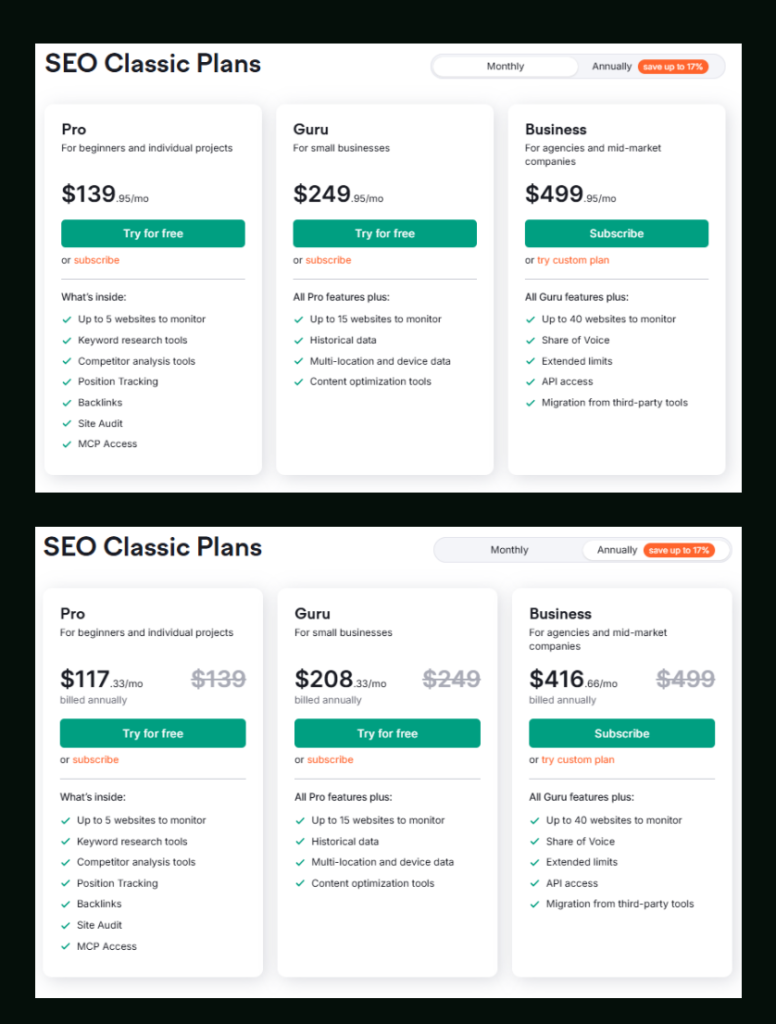
Annual billing saves you up to 17%, which adds up to a meaningful difference over 12 months.
What’s Actually Different Between Plans?
This is where most “Semrush pricing” articles go vague. Let me be specific:
Pro gives you:
- Up to 5 websites to monitor
- 500 keywords to track (daily updates)
- 100,000 pages to crawl/month
- 10,000 results per report
- 3,000 reports per day
- 250 keyword metric updates/month
- No historical data, no JavaScript rendering in audits, no Looker Studio integration
Guru adds:
- Up to 15 websites
- 1,500 keywords tracked
- 300,000 pages crawled/month
- 30,000 results per report
- Historical data (this is a big one — you can analyze ranking trends over time)
- JavaScript rendering in Site Audit
- Keyword Cannibalization reports
- Multi-location and device data
- Content optimization tools
- Looker Studio integration
Business goes further:
- Up to 40 websites
- 5,000 keywords tracked
- 1,000,000 pages/month
- Share of Voice tracking
- API access
- Extended limits across the board
- Migration from third-party tools
If you’re deciding between Pro and Guru specifically, I’ve written a more detailed Semrush Pro vs Guru breakdown that goes into which one actually makes sense depending on your situation.
Semrush SEO Free Trial ( Pro & Guru )
Get full Pro access for 7 days — keyword research, site audit, backlink analysis & competitor research. No charge until after the trial ends.
Start Your Semrush 7-Day Free Trial→Semrush One — SEO + AI Visibility Bundled
Semrush has recently launched a second plan family — Semrush One — which bundles traditional SEO tools with AI visibility tracking in a single subscription. It’s currently tagged as Introductory Pricing.
| Plan | Monthly | Billed Annually |
|---|---|---|
| Starter | $199/mo | $165.17/mo |
| Pro+ | $299/mo | $248.17/mo |
| Advanced | $549/mo | $455.67/mo |
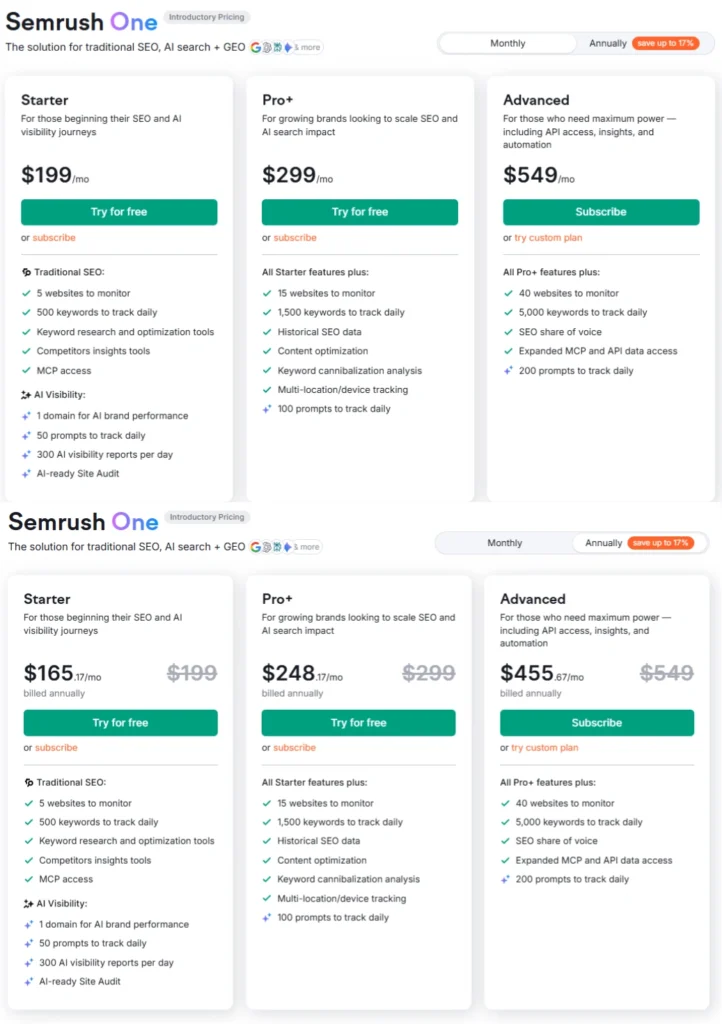
Starter includes 5 websites, 500 daily keywords, plus AI visibility: 1 domain for AI brand performance, 50 daily AI prompts tracked, 300 AI visibility reports/day, and an AI-ready Site Audit.
Pro+ scales to 15 websites, 1,500 keywords, 100 daily AI prompts, historical data, content optimization, and keyword cannibalization analysis.
Advanced unlocks 40 websites, 5,000 keywords, 200 daily AI prompts, SEO share of voice, and expanded MCP and API access.
Starter and Pro+ include a 7-day free trial. Advanced requires a direct subscription.
If AI visibility tracking matters to your workflow, Semrush One is worth considering over the Classic plans. Classic Pro still makes sense for pure traditional SEO on a tighter budget.
Semrush One Free Trial
Everything you need to win AI visibility and drive SEO Success. Get full Semrush One access for 7 days — explore the Starter, Pro+, or Advanced plans. Track your website’s SEO performance, monitor AI visibility and brand share of voice, run deep site audits, and get AI-driven marketing insights. No charge until after your 7-day trial ends.
Start Your Semrush One 7-Day Free Trial →Add-Ons: Where It Gets Modular
Semrush lets you extend any plan with paid add-ons:
- Additional Users — starting at $45/mo (for team collaboration with individual logins)
- Lead Generation — $90/mo (Semrush Agency Partners profile, verified badge, 1,000 Lead Finder credits)
- Base Report — $10/mo (automated reports pulling from 20+ tools, GA + GSC integration, PDF export)
- Pro Report — $20/mo (everything in Base Report + white-labeling, AI summaries, 20+ external integrations, delivery scheduling)
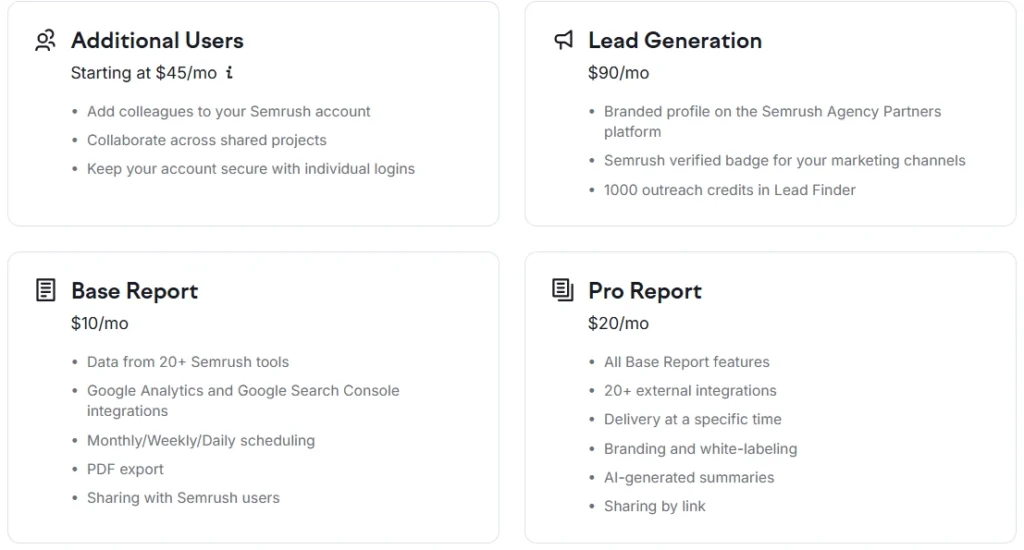
The Pro Report add-on is genuinely useful for agencies sending branded reports to clients without them logging into Semrush directly.
Who Actually Uses Semrush?
Semrush positions itself for a wide audience, but realistically:
It makes the most sense for:
- SEO freelancers managing multiple client sites
- In-house SEO and content teams at growing businesses
- Digital marketing agencies need competitive intelligence
- E-commerce brands running both organic and paid traffic
It’s probably overkill if:
- You’re running a single blog with no monetization goals
- You only need basic keyword ideas (free tools might do)
- Your budget is under $100/month, and you need just one feature
That said, both Pro and Guru have a free trial option (“Try for free” buttons are live on both), so you can test the full suite before committing. If that’s your next step, here’s how to get the Semrush free trial without getting charged.
Everything You Need About Semrush Free Trial
Activate your Semrush free trial directly, read our step-by-step guide on how to get it, or learn how to cancel before getting charged — all in one place.
Start Semrush Free Trial
Get full Pro access for 7 days — keyword research, site audit, backlink analysis & competitor research. No charge until after the trial ends.
Start Free Trial →How to Get Free Trial
Step-by-step guide to activate your Semrush free trial — what you unlock, how to use it right, and how to get maximum value in 7 days.
Read Full Guide →How to Cancel Trial
Don’t get charged by mistake. Step-by-step guide to cancel your Semrush trial before the billing date — timing tips included.
Read Cancel Guide →My Real Experience With It
In my testing across client projects, the features I return to most consistently are Organic Research and Position Tracking. The keyword gap analysis alone has surfaced content opportunities I wouldn’t have found otherwise — specifically, finding pages where a competitor ranked in positions 4–15 for a cluster of terms, which made them easy targets.
The Site Audit tool flagged a JavaScript rendering issue on one project that wasn’t visible from the front-end at all. That kind of catch isn’t something you stumble on manually. On Pro, you’d miss that — JavaScript rendering only kicks in from Guru upward.
One honest observation: the sheer volume of data can create decision paralysis if you don’t have a clear workflow going in. Semrush is a tool that rewards people who know what question they’re trying to answer.
Where It Falls Short
No tool is perfect. A few things worth knowing:
- Price is a real barrier — $139.95/month for Pro is significant for solopreneurs just starting out. There are lighter alternatives if budget is the primary constraint. I’ve compared Semrush vs Mangools and Semrush vs Ubersuggest if you want a cost-focused look.
- Learning curve — the interface has improved, but there’s a real onboarding investment required
- Some toolkits cost extra — Social, Local, Advertising, and Traffic toolkits aren’t included in the classic plans
- Business plan has no free trial — only Pro and Guru offer the “Try for free” option
Semrush vs. The Alternatives — A Quick Reality Check
| Tool | Best For | Price Starts At |
|---|---|---|
| Semrush | All-in-one SEO + marketing | $117.33/mo (annual) |
| Ahrefs | Backlink analysis depth | Similar range |
| Moz Pro | Beginners, simpler interface | Lower |
| SE Ranking | Budget-conscious teams | Lower |
| Mangools | Affordable keyword research | Much lower |
Best Semrush Alternatives to Consider
If Semrush’s pricing feels steep after the trial, these three tools cover most of what you need at a lower price point — SE Ranking, Mangools, and Ubersuggest all offer free trials too.
SE Ranking
More affordable entry pricing, solid rank tracking and audit features. Good for small agencies and freelancers who don’t need Semrush’s full data depth.
Try SE Ranking →Mangools
Beginner-friendly, clean UI, strong keyword and SERP tools at a much lower price point. Perfect for solo bloggers who need keyword research without the complexity.
Try Mangools →Ubersuggest
Neil Patel’s SEO Tool — keyword research, site audit, and competitor analysis at a very affordable price. Great for beginners and small business owners on a tight budget.
Try Ubersuggest →I’ve done full comparisons on several of these — Semrush vs Ahrefs and Semrush vs SE Ranking are good starting points if you’re still evaluating options.
The honest summary: Semrush wins on breadth. If you need one platform to handle SEO, content, competitor research, and reporting, it’s hard to beat. If you need depth in one specific area (like backlinks), a specialized tool might edge it out.
Is There a Way to Use It for Free?
Yes — a few ways, actually.
Semrush has a limited free account that gives you access to a small number of daily searches. It’s useful for a quick look, but you’ll hit the ceiling fast.
The better move is the free trial on Pro or Guru, which opens up the full feature set for a limited period. I’ve put together a guide on how to use Semrush for free if you want to maximize what’s available without paying upfront.

Semrush SEO Free Trial
Get full Pro access for 7 days — keyword research, site audit, backlink analysis & competitor research. No charge until after the trial ends.
Start Your Semrush 7-Day Free Trial →Frequently Asked Questions
What is Semrush used for?
Semrush is used for SEO research, competitor analysis, keyword tracking, site auditing, content planning, social media management, and PPC research. Most users start with keyword research and competitor analysis, then expand into other tools as their strategy matures. It’s one of the few platforms that covers organic and paid channels under one roof.
Is Semrush worth it for beginners?
It can be — especially if you start with the Pro plan free trial and focus on two or three core tools rather than exploring everything at once. Beginners who get the most value are usually those with a clear goal: ranking a blog, auditing a new client site, or researching a content niche. Without a goal, the tool can feel overwhelming.
How much does Semrush cost in 2026?
Semrush’s SEO Classic Plans are priced at $139.95/mo (Pro), $249.95/mo (Guru), and $499.95/mo (Business) on a monthly billing. Annual billing brings those down to $117.33, $208.33, and $416.66 per month, respectively — a saving of up to 17%. Pro and Guru both include a free trial option.
What’s the difference between Semrush Pro and Guru?
The biggest practical differences are historical data access, JavaScript rendering in site audits, keyword tracking limits (500 vs 1,500), and the number of websites you can monitor (5 vs 15). Guru also includes content optimization tools and Looker Studio integration. For a detailed comparison, see the full Semrush Pro vs Guru breakdown.
Can I cancel a Semrush free trial?
Yes, you can cancel anytime before the trial ends to avoid being charged. The process is straightforward from inside your account settings. If you want step-by-step instructions, I’ve written a guide on how to cancel your Semrush trial to make sure nothing gets missed.
Does Semrush offer a free plan?
Semrush does have a free account with limited daily usage — you get a small number of keyword lookups and domain overview searches per day. It’s enough to explore the interface, but not enough for real research workflows. The free trial on paid plans is a much better option if you want to evaluate the tool properly.
What add-ons does Semrush offer?
Current add-ons include Additional Users (from $45/mo), Lead Generation ($90/mo), Base Report ($10/mo), and Pro Report ($20/mo). These sit on top of your core plan and are optional. The reporting add-ons are particularly useful for agencies managing client communication.