You’ve probably landed here because you’re stuck between two tools that everyone seems to recommend — and you just want a straight answer.
Here’s the thing: Semrush and Moz Pro are both solid, but they’re built for different types of SEOs. One is a full-scale marketing intelligence platform. The other is a focused, beginner-friendly SEO suite with a well-earned reputation for trust metrics. Picking the wrong one doesn’t just waste money — it creates workflow friction you’ll feel every single day.
I’ve spent considerable time working with both platforms across different project types, and this comparison is based on that actual experience, not just feature checklists.
Semrush vs Moz Pro: Quick Answer
Semrush is the stronger all-around choice for agencies, content marketers, and growth-focused teams who need deep data across SEO, PPC, content, and competitor research. Moz Pro is better suited for smaller businesses or beginner SEOs who want clean, digestible insights without the learning curve — especially if link authority metrics matter most to their workflow.
The Price Gap Is Real — Let’s Talk Numbers First
Pricing is often where this debate starts, so let’s not bury it.
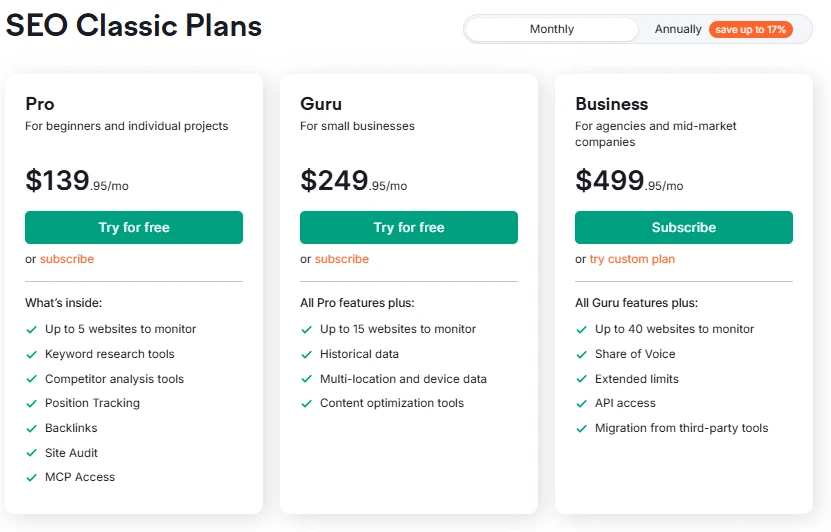
Semrush SEO Classic Plans (Monthly Billing):
| Plan | Price/mo | Best For |
|---|---|---|
| Pro | $139.95/mo | Freelancers & individual projects |
| Guru | $249.95/mo | Small businesses & growing teams |
| Business | $499.95/mo | Agencies & mid-market companies |
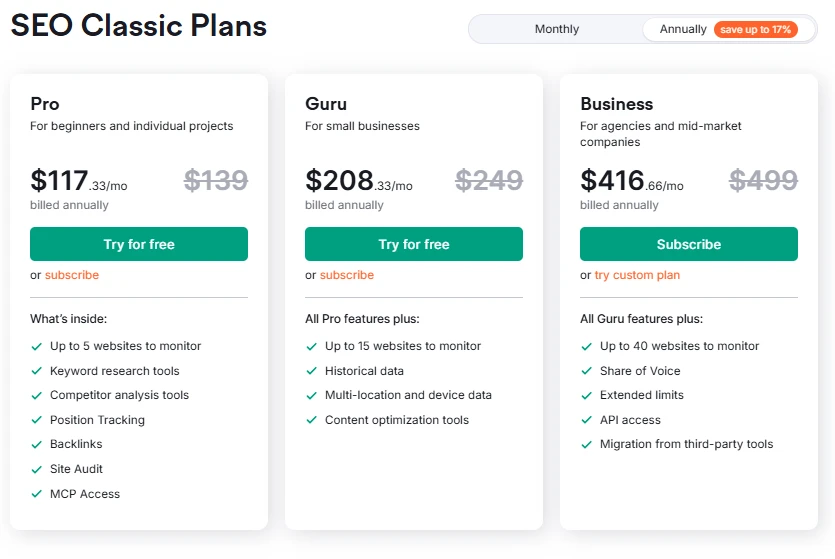
Semrush SEO Classic Plans (Annual Billing — Save up to 17%):
| Plan | Billed Annually (per mo) | vs Monthly |
|---|---|---|
| Pro | $117.33/mo | Save ~$22/mo |
| Guru | $208.33/mo | Save ~$41/mo |
| Business | $416.66/mo | Save ~$83/mo |
Both Pro and Guru come with a free trial — you can start the Semrush free trial here. Business requires a direct subscription.
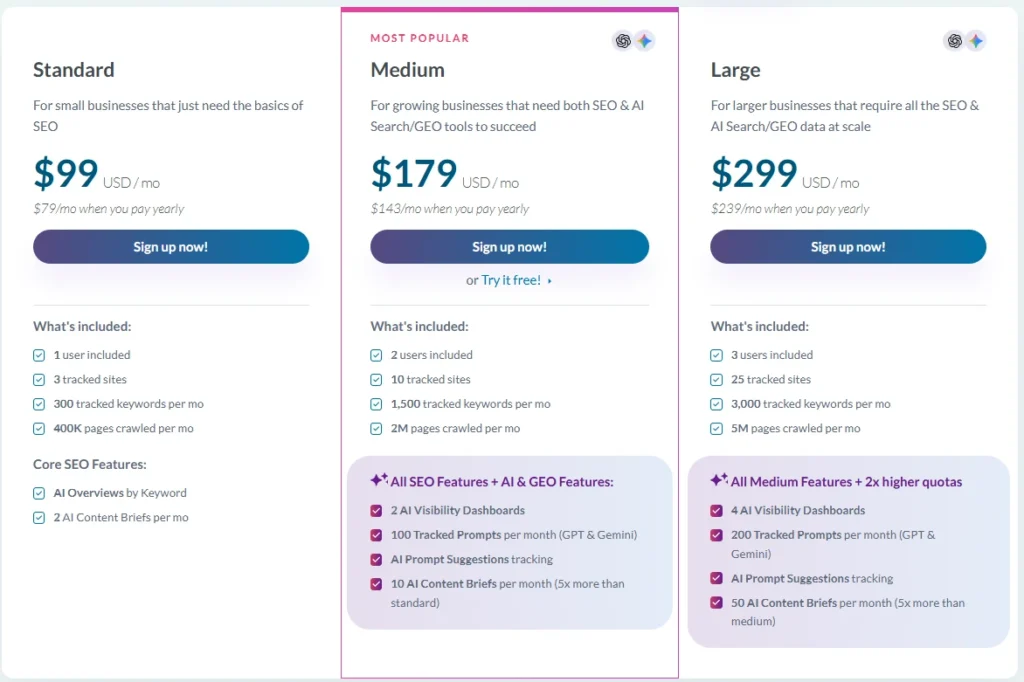
Moz Pro Plans (Monthly Billing):
| Plan | Price/mo | Best For |
|---|---|---|
| Standard | $99/mo | Small businesses, basic SEO |
| Medium | $179/mo | Growing businesses, SEO + AI tools |
| Large | $299/mo | Larger teams, scale & data |
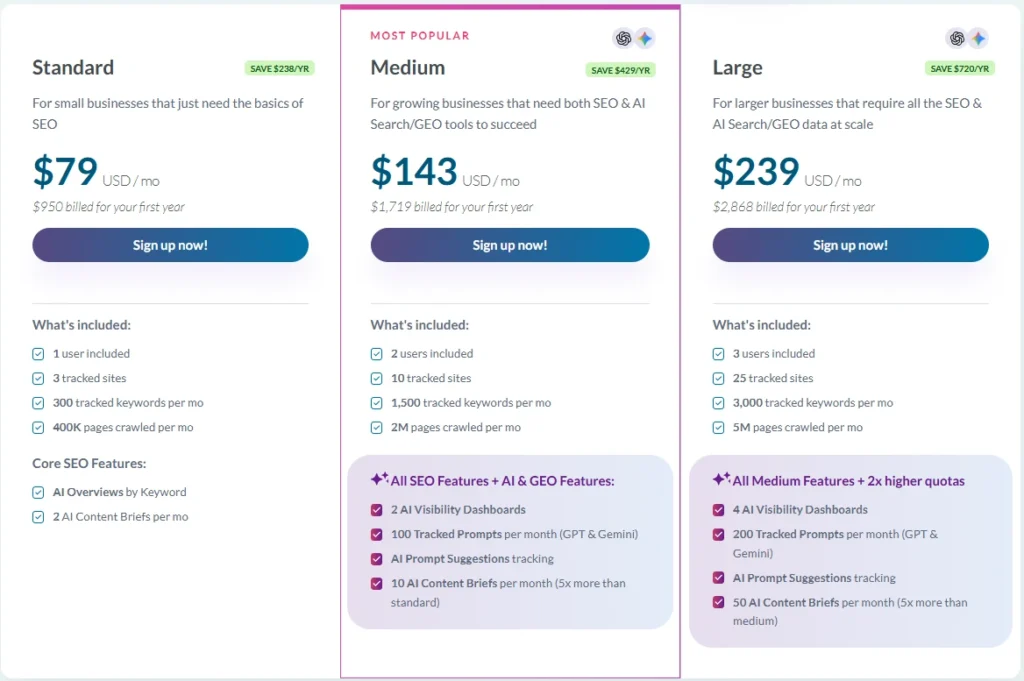
Moz Pro Plans (Annual Billing — Save 20%):
| Plan | Billed Annually (per mo) | Annual Total |
|---|---|---|
| Standard | $79/mo | $950/year |
| Medium | $143/mo | $1,719/year |
| Large | $239/mo | $2,868/year |
Moz also has a Starter plan at $49/month for individuals managing a single website.
On the surface, Moz looks more affordable. And it is — but the limit differences between what each tool gives you at each price point are significant. More on that below.
What You Actually Get at Each Level
This is where most comparison articles just list features without context. Let me break down what these numbers mean in practice.
Keyword & Rank Tracking
Semrush Pro tracks 500 keywords daily across 5 websites. Guru jumps to 1,500 keywords across 15 websites, and Business goes up to 5,000 keywords across 40 websites — with unlimited targets per monitored site.
Moz Standard tracks 300 keywords across 3 campaigns. Medium handles 1,500 keywords across 10 campaigns, and Large covers 3,000 keywords across 25 campaigns.
So, at the mid-tier — Semrush Guru vs Moz Medium — they’re surprisingly close on keyword tracking volume. But Semrush Guru adds things like historical data, JavaScript rendering in Site Audit, Looker Studio integration, Keyword Cannibalization reports, and multi-location + device data that Moz Medium doesn’t match at the same price point.
Site Crawling
Semrush Pro crawls 100,000 pages per month (20,000 per monitored site). Guru extends this to 300,000 pages, and Business hits 1,000,000 with 100,000 per site.
Moz Standard crawls 100,000 pages per week, which is actually competitive at that entry level. Medium handles 500,000/week, and Large reaches 1.25 million/week.
Pro Observation: Moz’s crawl is measured weekly, while Semrush’s is monthly. In my testing across a mid-size e-commerce site (~8,000 pages), Semrush’s Site Audit surfaced more actionable issues — particularly around internal linking gaps and JavaScript-rendered content errors — once I was on Guru. On Moz’s Standard plan, the crawl was fast, but the depth of the technical recommendations felt lighter.
Research & Analytics
Here’s where Semrush creates separation. On the domain and keyword analytics side:
- Semrush Pro gives you 10,000 results per report and 3,000 reports/day
- Guru extends to 30,000 results and 5,000 reports/day, adding historical data and Topics
- Business tops out at 50,000 results and 10,000 reports/day
Semrush’s keyword metric update allowance — 250/month on Pro, 1,000 on Guru, 5,000 on Business — is worth paying attention to if you’re actively managing large content operations.
Moz’s SEO research quotas on Standard: 150 keyword queries/month, 50 domain overviews, and 5,000 backlink queries/month. Medium jumps to 5,000 keyword queries and 20,000 backlink queries, which is a meaningful upgrade. Large pushes to 15,000 keyword queries and 70,000 backlink queries.
Moz’s Quiet Strength: Domain Authority & Link Intelligence
Most people don’t realize this — Moz’s backlink data and proprietary trust metrics are genuinely still some of the most respected in the industry.
Domain Authority (DA), Page Authority (PA), and Brand Authority are Moz’s own inventions, and after 20+ years, they’re deeply embedded in how SEOs communicate link value to clients. If you’re doing link prospecting, outreach reporting, or client-facing deliverables, having Moz’s authority scores in your toolkit has real credibility.
Semrush has its own authority metrics too (Authority Score), but DA is the metric most clients and publishers recognise by name. It’s a small but real workflow advantage for Moz in agency settings.
Semrush’s Edge: It’s Not Just an SEO Tool
Honestly, calling Semrush an “SEO tool” in 2026 is a bit of an understatement. The core SEO toolkit is just one part of a broader ecosystem that also covers:
- Content Marketing Toolkit — Topic research, SEO Writing Assistant, Content Audit
- Social Media Toolkit — Publishing, scheduling, analytics
- Advertising Toolkit — PPC research, ad copy analysis
- Local SEO Toolkit — Listing management, review tracking
- Traffic & Market Analytics — Market share, traffic estimation, audience overlap
Moz doesn’t have anything comparable to those layers. If your workflow touches paid search, content at scale, or local SEO alongside your organic strategy — Semrush wins that comparison without much debate.
Moz’s New AI Research Layer (This Changed Things a Bit)
To Moz’s credit, their Medium and Large plans now include features that directly address the AI search/GEO tracking wave:
- AI Visibility Dashboards — 2 on Medium, 4 on Large
- Tracked Prompts — 100/month on Medium (GPT & Gemini), 200 on Large
- AI Prompt Suggestions tracking
- AI Content Briefs — 10/month on Medium, 50 on Large
The Standard plan is left out of this entirely (just 2 AI Content Briefs, no AI visibility dashboards).
Semrush has its own AI Visibility Toolkit, though it’s a separate add-on — the AI Visibility Toolkit doesn’t include a free trial. Moz baking this into Medium and Large is genuinely useful for SEOs who want to start tracking AI search visibility without paying an extra layer.
Semrush Add-Ons: Extend What You Have
If you’re on Semrush and need to expand specific capabilities, their add-on structure is fairly transparent:
| Add-On | Price |
|---|---|
| Additional Users | Starting at $45/mo |
| Lead Generation | $90/mo |
| Base Report | $10/mo |
| Pro Report | $20/mo |
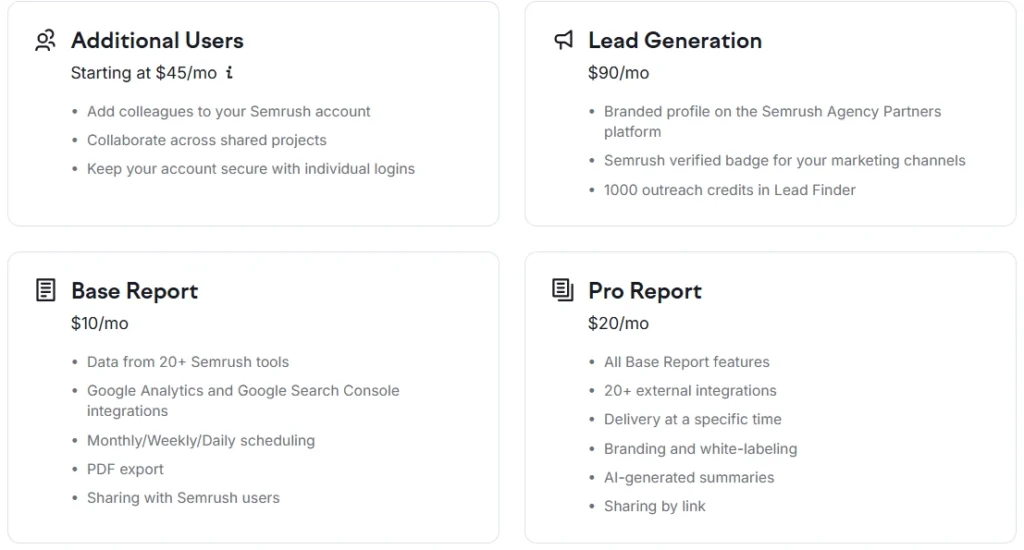
The Lead Generation add-on includes a branded profile on the Semrush Agency Partners platform, plus 1,000 outreach credits in Lead Finder — worth it for agencies actively prospecting clients.
Moz doesn’t have a public add-on marketplace in the same way, though you can add tracked keywords and campaigns at extra cost.
Where Each Tool Falls Short
Semrush limitations to know:
- Gets expensive fast if you need multiple users (extra seats at $45+/mo each)
- The interface can genuinely overwhelm new users — there’s a real learning curve
- Business plan (for Share of Voice, API access, migration tools) is a significant jump at $499.95/mo monthly
- The AI Visibility Toolkit is a separate purchase with no free trial
Moz Pro limitations to know:
- Keyword query limits on Standard (150/month) are tight for anything beyond a small site
- No equivalent to Semrush’s competitor ad research, social tools, or content marketing suite
- At $179/month for Medium, it’s comparable to Semrush Guru pricing after annual discounts — and Guru gives you considerably more raw data volume
- The standard plan misses all AI visibility features
Semrush Pro vs Guru — Worth the Upgrade?
If you’re on the fence about which Semrush plan to start with, I’ve covered this in detail separately: Semrush Pro vs Guru — the short version is that Guru’s historical data and multi-location tracking make it worth it for anyone running more than one active project.
And if you want to test Semrush before spending anything, check out how to get the Semrush free trial — or if you just want to explore the limits of the free tier, here’s how to use Semrush for free without committing to a paid plan.
Head-to-Head: Semrush vs Moz Pro at a Glance
| Feature | Semrush Guru | Moz Medium |
|---|---|---|
| Monthly Price | $249.95 | $179/mo |
| Annual Price | $208.33/mo | $143/mo |
| Keywords Tracked | 1,500 | 1,500 |
| Websites/Campaigns | 15 | 10 |
| Pages Crawled | 300,000/mo | 500,000/wk |
| Historical Data | ✓ | ✓ |
| Backlink Queries/mo | High (via Semrush DB) | 20,000 |
| AI Visibility Features | Add-on (separate) | ✓ Included |
| Content Marketing Tools | ✓ (Content Toolkit) | Limited |
| PPC / Ad Research | ✓ | ✗ |
| Local SEO Tools | ✓ (Local Toolkit) | Limited |
| User Seats | 1 (+ $45/mo extra) | 2 included |
| DA/Authority Metrics | Authority Score | Domain Authority (DA) |
| Free Trial | ✓ (Pro & Guru) | ✓ (Medium only) |
Who Should Pick Which
Go with Semrush if:
- You’re managing SEO, content, and paid search under one roof
- You run multiple client sites and need deep competitor data
- You need serious keyword research volumes and crawl depth
- You want an all-in-one platform and don’t mind paying for it
You can start with the Semrush free trial here — cancel any time. Pro and Guru Plans.
Go with Moz Pro if:
- You’re an independent blogger or small business focused purely on organic SEO
- Domain Authority is a metric your clients or team already live by
- You want AI search tracking built into your plan without extra costs
- You’re budget-conscious, and the $99 Standard or $143/year Medium tier fits your ceiling
One More Option Worth Knowing
If neither feels quite right — Semrush is too much, Moz is too limiting — SE Ranking sits in a compelling middle ground, especially for solo operators and small teams. It’s worth a look before you commit.

Semrush SEO Free Trial
Get full Pro access for 7 days — keyword research, site audit, backlink analysis & competitor research. No charge until after the trial ends.
Start Your Semrush 7-Day Free Trial →Frequently Asked Questions
Is Semrush better than Moz Pro for beginners?
Honestly, this depends on what “beginner” means in your case. If you’re just starting with SEO and want something with a gentler learning curve, Moz Pro’s interface is cleaner and less overwhelming. But if you’re a beginner who’s serious about growing fast — and you want access to competitor research, keyword gap analysis, and content tools from day one — Semrush’s Pro plan (with its free trial) gives you a much bigger playground to learn in. Most beginners outgrow Moz’s Standard plan faster than they expect.
Does Moz Pro offer a free trial?
Yes — Moz Pro’s free trial is available on the Medium plan. The Standard and Large plans require direct signup without a trial option. The trial lets you test the full Medium feature set, including AI Visibility Dashboards and tracked prompts, before committing to $179/month or $143/month billed annually.
Can I get a Semrush free trial in 2026?
Yes. Semrush currently offers a free trial on both the Pro ($139.95/mo) and Guru ($249.95/mo) plans. The Business plan requires a direct subscription. If you want step-by-step instructions on activating it, check out this guide on how to get the Semrush free trial.
Which tool has better keyword research — Semrush or Moz?
Semrush wins here, and it’s not particularly close. On the Guru plan alone, you get 30,000 results per report, 5,000 reports per day, 1,000 keyword metric updates per month, and access to Topics clustering — none of which Moz’s Medium plan matches at a comparable level. Moz’s Keyword Explorer is genuinely useful for smaller workflows, but volume-wise and feature-wise, Semrush pulls ahead significantly.
Which is better for agencies — Semrush or Moz Pro?
For most agency workflows, Semrush is the stronger fit. The Business plan supports up to 40 websites, 5,000 tracked keywords, Share of Voice reporting, API access, and migration from third-party tools — all things agencies need at scale. Add the Lead Generation add-on ($90/mo) for agency partner visibility and outreach credits, and it becomes a legitimate agency operations platform. Moz Large supports 25 campaigns and 3 users, which works for smaller agencies but hits limits faster.
Does Semrush include local SEO tools?
Yes, but it’s a separate toolkit. Semrush’s Local SEO Toolkit covers listing management and review tracking and isn’t bundled into the core SEO Classic plans. Moz has Moz Local as a separate product, too. Neither includes local SEO features in their core plans — so if local is a priority, budget for an add-on either way.
Can I use Semrush for free without a trial?
Yes, to a limited extent. Semrush has a free account tier with restricted daily limits — you can run a handful of keyword searches and domain lookups before hitting the cap. It’s useful for occasional spot-checks but not sustainable for ongoing work. For a fuller breakdown of what’s available without paying, this guide on how to use Semrush for free covers exactly what you get and where the walls are.
Final Take
Semrush is the more powerful platform. Full stop. If you’re doing SEO professionally — whether for clients or a growing business — the data depth, toolset breadth, and research capability put it a level above Moz Pro.
That said, Moz Pro isn’t a consolation prize. Its focus, cleaner UX, included AI visibility features on higher plans, and the enduring authority of its DA metric makes it a legitimate choice for the right user.
The real mistake is picking based on price alone. Pick based on your workflow. If your SEO work stays within the core of keyword research, rank tracking, site audits, and backlinks — and you want something approachable — Moz works. If you’re building anything more ambitious, Semrush is where you’ll be glad you started.
Best Semrush Alternatives to Consider
If Semrush’s pricing feels steep after the trial, these three tools cover most of what you need at a lower price point — SE Ranking, Mangools, and Ubersuggest all offer free trials too.
SE Ranking
More affordable entry pricing, solid rank tracking and audit features. Good for small agencies and freelancers who don’t need Semrush’s full data depth.
Try SE Ranking →Mangools
Beginner-friendly, clean UI, strong keyword and SERP tools at a much lower price point. Perfect for solo bloggers who need keyword research without the complexity.
Try Mangools →Ubersuggest
Neil Patel’s SEO Tool — keyword research, site audit, and competitor analysis at a very affordable price. Great for beginners and small business owners on a tight budget.
Try Ubersuggest →