Most people open Semrush, pull up a competitor’s domain, and completely skip past the number sitting right at the top of the report.
That number is Semrush Rank — and honestly, it tells you more about a site’s SEO health in two seconds than most people realize.
Quick Answer
Semrush Rank is a global ranking system that orders websites based on estimated organic search traffic from Google. The lower the number, the more organic traffic the site receives. Rank #1 means the highest estimated organic traffic worldwide. It’s updated regularly and is useful for quick competitor benchmarking without digging through full reports.
What Semrush Rank Actually Is (Not What You Think)
Here’s the thing — a lot of beginners confuse Semrush Rank with Google’s PageRank or Domain Authority. They’re not the same thing at all.
Semrush Rank is purely traffic-based. It doesn’t measure backlinks, authority scores, or trust signals directly. It asks one simple question: how much estimated organic traffic is this domain getting from Google right now?
The site with the highest estimated organic traffic gets Rank #1. Every other site falls below it in order.
So when you see a domain sitting at Semrush Rank #4,200, that means roughly 4,199 websites worldwide are estimated to pull more organic traffic than that domain. For a niche site, that’s actually impressive.
How Semrush Calculates It
Semrush doesn’t pull this number from thin air. The calculation runs on their database of over 25 billion keywords (as of recent updates), cross-referenced against search volumes and click-through rate models for each keyword a domain ranks for.
The rough process:
- Semrush identifies every keyword a domain ranks for in Google’s top 100
- It estimates how many clicks that ranking position generates based on average CTR data
- It sums the estimated monthly organic visits across all keywords
- It then ranks all domains globally by that traffic estimate
What makes this interesting is that two sites with identical traffic estimates can have very different keyword profiles. One might rank for 3 high-volume keywords. Another ranks for 10,000 long-tail terms. Semrush Rank treats them similarly if the estimated traffic output is the same.
In my testing across several niche sites, I noticed that sites with strong long-tail keyword coverage often have better Semrush Rank stability than sites dependent on 2–3 head terms. One algorithm update can wreck a head-term-dependent site’s rank overnight.
What the Numbers Actually Mean
| Semrush Rank Range | What It Signals |
|---|---|
| #1 – #500 | Global giants — Google, YouTube, Amazon territory |
| #500 – #10,000 | High-authority publishers and major brands |
| #10,000 – #100,000 | Strong niche authority or regional leaders |
| #100,000 – #500,000 | Established websites with consistent content |
| #500,000 – #1,000,000 | Growing sites with moderate traffic |
| #1,000,000+ | New sites or low-traffic domains |
Most people building content sites should realistically target getting under #500,000 within their first year as a meaningful milestone. Breaking into #100,000 typically signals real topical authority in your niche.
Where to Find Semrush Rank
Semrush Rank shows up in two different places inside the platform — and both serve a different purpose.
1. Domain Overview (Individual Domain Rank)
If you want to check the Semrush Rank of a specific website, head over to Domain Overview and enter any domain. Right at the top of the summary panel, you’ll see a dedicated Semrush Rank box showing that domain’s global rank number. For example, medium.com sits at rank #39 worldwide — meaning only 38 domains are estimated to pull more organic traffic globally.
2. Semrush Rank Tool (Global Leaderboard)
This is the one most people miss. Inside your Semrush dashboard, go to SEO → Extras → Semrush Rank in the left sidebar. This opens a dedicated tool showing a global leaderboard of 36.6 million+ ranked domains — complete with SE Keywords, SE Traffic, Costs, and Paid Traffic data side by side.
As of May 2026, the top positions look like this:
| Rank | Domain | SE Keywords | SE Traffic |
|---|---|---|---|
| #1 | youtube.com | 1.6B | 3.6B |
| #2 | wikipedia.org | 208.5M | 1.7B |
| #3 | reddit.com | 321.8M | 1.2B |
| #4 | facebook.com | 640.7M | 1.1B |
| #5 | instagram.com | 548.5M | 969M |
| #7 | google.com | 44.7M | 499.7M |
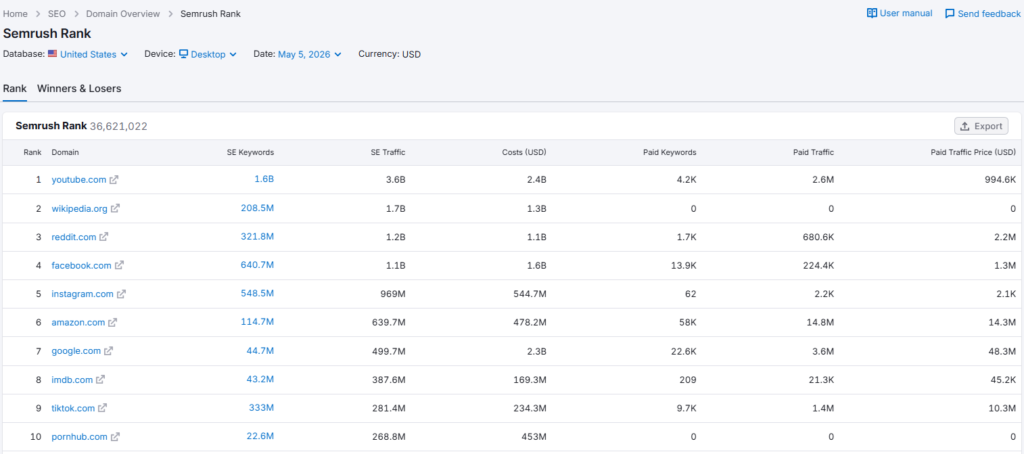
One thing worth noting — google.com itself ranks #7, not #1. That’s because Semrush Rank is built on organic search traffic, and Google’s own domain doesn’t rank for nearly as many keywords as YouTube or Wikipedia do.
The tool also has two tabs:
- Rank Tab — The main global leaderboard ordered by estimated organic traffic
- Winners & Losers Tab — Shows which domains are gaining or losing SE Keywords most rapidly, making it useful for spotting momentum shifts across the web
The Winners & Losers tab is where things get genuinely interesting for competitive research. As of May 2026, instagram.com gained +3.5M SE Keywords while tiktok.com added +1.2M — both signaling aggressive content indexing. On the flip side, some domains show significant keyword losses, which can be early signals of a Google penalty or algorithm impact worth monitoring in your niche.
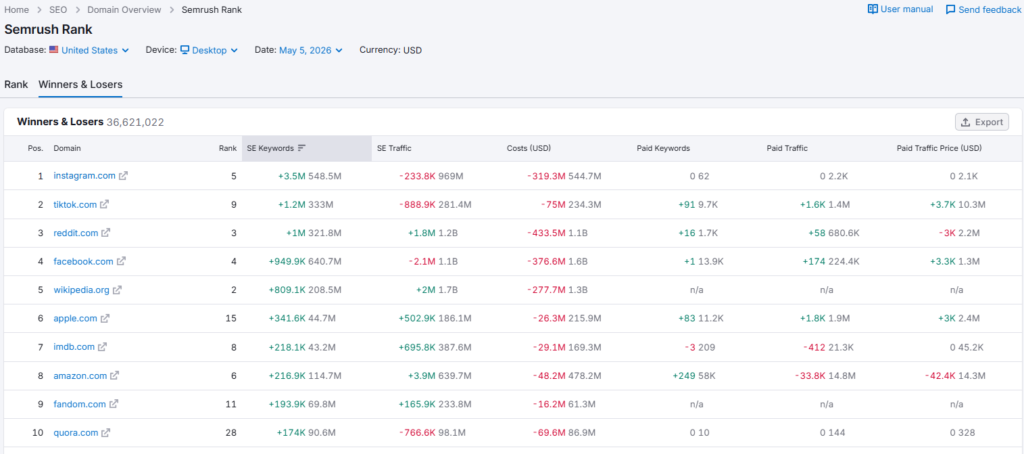
One limitation on the free plan — you only get the top 10 results. To access the full ranked list of 36+ million domains, you’ll need a paid plan or a Semrush free trial, which unlocks complete data without any upfront commitment.
Semrush Rank vs Authority Score — They’re Not Interchangeable
This trips people up constantly.
- Semrush Rank = Traffic-based global position
- Authority Score = Link-based quality metric (similar to DA or DR)
A site can have a high Authority Score but a poor Semrush Rank if it has strong backlinks but thin content. Conversely, a high-volume content farm might have excellent Semrush Rank but mediocre Authority Score.
For SEO work, you need to look at both. Semrush Rank tells you the output (traffic result). Authority Score hints at the infrastructure (link equity). Neither metric alone gives you the full picture.
My Real Experience Using Semrush Rank for Competitor Research
When I’m auditing a new niche, the first thing I do is check Semrush Rank for the top 5–10 ranking competitors across target keywords.
Here’s what that actually looks like in practice:
Say I’m entering the “project management software” niche. I pull up the top-ranking domains and check their Semrush Rank. If the leaders are sitting at #3,000–#15,000, that’s a competitive space — major publications dominate it. But if the top rankers are in the #200,000–#500,000 range? That signals a real gap. An emerging site with solid content could realistically compete within 12–18 months.
Most people don’t use it this way. They jump straight into keyword-level data and miss the macro competitive picture that Semrush Rank gives in 30 seconds flat.
Where Semrush Rank Falls Short
It’s not a perfect metric. A few limitations worth knowing:
It’s estimate-based. Semrush doesn’t have access to Google Analytics data. The traffic numbers are modeled, not measured. For some niches, estimates can be off by 20–40%.
It ignores paid traffic entirely. A domain running heavy Google Ads campaigns won’t see that reflected in Semrush Rank at all. It’s strictly organic.
It can lag after major updates. After a Google core update, Semrush Rank adjustments can take a few weeks to fully reflect the new traffic reality.
International variance. Semrush Rank is global by default. A site that dominates in Germany but barely ranks in the US could have a misleading global rank depending on your market focus.
For international SEO research, tools like Semrush vs SE Ranking can offer useful context on how different platforms handle localized rank data.
“If those limitations are dealbreakers for your workflow, a few alternatives are worth knowing about.”
Best Semrush Alternatives to Consider
If Semrush’s pricing feels steep after the trial, these three tools cover most of what you need at a lower price point — SE Ranking, Mangools, and Ubersuggest all offer free trials too.
SE Ranking
More affordable entry pricing, solid rank tracking and audit features. Good for small agencies and freelancers who don’t need Semrush’s full data depth.
Try SE Ranking →Mangools
Beginner-friendly, clean UI, strong keyword and SERP tools at a much lower price point. Perfect for solo bloggers who need keyword research without the complexity.
Try Mangools →Ubersuggest
Neil Patel’s SEO Tool — keyword research, site audit, and competitor analysis at a very affordable price. Great for beginners and small business owners on a tight budget.
Try Ubersuggest →How to Actually Use Semrush Rank (Practical Workflow)
Step 1 — Benchmark competitors on entry
Before targeting any keyword cluster, pull Semrush Rank for the top 10 ranking domains. This tells you who you’re actually competing against at a macro level.
Step 2 — Track your own rank monthly
Add your domain to a simple spreadsheet and record your Semrush Rank every month. It’s a blunt but honest progress tracker — especially useful when organic traffic numbers feel inconsistent.
Step 3 — Identify fast movers
Search for rising sites in your niche and check how their Semrush Rank has shifted over 6–12 months. Sites moving from #800,000 to #200,000 in under a year are doing something right — reverse-engineer their content strategy.
Step 4 — Use it alongside keyword gap analysis
If a competitor has a significantly better Semrush Rank than you despite similar content volume, run a Keyword Gap report to find what they’re ranking for that you’re missing.
Pro Observation: Semrush Rank Is a Lagging Indicator
Most SEOs treat Semrush Rank as a real-time signal. It’s not.
Because it’s built on crawled keyword data and modeled traffic, it reflects what happened 2–4 weeks ago rather than what’s happening today. This matters during volatile periods — if you publish a cluster of articles targeting trending keywords, don’t expect your Semrush Rank to respond within days.
Think of it like body weight on a scale. It’s an accurate reflection of your overall state — but it doesn’t move the morning after one good workout. Consistency is what moves it.
Is Semrush Rank Worth Tracking?
For casual bloggers? Probably not worth obsessing over.
For anyone doing serious competitor research, content strategy, or SEO consulting? Absolutely. It’s a macro health indicator that cuts through the noise of individual keyword fluctuations and gives you a clean view of trajectory.
Pair it with Authority Score, organic keyword count, and traffic trends, and you have a genuinely powerful competitor snapshot — all available inside a single Semrush Domain Overview report.
If you haven’t explored what Semrush’s full toolset looks like, the free trial gives you unrestricted access to Domain Overview, competitor analysis, and rank tracking — enough to run a serious audit on 4–5 competitors before spending anything.
“If you decide it’s worth tracking seriously, here’s what access actually costs:”
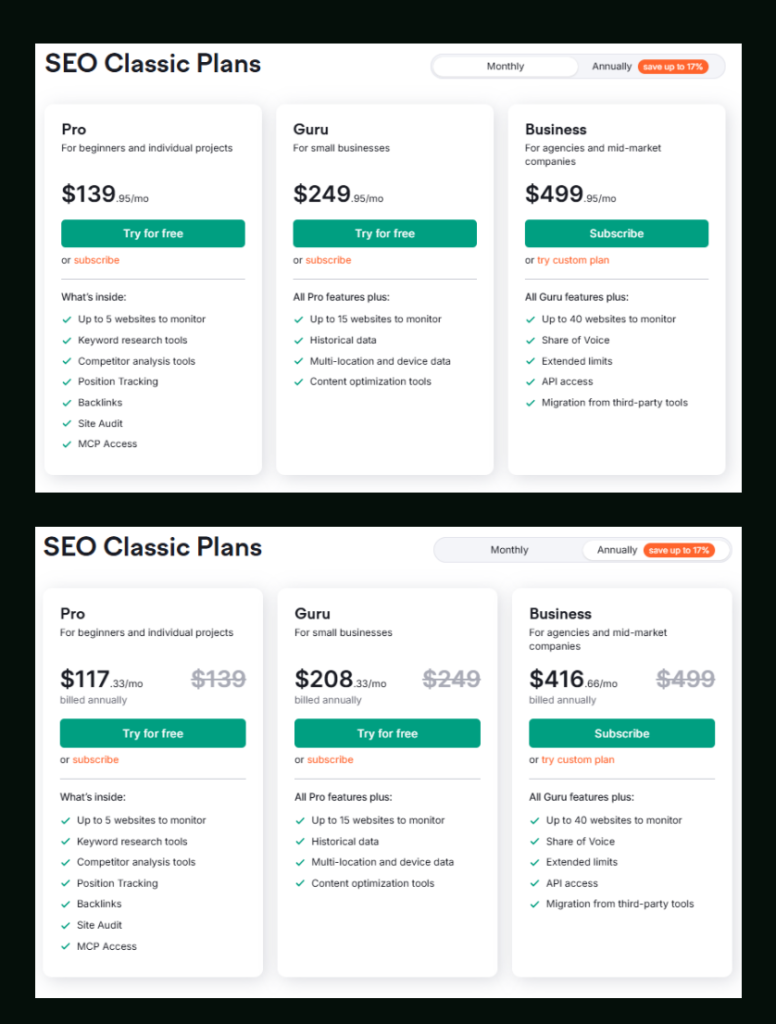
The paid plans — Pro at $139.95/mo (or $117.33/mo billed annually), Guru at $249.95/mo (or $208.33/mo billed annually) — both give you full Domain Overview access with historical data on Guru and above. If you’re actively doing competitor research, the Semrush Pro vs Guru breakdown is worth reading before you decide.

Semrush SEO Free Trial
Get full Pro access for 7 days — keyword research, site audit, backlink analysis & competitor research. No charge until after the trial ends.
Try Free Trial →Frequently Asked Questions
What is Semrush Rank and how is it different from Google ranking?
Semrush Rank is a global website ranking based on estimated organic traffic — lower numbers mean more traffic. It’s completely separate from Google’s search ranking system. A site can rank #1 on Google for a keyword but still have a poor Semrush Rank if that keyword has low search volume. It reflects total organic traffic output, not individual keyword positions.
What is a good Semrush Rank for a niche website?
For a niche content site, breaking into the top 500,000 within the first year is a healthy target. Reaching under 100,000 typically indicates strong topical authority in your space. The specific “good” number depends heavily on your niche — a site ranking in the top 50,000 in a competitive vertical is outperforming most established publishers.
How often does Semrush Rank update?
Semrush updates rank data regularly, but it typically reflects organic traffic patterns from the past 2–4 weeks. After a Google core update, expect a delay of 2–3 weeks before Semrush Rank fully adjusts to reflect the new traffic distribution across affected domains.
Can I check my competitors’ Semrush Rank for free?
Yes — Semrush’s free plan allows limited Domain Overview lookups. However, for unrestricted competitor research, the Semrush free trial gives you full access to Domain Overview reports, Semrush Rank history, and traffic estimates without paying upfront.
Is Semrush Rank the same as Authority Score?
No, and this is a common mix-up. Semrush Rank is purely based on estimated organic traffic volume. Authority Score is a separate link-based quality metric influenced by backlink profile, referring domains, and spam signals. Both are useful, but they measure completely different things. A site can score well on one and poorly on the other.
Why did my Semrush Rank drop even though my traffic increased?
This happens when other domains in the index gained traffic at a faster rate than yours. Semrush Rank is relative — it’s your position among all websites in Semrush’s database. If your traffic grew 10% but competitors in your space grew 25%, your rank can decline even with genuine traffic gains on your end.
Does Semrush Rank affect SEO directly?
No. Semrush Rank is a third-party metric — Google has no involvement in it. It won’t influence your actual rankings or crawl priority. It’s purely a benchmarking and analysis tool to help you understand your competitive position and track organic growth over time.
Everything You Need About Semrush Free Trial
Activate your Semrush free trial directly, read our step-by-step guide on how to get it, or learn how to cancel before getting charged — all in one place.
Start Semrush Free Trial
Get full Pro access for 7 days — keyword research, site audit, backlink analysis & competitor research. No charge until after the trial ends.
Start Free Trial →How to Get Free Trial
Step-by-step guide to activate your Semrush free trial — what you unlock, how to use it right, and how to get maximum value in 7 days.
Read Full Guide →How to Cancel Trial
Don’t get charged by mistake. Step-by-step guide to cancel your Semrush trial before the billing date — timing tips included.
Read Cancel Guide →