Contents
- 1 They Were Built for Different Jobs
- 2 Where the Data Actually Comes From
- 3 The Specific Features That Set Them Apart
- 4 Why the Traffic Numbers Look So Different
- 5 My Actual Workflow Using Both Tools
- 6 Where Each Tool Falls Short
- 7 The Pricing Reality
- 8 So Which One Should You Actually Use?
- 9 Frequently Asked Questions
- 9.1 Why do Semrush and Similarweb show such different traffic numbers for the same site?
- 9.2 Is Semrush or Similarweb more accurate?
- 9.3 Can I use Semrush as a Similarweb replacement?
- 9.4 Does Similarweb have SEO tools like Semrush?
- 9.5 Why would an agency use both tools?
- 9.6 Does Semrush track AI search visibility like Similarweb?
- 9.7 Is there a free trial for Semrush before committing?
- 10 The Bottom Line
- 11 Everything You Need About Semrush Free Trial
Most people assume Semrush and Similarweb are competing versions of the same thing — pick one, get the same data, move on. That assumption is what causes so much confusion when you open both tools on the same domain, and the traffic numbers look completely different.
They’re not the same tool. They don’t measure the same things. And the gap in their numbers isn’t a bug — it’s the product of fundamentally different designs, data sources, and intended use cases.
Quick Answer: Semrush and Similarweb show different data because they’re built for different purposes. Semrush is an SEO and digital marketing toolkit that estimates organic search traffic based on keyword rankings and search volumes. Similarweb is a market intelligence platform that estimates total website traffic using panel data, ISP data, and behavioral signals. Their numbers diverge because they’re measuring different things — not because one is more accurate than the other.
They Were Built for Different Jobs
This is the part most comparison articles skip entirely — and it’s the most important thing to understand.
Semrush started as an SEO research tool. Its core DNA is search: keyword rankings, backlink profiles, on-page optimization, and content gaps. When Semrush estimates traffic for a domain, it’s doing so through a search-first lens — it looks at what keywords a site ranks for, multiplies by estimated click-through rates and search volumes, and produces a number that reflects organic search-driven traffic specifically.
Similarweb, on the other hand, was built as a market intelligence platform from the start. Its goal was never SEO. It was built to answer questions like: how much total traffic does a website get, from all channels combined? How does its audience behave? What’s the competitive landscape in a given industry?
Same surface question (“how much traffic does this site get?”), completely different methodology, completely different answer.
That’s not a malfunction. That’s by design.
Where the Data Actually Comes From
Understanding the discrepancy means understanding what each tool uses as its raw material.
How Semrush Builds Its Traffic Estimates
Semrush constructs traffic estimates from keyword data — specifically, it tracks keyword rankings across its own crawl database, applies click-through rate models based on ranking position, and multiplies by estimated monthly search volumes pulled from its keyword research infrastructure.
The result is a traffic estimate that’s reasonably accurate for organic search traffic — particularly for sites where Google search is a dominant acquisition channel. But it’s inherently incomplete for sites that rely heavily on direct traffic, social referrals, email newsletters, or paid channels.
In my five years of using Semrush across client projects, I’ve consistently found that its organic traffic estimates are solid for content-heavy sites where search is the primary driver. For e-commerce brands running aggressive paid campaigns or viral social content? The gap between Semrush’s number and reality grows considerably.
How Similarweb Builds Its Traffic Estimates
Similarweb takes a fundamentally different approach. It draws from a combination of sources: anonymized panel data (browser extensions, apps, opted-in user data), ISP-level data partnerships, and publicly available web crawl signals. The goal is to estimate total traffic across all channels — not just search.
That breadth is both Similarweb’s strength and its limitation. For large domains with millions of monthly visitors, its estimates tend to be remarkably close to reality. For smaller sites under ~50,000 monthly visitors, the panel size gets thin, and the estimates can swing significantly.
Similarweb is also more explicit about this limitation than most people realize. Their own documentation acknowledges that free-tier data is a high-level sample — the deeper you go in their paid tiers, the more granular and reliable the data becomes.
The Specific Features That Set Them Apart
Both tools have expanded significantly over the past few years. The gap between them isn’t just about traffic estimation methodology anymore — it’s about the entire product philosophy.
What Semrush Is Actually Good At
Semrush’s core strength remains keyword and search intelligence. Its keyword database covers billions of terms. Its backlink analytics, technical site audit, rank tracking, and content optimization tools are genuinely class-leading for SEO work.
The more recent Semrush One plans also fold in AI visibility tracking — monitoring how your brand appears in AI-generated responses from ChatGPT, Gemini, Perplexity, and others. That’s a meaningful evolution beyond pure SEO. But the foundation is still searching for data, and everything builds from there.
If your question is “why isn’t my page ranking” or “what keywords should I target next quarter,” Semrush gives you the most actionable answers.
What Similarweb Is Actually Good At
Similarweb’s strength is market-level intelligence. If you want to understand how an entire industry segment is moving — which players are gaining traffic share, where audiences are coming from, what the competitive landscape looks like from a 30,000-foot view — Similarweb has depth that Semrush simply doesn’t match.
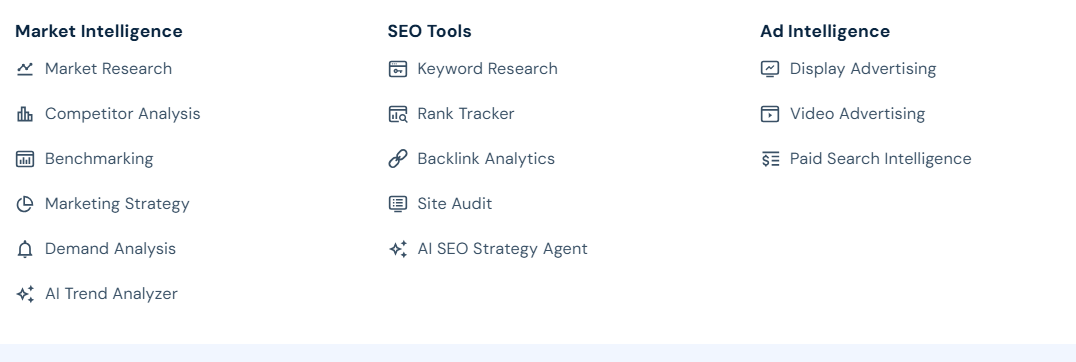
Its Web Intelligence suite covers competitive intelligence, audience demographics, marketing channel breakdowns, and now AI brand visibility tracking through its AEO Intelligence features (available on the Competitive Intel & SEO & AEO tiers at $333/mo billed annually). The Retail Intelligence product goes even further for eCommerce, tracking Amazon seller data, category management, and shopper behavior signals that are irrelevant to an SEO tool but invaluable to a retail strategist.
This isn’t something Semrush is trying to compete with — and vice versa.
Why the Traffic Numbers Look So Different
Let’s get concrete about why the discrepancy exists when you look at the same domain in both tools.
Scenario: You pull a mid-size SaaS company (say, 200,000 monthly visitors according to their own GA4 data) in both tools.
- Semrush shows: 85,000 monthly visits
- Similarweb shows: 210,000 monthly visits
Neither number is wrong in isolation. Semrush is estimating organic search traffic, and organic accounts for about 40% of this company’s actual traffic mix. Similarweb is estimating total traffic across all channels and lands closer to the real number because it includes direct, social, referral, and paid.
Comparing those two numbers directly makes no sense. It’s like comparing miles driven to total distance traveled, including flights. Different measurement. Different scope.
This is the explanation most users never get — and it’s why “which tool shows accurate traffic data” is genuinely the wrong question to ask.
My Actual Workflow Using Both Tools
Here’s the thing — after five years of working with Semrush across dozens of projects, I don’t treat these two tools as competitors at all. They slot into completely different stages of my research process.
Whenever I start working on a new website — whether it’s a fresh build or an existing site I’m taking on — I open Semrush first. I use it to map the keyword landscape, understand what competitors are actually ranking for, identify content gaps, and build a research foundation that shapes the entire SEO strategy. The keyword data depth, the competitor analysis, and the site audit — all of it runs through Semrush from day one. After five years, it’s genuinely become the non-negotiable first step in how I approach any new project.
Similarweb serves a different purpose in my workflow. I use it at the research stage for getting a fast read on a domain’s overall traffic picture — total visits, channel breakdown, audience geography — before deciding how deep to go. The browser extension is useful for a quick on-the-fly ballpark, but where Similarweb actually earns its place is when I’m doing market-level competitor research: understanding which channels a competitor is leaning on, whether their traffic is search-heavy or relying on direct and social, and how their audience profile compares. That kind of top-down market context isn’t something Semrush gives you — and it genuinely shapes how I prioritize the SEO work that follows.
The way I see it: Similarweb tells me the competitive landscape. Semrush tells me exactly how to win in it.
Where Each Tool Falls Short
Honesty matters here because both tools have real limitations.
Semrush limitations worth knowing:
- Traffic estimates miss non-search channels almost entirely
- Backlink data, while large, can sometimes lag fresh link acquisitions
- The Semrush One AI visibility features are genuinely new — the dataset is still maturing compared to the depth of their organic search data
- It can overestimate traffic for pages ranking for highly seasonal keywords if the snapshot timing isn’t aligned
Similarweb limitations worth knowing:
- Smaller sites (under ~50K monthly visitors) get unreliable estimates — panel data is too thin at that scale
- SEO-specific intelligence (keyword-level data, ranking positions) is less granular than Semrush, even in higher tiers
- The pricing structure can be complex — their entry-level Web Intelligence plan at $125/mo (billed annually) gives you Competitive Intelligence but no SEO or AEO tools; those start at $333/mo annually
- Enterprise/custom features require sales calls rather than self-serve signup
The Pricing Reality
Since pricing often influences which tool someone ends up using, here’s what you’re looking at:
Semrush SEO Classic Plans
The traditional Semrush plans remain the most popular entry point for SEO professionals:
- Pro: $117.33/mo (billed annually) — 5 websites, 500 keywords tracked daily, keyword research and competitor tools, MCP access
- Guru: $208.33/mo (billed annually) — 15 websites, 1,500 keywords daily, historical data, content optimization, keyword cannibalization analysis
- Business: $416.66/mo (billed annually) — 40 websites, 5,000 keywords daily, API access, Share of Voice, migration from third-party tools
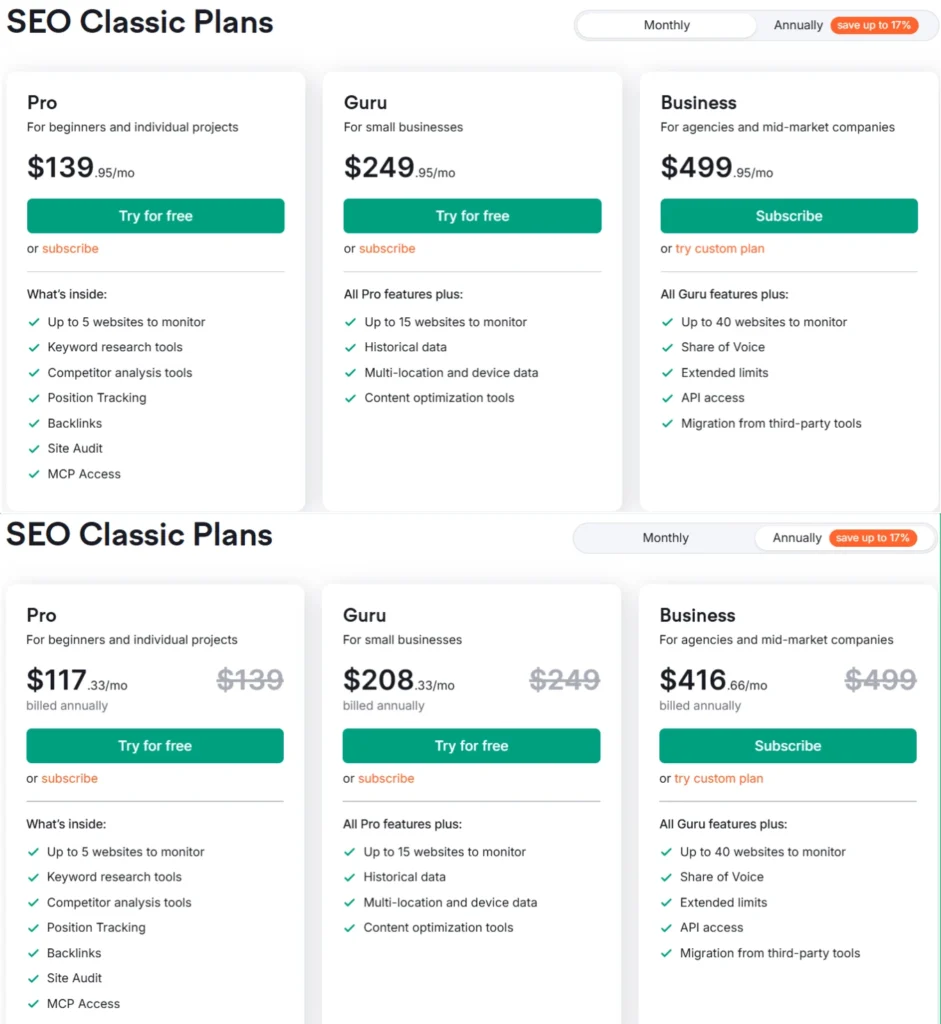
Pro and Guru include a 7-day free trial. Business requires a custom signup.
Semrush SEO Free Trial ( Pro & Guru )
Get full Pro access for 7 days — keyword research, site audit, backlink analysis & competitor research. No charge until after the trial ends.
Start Your Semrush 7-Day Free Trial→Semrush One (Introductory Pricing)
The newer Semrush One plans bundle traditional SEO with AI visibility tracking:
- Starter: $165.17/mo (annually) — 5 websites, 500 keywords, 1 domain for AI brand performance, 50 prompts daily, 300 AI visibility reports/day
- Pro+: $248.17/mo (annually) — 15 websites, 1,500 keywords, 100 prompts daily, historical SEO data
- Advanced: $455.67/mo (annually) — 40 websites, 5,000 keywords, 200 prompts daily, SEO share of voice, expanded API access
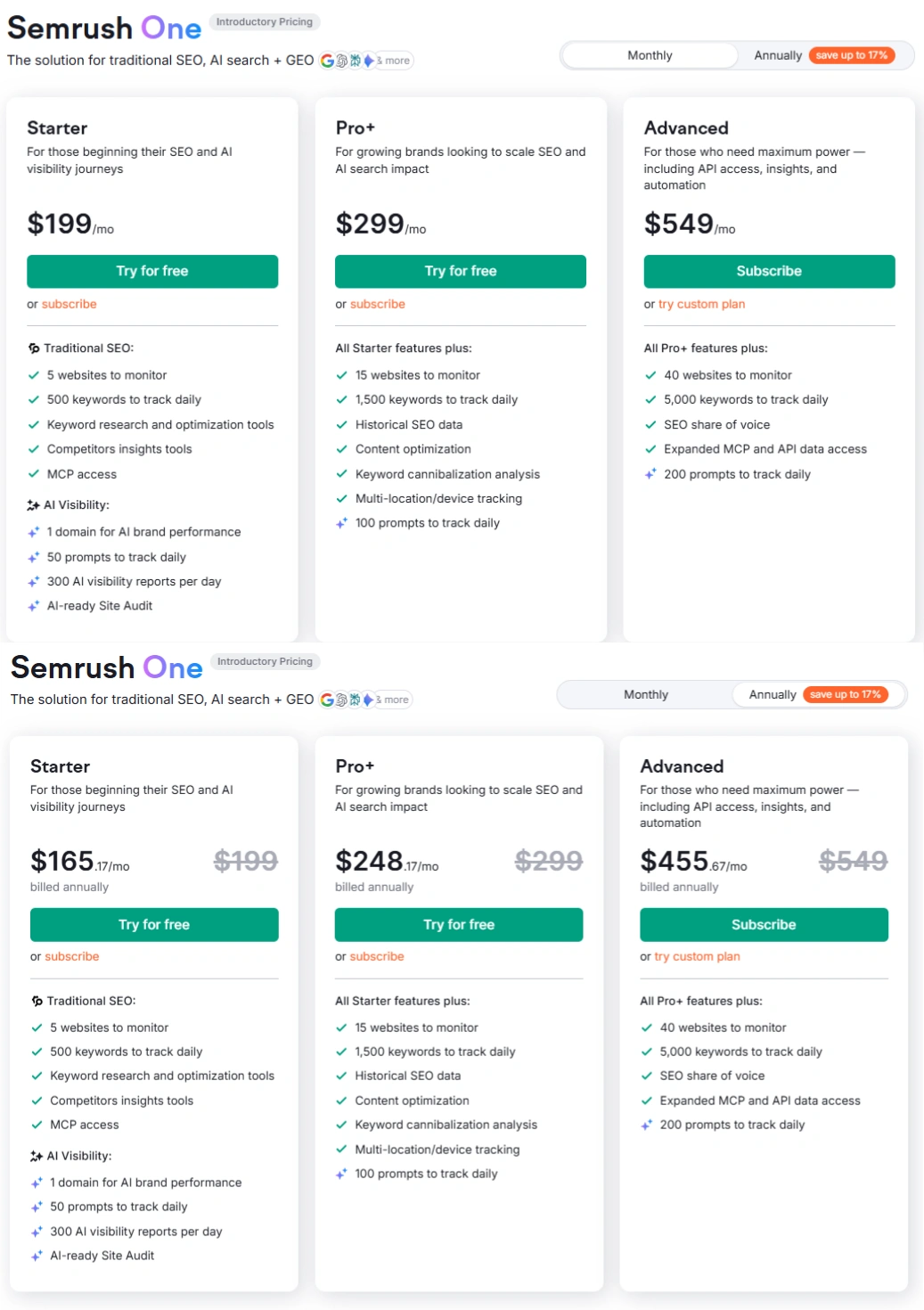
Starter and Pro+ offer a free trial. Advanced requires a subscription or a custom plan.
Semrush One Free Trial
Everything you need to win AI visibility and drive SEO Success. Get full Semrush One access for 7 days — explore the Starter, Pro+, or Advanced plans. Track your website’s SEO performance, monitor AI visibility and brand share of voice, run deep site audits, and get AI-driven marketing insights. No charge until after your 7-day trial ends.
Start Your Semrush One 7-Day Free Trial →You can explore Semrush Pro vs Guru if you’re deciding between the classic tiers, or check the current Semrush plan breakdown for a full comparison.
Similarweb Web Intelligence Plans
Similarweb’s self-serve Web Intelligence tiers for entrepreneurs:
- Competitive Intelligence: $125/mo (annually) or $199/mo (monthly) — website performance, traffic & engagement, customer demographics, marketing channel overview, 3 months historical data
- Competitive Intel & SEO & AEO: $333/mo (annually) or $399/mo (monthly) — adds organic search, keyword research, rank tracking, site audit, AI brand visibility, 150 tracked prompts, 6 months historical data
- Competitive Intel, SEO & AEO & Ads: $542/mo (annually) or $649/mo (monthly) — adds display advertising, PPC marketing, publisher analysis, ad spend data
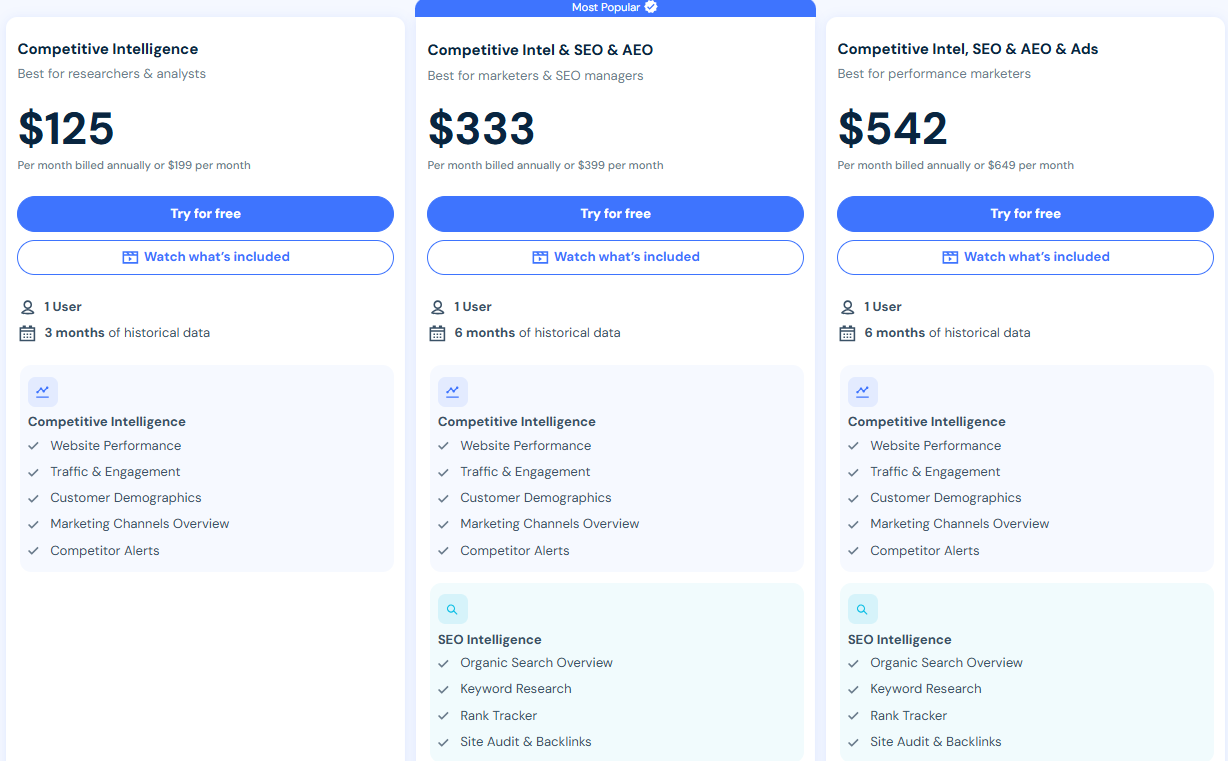
All three tiers include a free trial option.
Semrush vs Similarweb: Pricing at a Glance
| Semrush SEO Classic | Semrush One | Similarweb Web Intelligence | |
|---|---|---|---|
| Entry Plan | Pro — $117.33/mo (annual) | Starter — $165.17/mo (annual) | Competitive Intelligence — $125/mo (annual) |
| Mid Plan | Guru — $208.33/mo (annual) | Pro+ — $248.17/mo (annual) | Competitive Intel & SEO & AEO — $333/mo (annual) |
| Top Plan | Business — $416.66/mo (annual) | Advanced — $455.67/mo (annual) | Competitive Intel, SEO & AEO & Ads — $542/mo (annual) |
| Monthly Billing | Pro $139.95 / Guru $249.95 / Business $499.95 | Starter $199 / Pro+ $299 / Advanced $549 | CI $199 / CI+SEO+AEO $399 / CI+SEO+AEO+Ads $649 |
| Free Trial | ✅ Pro & Guru (7 days) | ✅ Starter & Pro+ (7 days) | ✅ All three tiers |
| SEO Tools | ✅ Full suite | ✅ Full suite + AI visibility | ✅ From mid-tier onwards |
| AI Visibility Tracking | ✅ Via Semrush One plans | ✅ Built-in (50–200 prompts/day) | ✅ From $333/mo (150 prompts) |
| Competitive / Market Intelligence | ⚠️ Competitor analysis only | ⚠️ Competitor analysis only | ✅ Full market intelligence suite |
| Keyword Research | ✅ All plans | ✅ All plans | ✅ Mid-tier and above |
| Backlink Analysis | ✅ All plans | ✅ All plans | ✅ Mid-tier and above |
| Historical Data | ✅ From Guru | ✅ From Pro+ | ✅ 3–6 months depending on tier |
| API Access | ✅ Business / Advanced only | ✅ Advanced only | ❌ Enterprise/custom only |
| Audience & Traffic Channel Data | ❌ Not available | ❌ Not available | ✅ All tiers |
| Retail / App / Sales Intelligence | ❌ Not available | ❌ Not available | ✅ Separate add-on products |
| Best For | SEO professionals & agencies | SEO + AI search visibility | Market research & competitive strategy |
So Which One Should You Actually Use?
The short answer: probably both, for different things. But if you have to pick one, the decision is simpler than it looks.
Use Semrush if:
- Your primary goal is SEO — ranking content, researching keywords, auditing your site, and building links
- You want actionable data at the keyword and page level
- You’re tracking AI search visibility as it relates to your own domain
- You’re a solo creator, agency, or SEO team with a search-first workflow
If you haven’t tried it yet, the 7-day Semrush free trial is the cleanest way to evaluate it without committing. You can also explore how to use Semrush for free beyond the trial to understand what the free-tier tools actually offer.
Use Similarweb if:
- Your primary goal is market-level competitive intelligence — understanding industry dynamics, tracking competitor traffic share, or analyzing audience behavior
- You’re in retail, eCommerce, or sales strategy where total traffic and channel mix matter more than keyword rankings
- You need to benchmark a company’s digital performance for investment, partnership, or acquisition research
Use both if:
- You’re an agency or in-house team running multi-channel campaigns where you need keyword-level SEO data and full-funnel traffic intelligence simultaneously
- You’re doing competitive research where you need to know both “what are they ranking for” and “how much of their growth is coming from non-search channels.”
Semrush One Free Trial
Dominate the future of AI search. Unlock advanced brand share of voice, monitor generative AI visibility, automate insights, and scale marketing impact across all digital channels.
Semrush Pro & Guru Free Trial
Master your organic rankings. Run comprehensive site audits, track keyword positions, analyze backlink profiles, and spy on competitor SEO strategies completely risk-free for 7 days.
Frequently Asked Questions
Why do Semrush and Similarweb show such different traffic numbers for the same site?
Because they measure different things. Semrush estimates organic search traffic by analyzing keyword rankings and search volumes. Similarweb estimates total traffic across all channels using panel data, ISP signals, and behavioral data. If a site gets 60% of its traffic from direct and social sources, Semrush will show a fraction of the real number, while Similarweb will come closer to the full picture.
Is Semrush or Similarweb more accurate?
Neither is universally more accurate — they’re accurate for different things. Semrush is more accurate for keyword-level organic search data. Similarweb is more accurate for total traffic estimates on large domains. For small sites under ~50,000 monthly visitors, both tools have meaningful estimation gaps, and neither should be treated as ground truth.
Can I use Semrush as a Similarweb replacement?
Not really. Semrush doesn’t track total website traffic across all channels the way Similarweb does. It also lacks Similarweb’s market benchmarking, audience overlap, or retail intelligence features. They’re complementary tools, not interchangeable ones. That said, if your work is primarily SEO-focused, Semrush vs Ahrefs is probably a more relevant comparison than Semrush vs Similarweb.
Does Similarweb have SEO tools like Semrush?
Yes, but they’re not Similarweb’s core strength. The Competitive Intel & SEO & AEO tier ($333/mo annually) does include keyword research, rank tracking, site audit, and backlinks. But the depth and granularity of Semrush’s SEO data — especially for keyword research and technical auditing — is significantly greater. Similarweb’s SEO tools are solid for market-level SEO intelligence; Semrush wins on granular, actionable SEO workflows.
Why would an agency use both tools?
Agencies running full-funnel campaigns need two different types of intelligence. Semrush tells them what keywords a client or competitor is ranking for and what opportunities exist in organic search. Similarweb tells them how much total traffic a competitor is generating, where it comes from, and how audiences behave — which informs channel strategy, pitch decks, and market sizing that no SEO tool can answer alone.
Does Semrush track AI search visibility like Similarweb?
Semrush One plans now include AI visibility tracking — monitoring brand mentions and prompts across ChatGPT, Perplexity, Gemini, Claude, Grok, and Deepseek. Similarweb’s AEO Intelligence (available from the $333/mo tier) also covers AI brand visibility, prompt analysis, sentiment analysis, citation analysis, and AI traffic. Both are relatively new features; neither has the multi-year dataset depth of their respective core products yet.
Is there a free trial for Semrush before committing?
Yes — Semrush offers a 7-day free trial on Pro and Guru plans. You can start via the Semrush free trial link to test keyword research, site audit, rank tracking, and competitor analysis before making a decision.
The Bottom Line
The reason why Semrush and Similarweb show different data isn’t a mystery once you understand that they were never trying to answer the same question.
Semrush is an SEO and digital marketing toolkit built around search intelligence. Similarweb is a market intelligence platform built around total digital reach. Their traffic numbers diverge because one measures keyword-driven organic estimates and the other measures total cross-channel behavior.
If you’re in SEO — especially if search is where most of your traffic and strategy lives — Semrush gives you the depth and granularity that Similarweb simply isn’t designed to match. The 7-day free trial is worth running even if you already use Similarweb. The two tools answer different questions, and knowing which question you’re actually asking will determine which one earns its keep in your workflow.
Everything You Need About Semrush Free Trial
Activate your Semrush free trial directly, read our step-by-step guide on how to get it, or learn how to cancel before getting charged — all in one place.
Start Semrush Free Trial
Get full Pro access for 7 days — keyword research, site audit, backlink analysis & competitor research. No charge until after the trial ends.
Start Free Trial →How to Get Free Trial
Step-by-step guide to activate your Semrush free trial — what you unlock, how to use it right, and how to get maximum value in 7 days.
Read Full Guide →How to Cancel Trial
Don’t get charged by mistake. Step-by-step guide to cancel your Semrush trial before the billing date — timing tips included.
Read Cancel Guide →